
Blog
Digital Advertising How to Get More Restaurant Customers
Discover digital advertising how to attract more restaurant customers. Learn strategies to fill your dining room with effective campaigns.

Digital Advertising How to Get More Restaurant Customers
TL;DR:
- Effective restaurant digital advertising requires establishing proper tracking and targeting before launching campaigns. Combining Google Ads and Meta Ads strategically helps small restaurants reach local customers at different stages of their decision process. Consistent measurement, small initial budgets, and integrating email marketing are essential for sustainable ROI and long-term success.
Digital advertising is the practice of placing paid promotions on online platforms to reach specific customers at the exact moment they are searching for or discovering a restaurant like yours. For small and mid-sized restaurant owners, mastering this practice means the difference between a half-empty dining room and a fully booked week. This guide covers the digital advertising how to process from the ground up: what you need before you spend a dollar, which platforms work best for local restaurants, how to build and launch your first campaign, and how to combine paid ads with email marketing for lasting results. Tools like Google Ads, Meta Ads Manager, and Meta Pixel are your starting points.
What do you need before starting digital advertising?
The most common reason restaurant ad campaigns fail is not a bad creative. It is a missing technical foundation. Before you run a single ad, you need three things in place: a measurable goal, a defined local audience, and conversion tracking.
Set a specific business objective. “Get more customers” is not a goal. “Generate 50 online reservations in 30 days” is. Every campaign decision, from budget to platform to ad format, flows from this number.
Know your local audience. A taco spot near a college campus targets a very different customer than a fine dining restaurant in a suburban neighborhood. Define your customer by age, location radius, dining habits, and what they search for online. Google Analytics and Meta Audience Insights both give you this data for free.
Install conversion tracking before you spend anything. Conversion tracking setup via tools like Google Tag or Meta Pixel is the technical foundation for long-term campaign scalability and ROI. Without it, you are flying blind. You will know how many people clicked your ad but not how many actually made a reservation or ordered online.
Here is a quick overview of the tools every restaurant owner needs at the start:
| Tool | Purpose | Cost |
|---|---|---|
| Google Ads | Search and display advertising | Pay per click |
| Meta Ads Manager | Facebook and Instagram ads | Pay per click/impression |
| Meta Pixel | Tracks website actions from Meta ads | Free |
| Google Tag Manager | Manages all tracking tags in one place | Free |
| UTM Parameters | Tracks traffic sources in Google Analytics | Free |
Pro Tip: Set up your Meta Pixel and Google Tag before you build your first ad. Doing it after means you lose the data from your first campaign, which is often the most valuable learning you will get.
Starting with a modest daily budget of $10–$20 per platform is advisable while you learn and optimize before scaling spend. That is enough to generate real data without burning through your monthly budget in a week.
Which advertising platform is right for your restaurant?
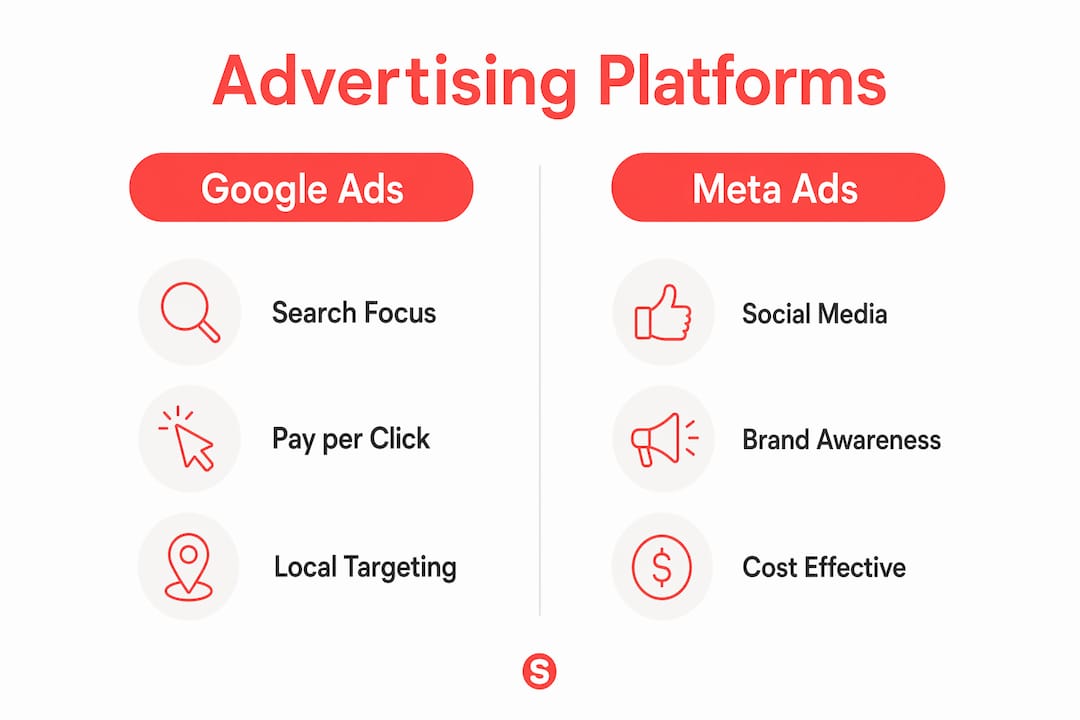
Google Ads and Meta Ads are not interchangeable. They serve different purposes, and the best restaurant campaigns use both strategically rather than treating them as alternatives.
Google Ads works best for high-intent search traffic, while Meta Ads excel at targeting interests and demographics for awareness campaigns. In practical terms: someone searching “best Italian restaurant near me” on Google is ready to book. Someone scrolling Instagram is not looking for you yet, but a well-placed ad can make them want to.
| Platform | Best For | Ad Formats | Avg. Cost | Targeting Type |
|---|---|---|---|---|
| Google Ads | High-intent local search | Search, display, maps | $1–$3 per click | Keyword and location |
| Meta (Facebook/Instagram) | Brand awareness, promotions | Image, video, carousel | $0.50–$2 per click | Interest and demographic |
| TikTok Ads | Younger audiences, viral content | Short video | $1–$3 per click | Interest and behavior |
| Google Maps Ads | Drive foot traffic directly | Local search listings | Pay per click | Location-based |
For most small restaurants, the right starting point is Google Ads for local search terms like “brunch near me” or “pizza delivery [your city],” combined with Meta Ads to run a weekly special or promote a new menu item to people within a 5-mile radius.
TikTok Ads are worth testing if your restaurant has a visual story to tell and your customer skews under 35. A 15-second video of your chef plating a signature dish can outperform a static image ad on any other platform.
How do you create and launch your first ad campaign?
A disciplined, step-by-step approach is what separates restaurants that see results from those that waste their budget. The practical launch steps for a digital campaign follow a clear sequence: set objectives, choose a platform, define your audience, create the ad, launch with a test budget, and optimize after reviewing data.
Here is how each step works in practice for a restaurant:
- Set a SMART goal. Define whether you want awareness (impressions), traffic (website visits), or conversions (reservations, online orders). Each goal requires a different campaign type and bidding strategy.
- Write ad copy that answers one question. Your customer is asking: “Why should I eat here tonight?” Answer it directly. “Fresh wood-fired pizza, ready in 12 minutes. Order now.” beats “Welcome to our restaurant!” every time.
- Choose your creative format. A high-quality photo of your best dish works for Google Display and Meta. A short video showing the dining experience works better for Instagram Stories and TikTok.
- Set your test budget. Allocate $10–$20 per day per platform for the first two weeks. Do not scale until you have data.
- Launch and wait. Most ad platforms need 48–72 hours to exit the learning phase. Do not change anything during this window.
- Review your metrics. The key performance metrics to track are ROAS (return on ad spend), CPA (cost per acquisition), CTR (click-through rate), and CPM (cost per thousand impressions). A CTR below 1% usually signals a weak headline or mismatched audience.
- Optimize one variable at a time. Change the headline, or the image, or the audience. Never all three at once.
Pro Tip: For local restaurants, add a location extension to your Google Ads. This shows your address, phone number, and a map link directly in the search result, which significantly increases foot traffic from mobile users.
How does email marketing multiply your ad campaign ROI?
Paid ads bring customers to your door once. Email marketing brings them back repeatedly. The highest ROI comes from combining paid advertising with owned email marketing for full customer lifecycle engagement. Email is free from auction price fluctuations and platform algorithm changes, which makes it the most stable channel in your marketing mix.
The practical workflow looks like this: you run a Meta Ad offering a free dessert with a first visit in exchange for an email signup. The customer claims the offer, you capture their email, and then an automated sequence takes over. A welcome email goes out immediately. A follow-up with your weekly specials goes out on Thursday. A birthday offer goes out when the date arrives.
Restaurants that integrate personalized email campaigns with digital ads see ROI as high as $36 for every $1 spent on email marketing. That number makes email the highest-returning channel in the restaurant marketing mix, by a wide margin.
Key elements of an effective restaurant email workflow:
- Lead capture ad: Run a Meta or Google Ad with a clear offer in exchange for an email address (discount, free item, exclusive access).
- Welcome sequence: Send 2–3 emails over the first week introducing your restaurant, your story, and your best dishes.
- Weekly specials email: A simple, visual email sent every Thursday drives Friday and Saturday reservations.
- Re-engagement campaign: Target customers who have not visited in 60 days with a personalized “We miss you” offer.
You can find a detailed breakdown of how to build this system in Sorbey’s guide on restaurant email workflows.
What mistakes kill restaurant ad campaigns early?
Most restaurant ad campaigns do not fail because of bad ideas. They fail because of avoidable technical and strategic errors that compound over time.
“Patience and stable data collection over a few days improve campaign learning and results.” This is the single most violated rule in restaurant advertising.
The most damaging mistakes follow a predictable pattern:
- Changing too many variables at once. If you update your headline, image, and audience targeting on the same day, you will never know what actually moved the needle. Test one element at a time.
- Skipping conversion tracking. Over-optimizing too early, ignoring conversion setup, and testing too many variables simultaneously are the three most common first-time advertiser mistakes. Conversion tracking is the one that costs you the most money when skipped.
- Scaling before the data is ready. Doubling your budget after two days of good results is a classic error. Wait for at least 7–10 days of consistent data before increasing spend.
- Using unclear calls to action. “Learn more” is weak. “Reserve your table tonight” or “Order now, ready in 20 minutes” tells the customer exactly what to do and why to do it immediately.
- Targeting too broadly. A restaurant in Austin, Texas has no reason to show ads to people in Dallas. Set a tight geographic radius (3–7 miles for most urban restaurants) and refine from there.
The fix for all of these is the same: slow down, measure everything, and change one thing at a time.
Key takeaways
Effective restaurant digital advertising requires tracking infrastructure, platform-specific strategy, and email integration to generate sustainable ROI.
| Point | Details |
|---|---|
| Install tracking first | Set up Meta Pixel and Google Tag before launching any paid campaign. |
| Match platform to goal | Use Google Ads for search intent and Meta Ads for awareness and promotions. |
| Start with small test budgets | Spend $10–$20 per day per platform until data guides your scaling decisions. |
| Combine ads with email marketing | Capture leads via ads and nurture them with email to reach up to $36 ROI per $1 spent. |
| Change one variable at a time | Isolate each test to understand what actually improves campaign performance. |
What i have learned running restaurant ad campaigns
After working with dozens of local restaurant owners, the pattern I see most often is this: owners invest in creative and ignore infrastructure. They spend hours picking the perfect photo and five minutes on tracking setup. Then they wonder why they cannot tell if the campaign worked.
The restaurants that scale their advertising successfully treat it as a measurement system first and a creative exercise second. They know their cost per reservation. They know which ad drove the most Friday night covers. They know that their Thursday email generates more revenue than their Sunday Meta Ad. That level of clarity only comes from proper setup, not from better photos.
The other thing I will say plainly: do not expect results in the first week. The platforms need data to optimize, and you need data to make decisions. The restaurants I have seen give up after 10 days are often the ones that were two weeks away from a breakthrough. Combine your paid ads with a real email list, run consistent campaigns for at least 60 days, and measure everything. That is the actual path to a full dining room.
— Barthelemy
How Sorbey can handle your restaurant’s digital advertising
Running paid ads, tracking conversions, building email sequences, and analyzing results is a full-time job on top of running a restaurant. Sorbey is built specifically for local restaurant owners who want all of that handled in one place.
Sorbey’s restaurant marketing services cover digital ad campaign management, conversion tracking setup, email marketing automation, and ROI reporting. You get a clear view of what your advertising is actually returning, without needing to become a marketing expert. If you want to see what your current marketing is worth before you start, use Sorbey’s free marketing ROI calculator to get a baseline in minutes.
FAQ
What is digital advertising for restaurants?
Digital advertising for restaurants is the practice of placing paid promotions on platforms like Google, Facebook, and Instagram to reach local customers and drive reservations or orders. It uses targeting tools to show ads to people within a specific geographic area who match your customer profile.
How much should a small restaurant spend on digital ads?
Starting with $10–$20 per day per platform gives you enough data to learn and optimize without overcommitting your budget. Scale spend only after 7–10 days of consistent performance data.
Which platform works best for restaurant advertising?
Google Ads captures customers actively searching for a restaurant, while Meta Ads build awareness among local audiences who are not yet looking. Most restaurants benefit from running both simultaneously with separate goals.
How do i measure if my restaurant ads are working?
Track four metrics: ROAS (return on ad spend), CPA (cost per acquisition), CTR (click-through rate), and CPM (cost per thousand impressions). A CTR below 1% signals a weak headline or mismatched audience and requires immediate adjustment.
How does email marketing connect to digital advertising?
Ads bring new customers in; email keeps them coming back. Capture email addresses through ad-driven offers, then use automated sequences to drive repeat visits. Restaurants using this combined approach see email ROI as high as $36 for every $1 spent.
Recommended
You might also like
Best Restaurant Loyalty Programs 2026: ROI Guide
Discover the best restaurant loyalty programs 2026 that boost repeat visits. Learn how Sorbey’s platform can transform your guest data strategy!

Why Mobile Marketing Matters for Business Growth
Discover why mobile marketing matters for business growth. Learn how optimizing for mobile drives traffic, conversions, and customer retention.

SF Dim Sum Restaurant Marketing Checklist for 2026
Transform your SF dim sum with our 2026 marketing checklist. Optimize your profile, showcase dishes, and attract customers fast!