
Blog
What Is Community Marketing? A Guide for Brands
Discover what community marketing is and how it boosts customer loyalty and engagement. Learn strategies to build brand-centered communities.

What Is Community Marketing? A Guide for Brands
TL;DR:
- Community marketing creates brand-connected groups that boost engagement, loyalty, and advocacy among customers. It offers long-term benefits like increased retention, higher customer lifetime value, and organic visibility through active participation. The strategy requires patience, specific community identities, and asynchronous platforms to build trust and generate sustainable growth.
Community marketing is defined as a strategy that creates and nurtures active, brand-centered groups to drive engagement, loyalty, and advocacy among existing and potential customers. Unlike a one-way broadcast, it turns customers into participants. Brands like Figma and Lego Ideas have built entire growth engines on this model. The data backs it up: 40.1% of consumers are more likely to stay loyal after engaging in an online brand community, and emotionally connected customers are 52% more valuable to brands. For marketing professionals and business owners, community marketing is not a trend. It is a compounding asset.
What is community marketing and why does it matter?
Community marketing is the practice of building and sustaining groups of people who share a common interest tied to your brand, then actively participating in those groups to generate value for members and business outcomes for you. The industry also refers to this as community-led growth, a term that signals the business model behind the tactic.

The distinction from general social media marketing is critical. Social media focuses on distribution and reach. Community marketing focuses on participation and belonging. A Facebook ad reaches strangers. A brand community turns customers into advocates who recruit more customers for you.
The business case is concrete. 66% of companies report a positive impact on retention from active brand communities. Trusted community relationships increase repeat purchase likelihood by 2.3x. These are not soft metrics. They show up in revenue.
What are the benefits of community marketing for brands?
Community marketing delivers benefits that paid advertising cannot replicate. The most significant is customer retention. When customers feel they belong to something, they stay longer and spend more.
Emotional connection drives this effect. Customers who feel genuinely connected to a brand are 52% more valuable over their lifetime. That gap in lifetime value is the core financial argument for investing in community before investing in another paid channel.
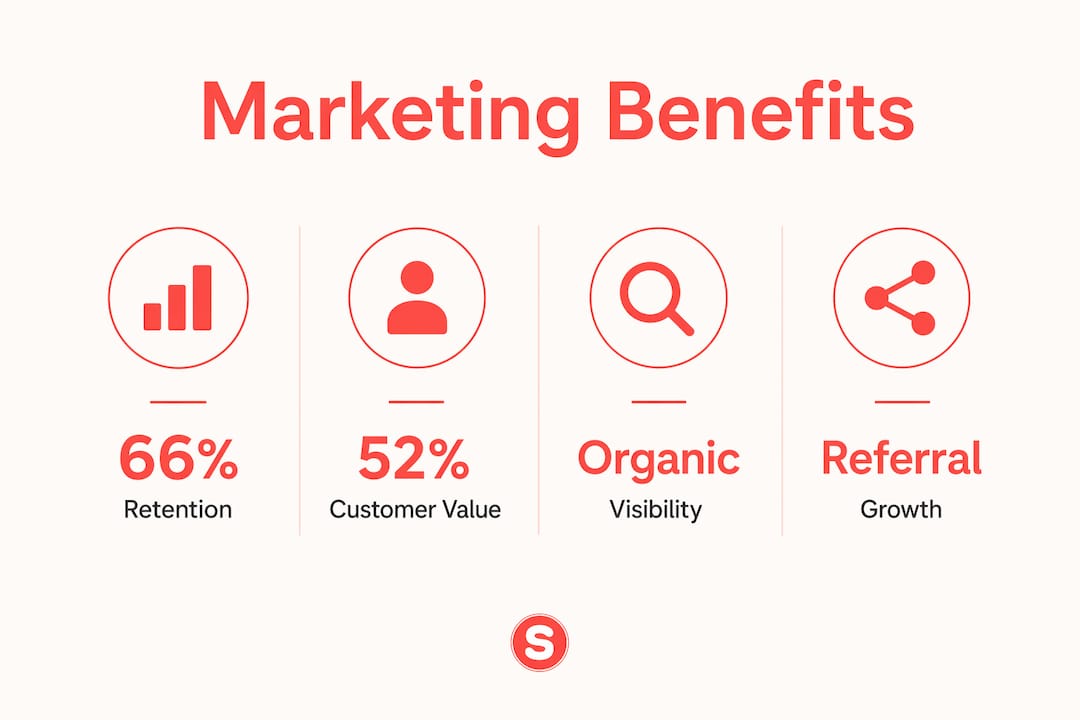
Referral generation is the second major benefit. Community members naturally recommend brands they feel part of. This reduces your customer acquisition cost over time, which matters as paid CAC continues to rise across every digital channel.
Community content also creates long-term organic visibility. Forum threads, discussion posts, and Q&A exchanges rank in search engines for 12–18 months. A single paid ad disappears the moment the budget stops. Community content keeps working.
Pro Tip: Think of community marketing as a compounding investment. The ROI from a paid ad is linear. The ROI from a thriving community grows as the member base grows, because each new member adds content, referrals, and social proof.
| Point | Details |
|---|---|
| Customer retention | 66% of companies report positive retention impact from active brand communities. |
| Lifetime value | Emotionally connected customers are 52% more valuable than average customers. |
| Repeat purchases | Trusted community relationships increase repeat purchase likelihood by 2.3x. |
| Organic visibility | Community content ranks in search engines for 12–18 months after publication. |
| Referral generation | Community members actively recruit new customers, reducing paid acquisition costs. |
How does community marketing differ from social media and traditional marketing?
Community marketing is not a replacement for paid ads or social media. It is a parallel investment with a different timeline and a different mechanism. Confusing the two leads to misaligned expectations and abandoned programs.
Social media marketing distributes content to an audience. Community marketing creates a space where the audience creates content and conversations with each other. The brand’s role shifts from broadcaster to host. Figma does not just post design tips on Instagram. It runs a community where designers share work, ask questions, and shape the product roadmap.
Influencer marketing rents attention. Community marketing builds owned attention. The difference matters when platform algorithms change or influencer contracts expire. Your community stays with you.
Traditional outbound methods like direct mail or TV advertising operate on interruption. Community marketing operates on invitation. Members choose to participate, which means their engagement is qualitatively different from passive ad exposure.
Pro Tip: Start with a narrow, specific community identity rather than a broad one. A community for “restaurant owners doing under $1M in annual revenue” builds trust faster than a community for “small business owners.” Specificity creates belonging.
| Approach | Primary aim | Timeline | Engagement type | Outcome |
|---|---|---|---|---|
| Community marketing | Loyalty and advocacy | 6–12 months | Active participation | Retention and referrals |
| Social media marketing | Reach and awareness | Immediate | Passive consumption | Brand visibility |
| Influencer marketing | Borrowed credibility | Short term | One-way exposure | Awareness and trial |
| Paid advertising | Direct response | Immediate | Interruption | Leads and conversions |
| Content marketing | Organic discovery | 3–6 months | Passive reading | SEO and authority |
What are effective community marketing strategies and best practices?
The most effective community marketing strategies share one structural feature: they are built around a specific identity, not a broad topic. Identity-focused communities build trust and value faster than generic ones because members immediately recognize that the space was built for them.
The communication format matters as much as the content. Synchronous weekly calls have declined in effectiveness. Asynchronous channels like Slack and Discord yield higher participation rates and produce searchable, evergreen content that AI search engines favor. A recorded discussion thread serves members across time zones and keeps generating value for months.
The community-to-content flywheel is the growth mechanism behind the most successful programs. Members ask questions. Those questions generate answers. Those answers become searchable content. That content attracts new members who ask more questions. Lego Ideas runs on this loop. Figma’s community forum runs on this loop. The flywheel compounds.
Social listening is the underused lever in most community programs. Figma’s consistent presence and genuine attention to what designers actually need has shaped its product roadmap for years. Letting community voices influence product development increases engagement and loyalty in ways that no campaign can manufacture.
Here are the core best practices for building and sustaining a brand community:
- Define a specific member identity before you launch. Know exactly who the community is for and why they would choose it over alternatives.
- Choose asynchronous platforms like Slack, Discord, or a dedicated forum over live-only formats.
- Create a content seeding plan for the first 90 days. Communities need initial momentum to feel alive.
- Assign a community manager who participates genuinely, not just moderates.
- Use social listening to surface product insights and feed them back to your product or brand team.
- Celebrate member contributions publicly. Recognition drives participation.
- Measure engagement volume and content output before you measure revenue impact.
Pro Tip: Do not monetize your community before trust is established. Premature harvesting, such as pushing paid offers before members feel genuine value, is the most common reason community programs fail.
How can marketers measure the ROI of community marketing?
Community marketing ROI does not appear in week two. Meaningful ROI emerges over 6–12 months, which is a fundamentally different expectation than paid search or social ads. Setting this expectation with stakeholders before launch is not optional. It is the difference between a program that survives and one that gets cut.
The measurement framework uses three layers of indicators. Leading indicators tell you if the community is healthy right now. Mid-level indicators tell you if it is generating business signals. Lagging indicators confirm revenue impact.
AI search engines now actively prefer community-sourced content. Brands without active communities lose relative AI citation share every quarter. Late adopters face a catch-up delay of up to 18 months. This makes community content an SEO asset, not just a retention tool.
CRM integration closes the attribution loop. Tag community members in your CRM and track their renewal rates, upsell rates, and referral activity separately from non-members. The delta between those two cohorts is your community’s business case in numbers.
Pro Tip: Report leading indicators monthly to maintain stakeholder confidence during the early months when revenue impact is not yet visible. Show engagement volume, content output, and branded mentions as proof of momentum.
| Indicator type | Metric | What it measures |
|---|---|---|
| Leading | Branded mentions, new member joins | Community health and early momentum |
| Mid-level | Engagement volume, content posts per week | Participation depth and content flywheel activity |
| Mid-level | NPS scores among community members | Sentiment and advocacy potential |
| Lagging | Retention rate vs. non-members | Direct business impact of community membership |
| Lagging | Pipeline contribution from community members | Revenue attribution to community participation |
Key Takeaways
Community marketing builds compounding loyalty and advocacy that paid advertising cannot replicate, with measurable ROI emerging over 6–12 months through retention, referrals, and organic content visibility.
| Point | Details |
|---|---|
| Core definition | Community marketing creates brand-centered groups that drive engagement, loyalty, and advocacy. |
| Retention impact | 66% of companies report positive retention from active communities; members are 2.3x more likely to repurchase. |
| Not a replacement | Community marketing runs parallel to paid ads, not instead of them, with a longer ROI horizon. |
| Asynchronous formats win | Slack and Discord outperform live calls for participation rates and produce evergreen, searchable content. |
| Measure in layers | Track leading, mid-level, and lagging indicators to demonstrate progress before revenue impact appears. |
The long game most brands are still afraid to play
Community marketing is the most durable competitive advantage I have seen in marketing, and it is also the most consistently underfunded. The reason is simple: it does not produce a result you can screenshot in 30 days. Executives want a dashboard that turns green by next quarter. Community does not work that way.
What I have observed is that brands treating community as a parallel investment alongside paid acquisition, rather than a replacement for it, are the ones that build genuine moats. Rising paid CAC is not a temporary problem. It is a structural shift. Community marketing is the hedge.
The catch-up tax is real and it is accelerating. AI search engines favor community-generated content. Brands that have been building active communities for two years are accumulating citation share that late adopters cannot buy overnight. Every quarter you wait makes the gap wider.
My honest advice: start smaller than you think you need to. A focused community of 200 highly engaged members in a specific niche will outperform a generic community of 2,000 passive followers every time. Build for depth first. Scale comes after trust. For local businesses, the restaurant loyalty strategies that work best are the ones rooted in exactly this principle.
— Barthelemy
Sorbey’s tools for measuring your marketing impact
Knowing your community marketing strategy is working is one thing. Proving it in numbers is another.
Sorbey builds all-in-one marketing tools designed for local businesses and restaurants that need clear, fast answers on what their marketing is actually returning. The SMS Campaign ROI Calculator gives you an instant read on campaign performance without a spreadsheet. The Marketing ROI Calculator helps you quantify returns across every channel, including community-driven campaigns that are harder to attribute with standard analytics. If you are building a marketing mix that includes community, these tools give you the numbers to defend that investment internally and refine it over time.
FAQ
What is community marketing in simple terms?
Community marketing is a strategy where a brand builds and participates in a group of customers who share a common interest, turning members into loyal advocates. The goal is engagement and retention, not just reach.
How does community marketing differ from social media marketing?
Social media marketing distributes content to a broad audience. Community marketing creates a space where members actively participate, generate content, and recruit other members, producing compounding returns over time.
How long does it take to see ROI from community marketing?
Community marketing ROI typically emerges over 6–12 months. Community content continues to rank in search engines for 12–18 months, extending the return well beyond the initial investment period.
What are the best platforms for community marketing?
Asynchronous platforms like Slack and Discord consistently outperform live-only formats for participation rates and produce searchable, evergreen content that benefits SEO over time.
Is community marketing the same as grassroots marketing?
Community marketing and grassroots marketing overlap but are not identical. Grassroots marketing focuses on organic, ground-up awareness campaigns. Community marketing focuses on sustained engagement within a defined group to build loyalty and advocacy over the long term.
Recommended
- What Is Visual Marketing? A Guide for Business Owners | Sorbey Blog | Sorbey
- How to Engage Local Customers: Proven 2026 Strategies | Sorbey Blog | Sorbey
- Why Digital Marketing Matters for Your Business Growth | Sorbey Blog | Sorbey
- Top Branding Tips for Restaurants to Attract Local Customers | Sorbey Blog | Sorbey
You might also like

Best Restaurant Loyalty Programs 2026: ROI Guide
Discover the best restaurant loyalty programs 2026 that boost repeat visits. Learn how Sorbey’s platform can transform your guest data strategy!

Why Mobile Marketing Matters for Business Growth
Discover why mobile marketing matters for business growth. Learn how optimizing for mobile drives traffic, conversions, and customer retention.

SF Dim Sum Restaurant Marketing Checklist for 2026
Transform your SF dim sum with our 2026 marketing checklist. Optimize your profile, showcase dishes, and attract customers fast!