
Blog
Top Benefits of Digital Marketing for Business Growth
Discover the key benefits of digital marketing for business growth. Lower costs, measurable ROI, and global reach are just the start!

Top Benefits of Digital Marketing for Business Growth
TL;DR:
- Digital marketing enables businesses to reach a global audience at lower costs and with measurable results.
- Successful strategies focus on targeted, data-driven campaigns that foster customer engagement and loyalty.
Digital marketing is defined as the use of online channels, including search engines, social media, email, and paid ads, to reach and convert customers. The benefits of digital marketing are concrete: lower costs than traditional media, measurable return on investment, and the ability to reach a global audience from a single campaign. For business owners and marketers, these advantages are not theoretical. They show up in real numbers, real customers, and real revenue.
1. What are the core benefits of digital marketing?
Digital marketing gives businesses access to tools that traditional advertising simply cannot match. You can target a specific zip code, track every click, and adjust your budget in real time. Traditional channels like radio spots or billboards offer none of that control. The result is a fundamentally different relationship between spending and results.

The three pillars of online marketing advantage are reach, precision, and accountability. Reach means your message can travel globally without a proportional increase in cost. Precision means you only pay to reach people who fit your customer profile. Accountability means every dollar spent is tied to a measurable outcome.
2. How does digital marketing improve global reach and brand exposure?
Social media and search engines give any business, regardless of size, access to a worldwide audience. A restaurant in Austin can build a following in Chicago. A local bakery can attract tourists before they even arrive in town. That kind of reach was once reserved for brands with national advertising budgets.
Increased exposure was identified as a primary benefit of social media marketing by 83% of marketers in 2026. That figure reflects a consistent pattern: visibility drives traffic, and traffic drives revenue. The same survey found that 71% of marketers reported increased website traffic and 62% noted new lead generation as direct outcomes.
The benefits of social media marketing extend beyond follower counts. Platforms like Instagram, YouTube, and TikTok now function as product discovery engines, with 63% of Gen Z and 49% of millennials using them to research products before buying. That means your social presence directly influences purchase decisions, not just brand awareness.
Pro Tip: Post consistently on the platforms where your customers already spend time. For restaurants, Instagram and TikTok outperform LinkedIn by a wide margin for driving foot traffic and reservations.
3. Why is digital marketing more cost-effective than traditional marketing?
Traditional advertising, think radio, print, and billboards, requires large upfront commitments with no guarantee of results. Digital channels flip that model. You can start a Google Ads campaign for $10 a day, pause it instantly, and reallocate budget to what works.
Organic social media helps marketers cut costs by up to 50% while still reaching their target audiences. That is a significant reduction for small businesses operating on tight margins. The key is consistency and content quality, not ad spend.
Email marketing delivers an average ROI of $36 for every dollar spent, making it the top channel for return among B2C brands. No other marketing channel comes close to that ratio. For local businesses, that means a well-maintained email list is one of the most valuable assets you own.
“The advantages of online marketing are clearest when you compare cost per customer acquired. A targeted Facebook ad campaign routinely outperforms a local radio spot at a fraction of the price, with full visibility into what worked.”
Small business adoption reflects this reality. 73% of small businesses now have a website and rely on social media to promote products cost-effectively. Getting online is no longer optional. It is the baseline for competing in any local market.
4. What targeting capabilities make digital marketing so effective?
Targeting is where digital advertising separates itself from every other medium. You can define your audience by age, location, income level, interests, past purchase behavior, and even the device they use. Traditional media cannot do any of that.
The practical impact is significant. A restaurant can run a lunch promotion targeting office workers within a two-mile radius between 10 a.m. and noon. A marketing agency can show ads only to business owners who have visited their pricing page. These are not hypothetical scenarios. They are standard features of platforms available to any business today.
AI and data analytics have made targeting even sharper. Platforms now predict which users are most likely to convert based on behavioral signals, not just demographic data. That means your ad budget goes further because it reaches people already primed to act.
Pro Tip: Build custom audiences from your existing customer list. Uploading your email subscribers to a paid ad platform lets you reach people who already trust your brand, which consistently produces higher conversion rates than cold audiences.
- Target by location, age, income, and interests simultaneously
- Retarget website visitors who did not convert on their first visit
- Use lookalike audiences to find new customers who resemble your best existing ones
- Exclude current customers from acquisition campaigns to avoid wasted spend
5. How does digital marketing provide measurable results?
Every action in digital marketing leaves a data trail. Clicks, opens, conversions, time on page, bounce rate, and cost per acquisition are all tracked automatically. That level of visibility does not exist in traditional marketing.
The practical difference is significant. With a billboard, you know how many cars passed it. With a digital ad, you know how many people saw it, clicked it, watched it for more than three seconds, and then bought something. That data lets you make decisions based on evidence, not guesswork.
| Metric | Digital Marketing | Traditional Marketing |
|---|---|---|
| Cost per impression | Tracked in real time | Estimated after the fact |
| Conversion tracking | Exact click-to-sale data | Not available |
| Campaign adjustment | Instant | Requires new production |
| Audience feedback | Comments, shares, replies | Delayed surveys or focus groups |
| ROI calculation | Precise | Approximate |
Real-time data also means faster learning. A campaign that underperforms can be paused within hours. A message that resonates can be scaled up the same day. That speed of iteration is a structural advantage that compounds over time.
6. What role does customer engagement play in digital marketing?
Digital marketing is not a broadcast medium. It is a two-way channel. Customers can reply to your emails, comment on your posts, share your content, and send direct messages. That interaction creates relationships that traditional advertising never could.
Email marketing is the clearest example of an owned audience channel. Email reaches 100% of your subscribers, unlike social media where organic reach often falls between 2% and 10% due to platform algorithms. That means when you send an email, your message actually arrives. Social posts, by contrast, are filtered before most of your followers ever see them.
The benefits of email marketing go beyond delivery rates. Most businesses see meaningful engagement within 60 to 90 days of starting an email program with a strong lead magnet. That timeline is short enough to produce results within a single quarter. The key variables are the quality of the offer and the use of marketing automation to follow up consistently.
AI-driven changes in email marketing in 2026 require a shift from volume to high-value content. Sending more emails does not improve results. Sending better emails, ones that educate, reward loyalty, or solve a specific problem, does. Brands that adapt to this model see stronger deliverability and subscriber retention.
- Respond to comments and messages within 24 hours to signal that your brand is active
- Use email sequences to onboard new subscribers and build trust before selling
- Collect customer feedback through polls, surveys, and reply-to emails
- Share user-generated content to build social proof and community
For restaurants, social media engagement has a direct link to brand awareness and foot traffic. A single viral post can fill tables for a week. A consistent posting schedule builds the kind of familiarity that makes customers choose you over a competitor they have never heard of.
Key Takeaways
Digital marketing delivers measurable, cost-effective growth by combining global reach, precise targeting, and owned audience channels that traditional advertising cannot replicate.
| Point | Details |
|---|---|
| Cost efficiency is real | Organic social and email marketing cut costs while delivering higher ROI than traditional channels. |
| Targeting beats broadcasting | Digital platforms let you reach specific audiences by location, behavior, and intent, not just demographics. |
| Email is your most reliable channel | Email reaches 100% of subscribers and delivers an average $36 return per dollar spent. |
| Data drives better decisions | Real-time metrics let you adjust campaigns immediately, unlike traditional media where results lag. |
| Engagement builds loyalty | Two-way digital channels create customer relationships that increase lifetime value over time. |
What I have learned about digital marketing after years in the field
Most business owners understand that digital marketing works. Fewer understand why their own efforts fall short. The gap is almost always the same: they chase metrics that feel good but do not drive revenue.
Follower counts are the most common trap. A restaurant with 10,000 Instagram followers and a dead email list is in a weaker position than one with 1,000 followers and 500 engaged email subscribers. Owned channels, especially email, are where real business value lives. Social platforms can change their algorithms overnight. Your email list cannot be taken from you.
The second mistake I see constantly is treating channels as separate strategies. Social media, email, and paid ads work best when they reinforce each other. A paid ad drives someone to a landing page. The landing page captures their email. The email sequence builds trust and drives a purchase. That loop is where the real AI-powered engagement gains happen for local businesses.
The businesses that see the strongest results are not the ones with the biggest budgets. They are the ones that stay consistent, measure what matters, and put the customer’s needs ahead of their own promotional instincts. That is not a new insight. It is just one that most people ignore until they have wasted enough money to take it seriously.
— Barthelemy
How Sorbey helps local businesses put these advantages to work
Running a restaurant means your time is already spoken for. Building a digital marketing program from scratch, managing social media, setting up email campaigns, and tracking results, takes hours you do not have.
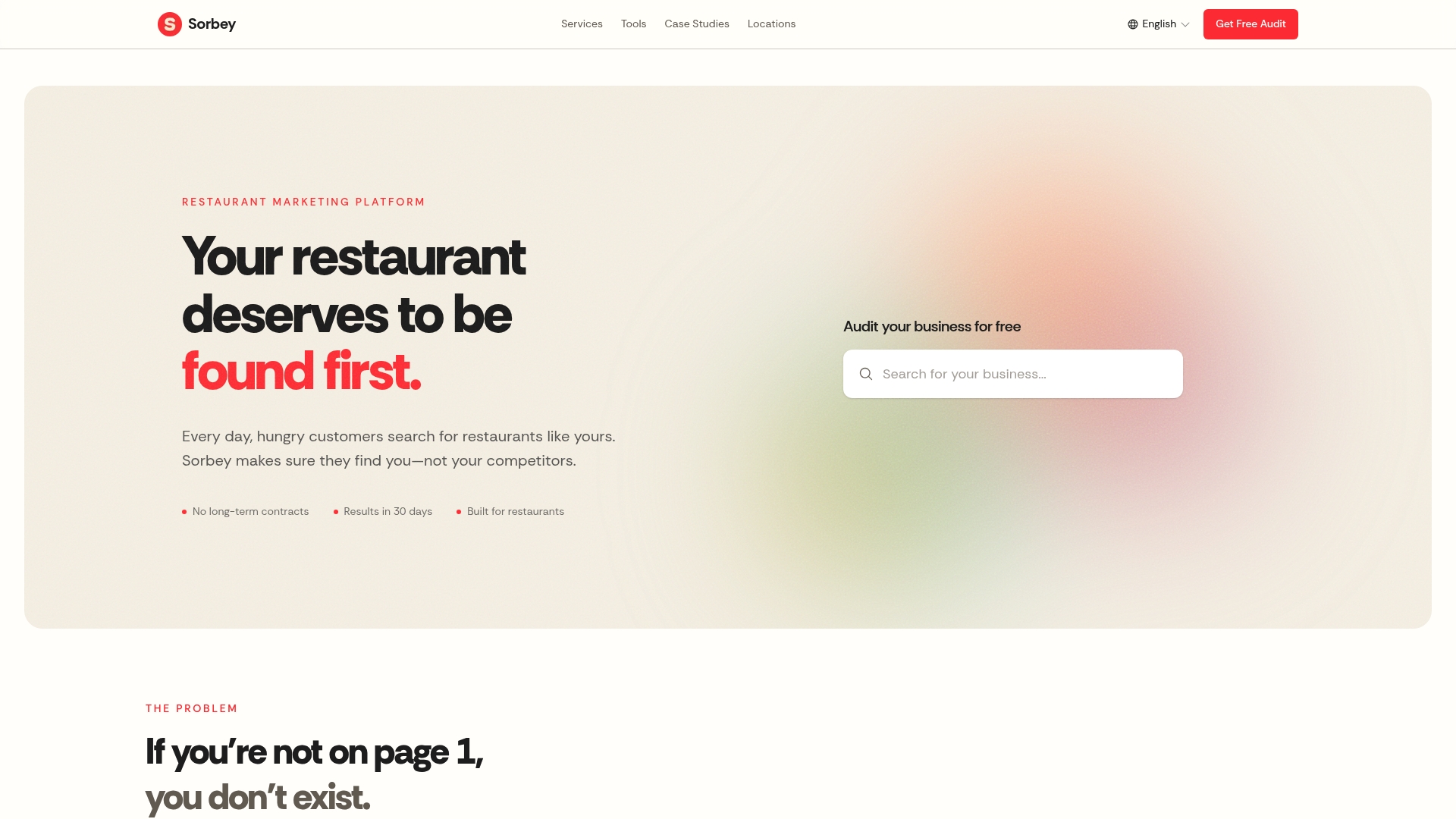
Sorbey is built specifically for local businesses like restaurants that need all of those functions in one place. From social media scheduling to email marketing and performance tracking, Sorbey’s marketing services are designed to deliver the benefits covered in this article without requiring a dedicated marketing team. If you want better visibility, more engaged customers, and a clearer picture of your digital marketing ROI, Sorbey is where to start.
FAQ
What are the main benefits of digital marketing?
The main benefits are global reach, lower costs than traditional advertising, precise audience targeting, and measurable ROI. Email marketing alone delivers an average return of $36 for every dollar spent.
How does digital marketing help small businesses compete?
Digital marketing levels the playing field by giving small businesses access to the same targeting and analytics tools as large brands. Organic social media and email marketing are particularly cost-effective for businesses with limited budgets.
Why is email marketing still worth using in 2026?
Email reaches 100% of your subscriber list, unlike social media where organic reach is often 2–10%. Brands that focus on high-value, educational content see stronger deliverability and subscriber loyalty.
How quickly can digital marketing produce results?
Most businesses see meaningful engagement within 60 to 90 days of launching an email program with a strong lead magnet. Paid digital advertising can drive traffic and conversions within days of launch.
What is the biggest mistake businesses make with digital marketing?
The most common mistake is focusing on vanity metrics like follower counts instead of building owned channels like an email list. Social platforms control your reach. Your email list belongs to you.
Recommended
También te puede interesar

Why Reputation Management Matters for Restaurants
Discover why reputation management matters for restaurants. Learn how online perceptions can drive customer traffic and boost revenue.

Restaurant Influencer Marketing Examples That Drive Reservations
Discover powerful restaurant influencer marketing examples that boost reservations. Learn strategies to engage audiences and drive results today!

Restaurant Email Marketing Checklist for 2026
Boost your restaurant's success with this essential email marketing checklist. Maximize ROI and drive customer loyalty with expert tips!