
Blog
SMS Marketing: Why It Works for Your Business in 2026
Discover why SMS marketing is essential for your business in 2026. With a 98% open rate, text messages guarantee engagement like no other channel.

SMS Marketing: Why It Works for Your Business in 2026
Why SMS marketing outperforms every other channel you’re using
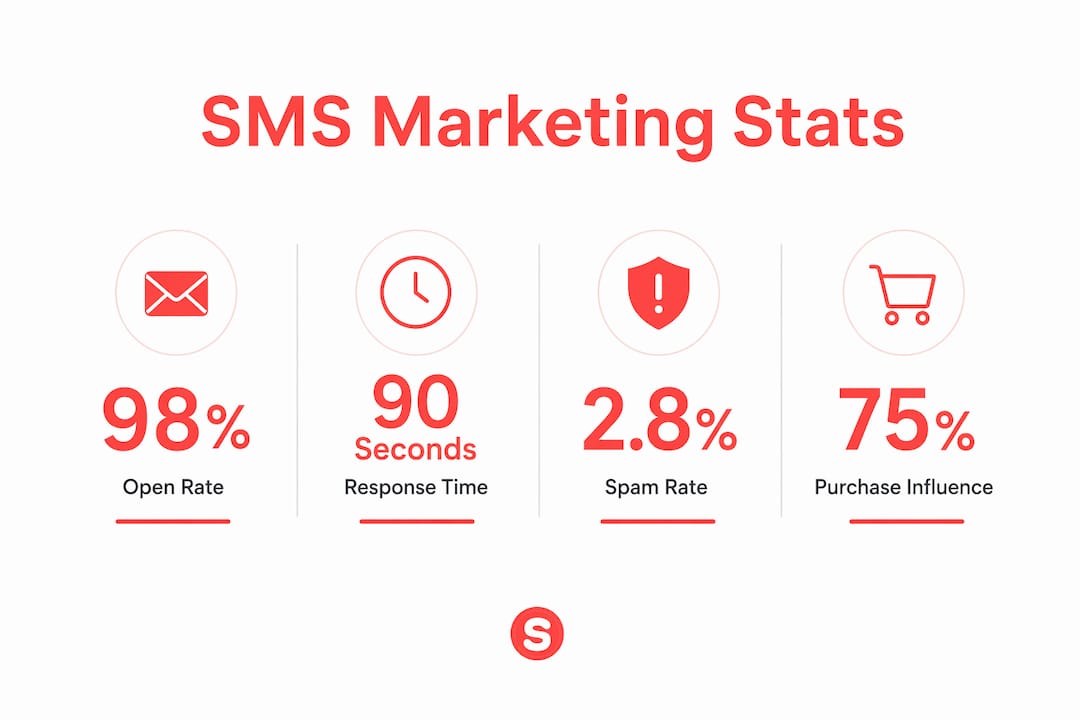
SMS marketing delivers a 98% open rate compared to email’s 22%. That single number explains why businesses across the United States are treating text messaging as their highest-priority direct channel, not a nice supplement to email or social media.
The core case for SMS marketing comes down to three things: people always have their phones, they open texts almost immediately, and they gave you permission to reach them. That last part matters more than most marketers realize. When someone opts into your texts, they’re signaling genuine interest. You’re not fighting for attention in a crowded feed or hoping your email clears a spam filter.
Here’s what SMS marketing does better than any other channel right now:
- Open rates: 98% open rate versus 22% for email, meaning nearly every message you send gets seen
- Response speed: Customers respond to texts in an average of 90 seconds, compared to hours or days for email
- Mobile reach: IDC Research finds that 79% of Americans carry their phones at least 22 hours per day
- Consumer demand: 78% of US consumers have made a purchase because of a brand’s text message
- Trust: Spam makes up less than 5% of texts received, which is why customers trust the channel
- Cost: SMS campaigns cost far less per message than paid social or search advertising, with measurable ROI
- Ownership: Unlike social media, you own your subscriber list and no algorithm can suppress your reach
For local businesses, restaurants, and service providers, SMS marketing is the shortest path between a promotion and a customer walking through your door.
10 reasons to use SMS marketing for business growth
1. Open rates that no other channel can match
The 98% open rate for SMS isn’t a rounding error. Email, even well-crafted campaigns from trusted brands, averages 22%. Social media organic reach has been declining for years. When you send a text, it gets read. That visibility is the foundation every other SMS advantage is built on, because a message that goes unseen does nothing for your business.
2. Customers respond in minutes, not days
The 90-second average response time for SMS is what makes the channel genuinely useful for time-sensitive situations. A flash sale that runs for four hours, a last-minute reservation opening, a back-in-stock alert for a popular item. These only work if customers see the message while the opportunity still exists. Email can’t reliably do that. SMS can.
3. You own the channel completely
Unlike Instagram or Facebook, your SMS subscriber list belongs to you. No platform can freeze your account, adjust an algorithm, or cut your organic reach overnight. As an owned marketing channel, SMS gives you complete control over who receives your messages, when they go out, and what they say. That stability is worth a lot when you’re building long-term customer relationships.
4. Cost-effective with measurable ROI
SMS campaigns require less budget than paid advertising, and the returns are trackable. You can measure click-through rates, redemption rates, and revenue directly tied to specific messages. Because most customers read texts within minutes, you’re not paying for impressions that never convert. For small and mid-sized businesses, that efficiency matters.

Pro Tip: Use unique promo codes in each SMS campaign so you can attribute revenue directly to that message, even if customers convert later on a different device.
5. Personalization that actually feels personal
SMS lets you reference a customer’s last purchase, send a birthday offer, or alert them about a product they’ve been watching. Businesses and consumers both agree that personalization increases brand loyalty, with 98% of businesses and 83% of consumers confirming this in Twilio’s State of Customer Engagement Report. A text that says “Hey Sarah, your usual table is available tonight” lands completely differently than a generic promotional blast.
6. Two-way communication builds real relationships
Consumers are texting businesses more, with a 31% increase since 2023. That’s not just customers responding to promotions. They’re asking questions, confirming appointments, and requesting support through text. Two-way SMS creates a human connection without requiring a large customer service team. 57% of people expect businesses to respond within 15 minutes when communicating by text, so having that channel open matters.
7. SMS bypasses spam filters entirely
Email has a 53% spam rate. SMS has a 2.8% spam rate. When someone opts into your texts, your message lands in their primary inbox alongside messages from friends and family. There’s no spam folder, no promotions tab, no algorithm deciding whether your content is worth showing. The message arrives, and it gets seen.
8. Quick feedback without friction
47% of consumers share feedback via text, which is a higher participation rate than most email survey campaigns achieve. A short NPS question sent right after a purchase or visit catches customers while the experience is still fresh. The format forces brevity, which actually helps. One question, one reply, done. That data is genuinely useful for improving your product or service.
9. SMS drives purchases directly
More than three-quarters of US consumers have made a purchase because of a brand text message, including 65% within the past year. That’s not passive brand awareness. That’s direct revenue attribution. 67% of consumers show increased product interest after receiving a text, which means even messages that don’t convert immediately are doing real work.
10. Easy to launch and fast to test
A text message is 160 characters. There’s no design team required, no lengthy production cycle, no graphic assets to approve. You write a clear message, add a link or promo code, and send it. 71% of consumers subscribe to business texts before making a first purchase, which means you can build an engaged audience and test offers quickly, even before a customer has bought anything from you.
How SMS marketing performs across US industries
SMS marketing isn’t a one-size-fits-all channel, but it performs well across nearly every industry that relies on direct customer communication. The specifics vary, but the underlying mechanics are the same: fast delivery, high visibility, and a direct line to someone who asked to hear from you.
Restaurants and food service see some of the strongest results. A text promoting a Tuesday night special or a limited-time menu item reaches customers at exactly the moment they’re deciding where to eat. For restaurants specifically, SMS works for reservation reminders, loyalty reward updates, and last-minute table availability. Sorbey’s mobile marketing strategies for food and beverage show how this plays out in practice for local operators.
- Retail: Flash sales, back-in-stock alerts, and abandoned cart reminders perform particularly well. The time-sensitive nature of these messages aligns perfectly with SMS’s speed advantage.
- Healthcare and wellness: Appointment reminders via text reduce no-shows more effectively than phone calls or emails. Patients respond to texts faster, and the confirmation process is frictionless.
- Service businesses: Plumbers, salons, auto shops, and similar businesses use SMS for appointment confirmations, follow-up check-ins, and review requests. The post-service text asking “How did we do?” catches customers while the experience is still top of mind.
- E-commerce: Shipping confirmations, delivery updates, and return status messages keep customers informed without requiring them to check an app or email. These transactional messages build trust and reduce support inquiries.
- Hospitality: Hotels and event venues use SMS for check-in reminders, upgrade offers, and post-stay feedback. The channel’s immediacy makes it ideal for time-sensitive hospitality communications.
For restaurants and local businesses looking to build repeat visits, customer engagement strategies built around SMS tend to outperform social media campaigns because the audience has already self-selected as interested. They opted in. They want to hear from you.
46% of US smartphone users signed up for more brand texts over the past year. That growth is happening across industries, not just retail. Businesses that move now are building subscriber lists while acquisition is still relatively inexpensive.
Pro Tip: Segment your SMS list by purchase behavior or visit frequency. A customer who visits your restaurant weekly should get different messages than someone who hasn’t been in three months. Relevant messages get responses; generic blasts get opt-outs.
What US compliance rules you need to know before you send
SMS marketing in the United States is regulated primarily by the Telephone Consumer Protection Act (TCPA), and the rules are not optional. Violating them carries real financial penalties, so understanding the requirements before you send your first campaign is worth the time.
The TCPA requires businesses to obtain explicit written consent before sending marketing texts to any consumer. That means a customer giving you their phone number at checkout is not enough. They need to actively agree to receive marketing messages, and that agreement needs to be documented.
Here’s what compliant SMS marketing looks like in practice:
- Explicit opt-in: Customers must affirmatively agree to receive texts, typically through a web form, keyword opt-in, or paper sign-up with clear disclosure language.
- Clear disclosure: At the point of opt-in, you must tell customers what kind of messages they’ll receive, how often, and that message and data rates may apply.
- Easy opt-out: Every message must include a simple way to unsubscribe, typically “Reply STOP to unsubscribe.” When someone opts out, you must honor it immediately.
- Message frequency: Sending too many texts is both a compliance risk and a practical one. Customers who feel overwhelmed opt out, and high opt-out rates signal a problem with your strategy.
- Quiet hours: The TCPA restricts calls and texts to between 8:00 AM and 9:00 PM in the recipient’s local time zone. Most platforms enforce this automatically, but you should verify.
- Record keeping: Maintain records of consent for every subscriber. If a complaint arises, documentation of the opt-in is your primary defense.
SMS marketing’s effectiveness relies on consumer trust, and that trust is built by respecting privacy and delivering real value. Compliance isn’t just about avoiding fines. It’s about building a subscriber list of people who actually want to hear from you, which is the only kind of list that produces results.
The “Value, Relevance, and Timing” framework applies directly to compliance as well. A message that arrives at 11:00 PM, promotes something the customer doesn’t care about, and comes from a brand they don’t remember opting into will generate an opt-out and possibly a complaint. Permission-based opt-ins are the foundation of a program that works long-term.
How to integrate SMS marketing into your broader strategy
SMS works best when it’s coordinated with your other channels, not running as a standalone effort. The most effective approach treats SMS as the high-urgency layer of your marketing stack, the message that arrives when timing is critical and action needs to happen now.
The “Value, Relevance, Timing” framework: Every SMS you send should deliver something useful, match the recipient’s current context, and arrive when they can actually act on it. Miss any one of those three, and you’re burning subscriber goodwill.
Integrating SMS into a cross-channel strategy significantly increases conversion rates, particularly when coordinated with email and mobile wallets. The practical version of this looks like: email carries the full story, SMS delivers the nudge. You send a detailed promotional email on Monday, then a short text on Wednesday that says “Last chance: your 20% off expires tonight.” The email does the explaining; the text drives the action.
Where SMS fits in the customer journey:
- Acquisition: Keyword opt-ins tied to a welcome offer (“Text PIZZA to 55555 for 15% off your first order”) build your list while delivering immediate value.
- Conversion: SMS is ideal for high-intent triggers like abandoned cart reminders and flash sales, where speed is the difference between a sale and a missed opportunity.
- Retention: Post-purchase follow-ups, loyalty point updates, and re-engagement messages for inactive customers keep your brand present without requiring a customer to seek you out.
- Feedback: A short satisfaction check-in sent within an hour of a visit or delivery catches customers at peak engagement.
For restaurants and local businesses, customer loyalty programs built around SMS touchpoints consistently outperform those relying solely on email or app notifications. The reason is simple: the text arrives in the same inbox as messages from friends, not in a promotional folder that customers check once a week.
SMS excels as part of an integrated approach, complementing email by serving as a timely nudge that pushes customers toward conversion moments. Three-quarters of consumers would interact more with brands that offer a digital wallet option alongside their texts, which means pairing SMS with Apple Pay or Google Pay links can turn a promotional message into a one-tap purchase.
Tracking attribution in a cross-channel setup requires unique links or promo codes per message. Without that, you can’t tell whether a sale came from the email, the text, or organic traffic. Most SMS platforms generate short, trackable links automatically. Use them consistently, and you’ll have clear data on which messages are actually driving revenue.
Understanding how email marketing fits alongside SMS helps you decide which message type to use for each situation. Long-form content, detailed product explanations, and storytelling belong in email. Time-sensitive offers, confirmations, and quick alerts belong in SMS. The two channels complement each other precisely because they serve different moments in the customer relationship.
One real limitation worth acknowledging: overusing SMS by sending non-urgent or lengthy content leads to opt-outs. The channel’s strength is its immediacy, and that strength disappears when you treat it like a broadcast medium for every piece of content you produce. Customers who opted in for flash sale alerts don’t want a weekly newsletter delivered as a text. Keep SMS reserved for messages where speed and brevity are the point.
Key Takeaways
SMS marketing is the highest-engagement direct channel available to US businesses, delivering a 98% open rate and 90-second average response time that no other marketing format can match.
| Point | Details |
|---|---|
| Open rate advantage | SMS achieves a 98% open rate versus 22% for email, making it the most visible channel for direct customer communication. |
| Purchase influence | More than three-quarters of US consumers have made a purchase because of a brand text message, demonstrating direct revenue impact. |
| Compliance is mandatory | The TCPA requires explicit opt-in consent and easy opt-out for every SMS marketing program in the United States. |
| Cross-channel coordination | SMS works best paired with email, using text for time-sensitive nudges and email for detailed content and storytelling. |
| Ownership and stability | Your SMS subscriber list is an owned asset; no algorithm change or platform restriction can reduce your reach. |
Recommended
También te puede interesar

Geo-Targeted Ads: Why Location Changes Everything
Discover why geo-targeted ads outperform broad campaigns by delivering relevant messages based on location, enhancing engagement and conversion.

Defining Cross-Promotion: A Practical Guide for Marketers
Discover defining cross-promotion strategies that boost brand trust, generate leads, and reduce acquisition costs. Start growing today!

Best Breadthmarketing.com Alternatives for Agencies in 2026
Discover top breadthmarketing.com alternatives like KlientBoost, INFUSE, and SmartSites. Find the best fit for your agency's growth in 2026!