
Blog
Local advertising guide for restaurants: boost visibility
Learn how to boost your restaurant's local visibility with proven advertising strategies, 2026 benchmarks, and step-by-step campaign guidance for more customers.
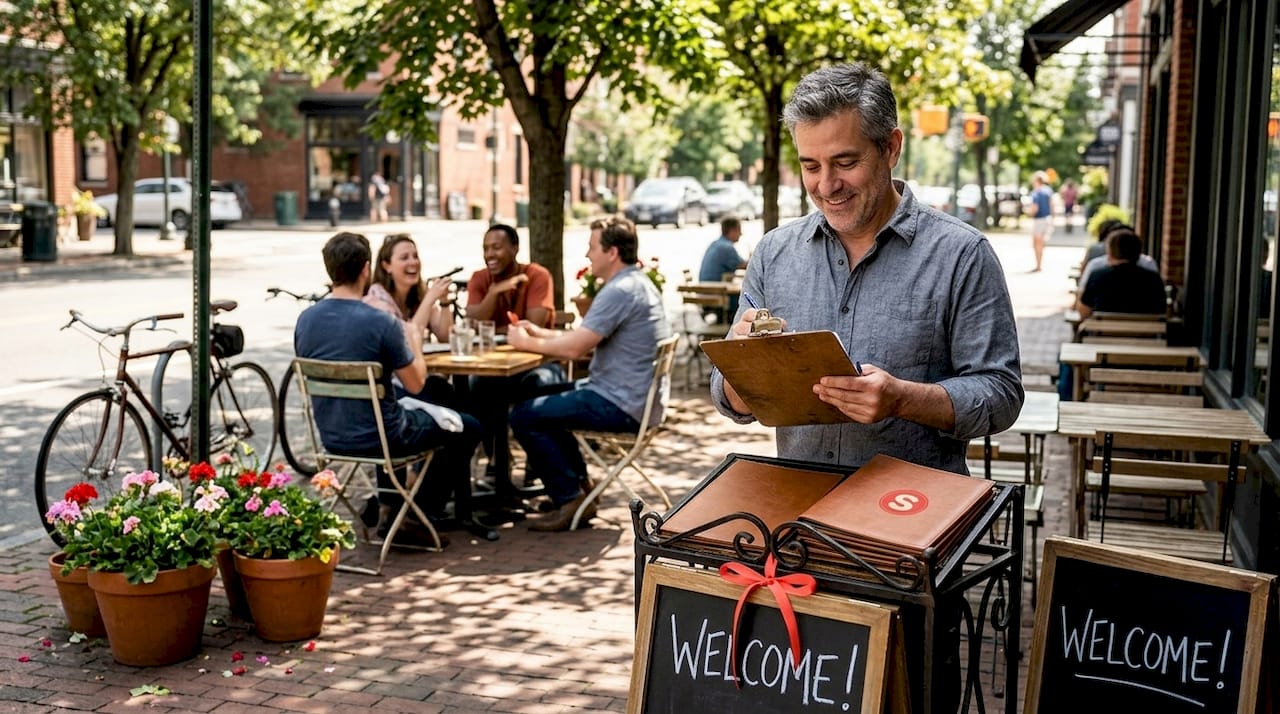
Local advertising guide for restaurants: boost visibility
TL;DR:
- Effective restaurant advertising relies on consistent local listings and active review management.
- Success depends on ongoing efforts like recurring photo updates, review acquisition, and campaign optimization.
- Integrating organic and paid local search strategies maximizes visibility and customer retention.
Standing out in your city’s restaurant scene has never been harder. With dozens of competitors fighting for the same hungry customers, showing up at the right moment in local search results can make or break your week. Organic search drives 48.2% of restaurant traffic, which means the restaurants winning online are the ones filling tables offline too. This guide walks you through every step of a proven local advertising playbook, from foundational setup to campaign execution and ongoing optimization, all grounded in 2026 industry benchmarks so you know exactly what good performance looks like.
Table of Contents
- Understand local advertising fundamentals
- Prep your restaurant for maximum visibility
- Execute effective local advertising campaigns
- Measure, adjust, and optimize your campaigns
- Why most restaurant advertising advice falls short—and what actually works
- Level up your restaurant advertising with expert support
- Frequently asked questions
Key Takeaways
| Point | Details |
|---|---|
| Check your restaurant basics | Make sure key information—name, address, phone—matches everywhere online before spending on ads. |
| Optimize for reviews and photos | Fresh photos and at least 5-10 new reviews per week boost authority and discoverability. |
| Focus on the right metrics | Track CPA, CPC, and retention rate to get real results and spot campaign wins or losses. |
| Iterate and improve | Regularly analyze campaign data and adjust for the highest return on your budget. |
Understand local advertising fundamentals
Local advertising means reaching potential customers in a specific geographic area, whether that’s a neighborhood, a city, or a metro radius around your restaurant. It covers both digital channels like Google Maps, search ads, and social media, and offline tactics like flyers, local sponsorships, and community partnerships. The goal is simple: put your restaurant in front of people who are nearby, hungry, and ready to decide.
Why does local targeting matter so much? Because restaurant decisions are hyper-local and time-sensitive. Someone searching “best tacos near me” at 6:30 p.m. is not browsing casually. They want an answer in seconds. If your restaurant isn’t showing up in that moment, a competitor is.
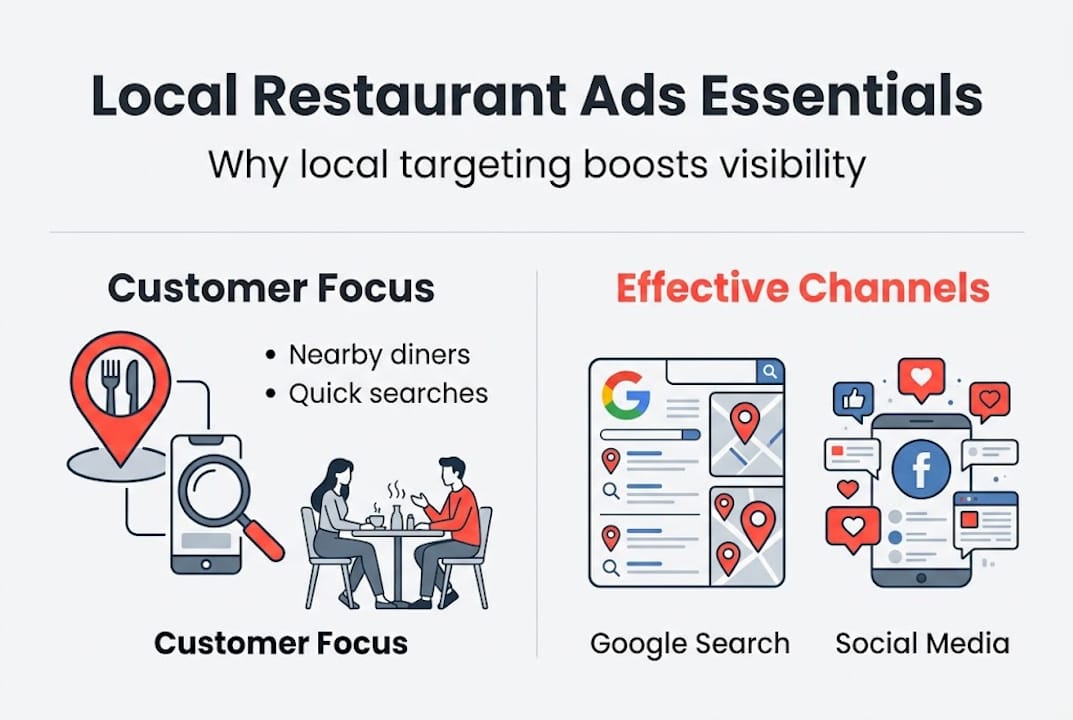
Before you spend a dollar on ads, you need to understand the metrics that define success. Here’s a quick-reference table for the key benchmarks in 2026:
| Metric | 2026 Restaurant Benchmark |
|---|---|
| Google Ads CPC (cost per click) | $1.95 |
| Facebook/Instagram CPC | $0.85 |
| Average CPA (cost per acquisition) | $18.50 |
| Customer retention rate | 30% |
| Organic search traffic share | 48.2% |
Google Ads CPC averages $1.95, Facebook/Instagram $0.85, and a healthy customer retention rate sits at 30%. These numbers give you a baseline to judge whether your campaigns are performing or bleeding money.
The main channels you’ll work with include:
- Google Maps and Google Business Profile for local search visibility
- Google Search Ads for paid placement on high-intent queries
- Facebook and Instagram Ads for audience targeting and visual storytelling
- Online directories like Yelp, TripAdvisor, and Apple Maps
- Review platforms for social proof and reputation building
- Community sponsorships and local partnerships for offline reach
Understanding your CPC and CPA before launching any campaign is the difference between a strategy and a guess. Know your numbers first.
Getting a handle on restaurant local SEO basics will also help you connect paid and organic efforts so they reinforce each other rather than compete.
With a high-level overview in mind, let’s identify exactly what restaurants need for successful local campaigns.
Prep your restaurant for maximum visibility
Before any ad goes live, your restaurant needs to be “advertising ready.” That means every listing, profile, and directory entry is accurate, complete, and consistent. This is called NAP consistency, which stands for name, address, and phone number. If your NAP differs across platforms, search engines get confused and your local ranking drops.
Here’s where you need consistent listings:
- Google Business Profile (the most critical)
- Yelp and TripAdvisor
- Apple Maps and Bing Places
- Facebook Business Page
- OpenTable or Resy if you take reservations
- Local chamber of commerce directories
A fully optimized profile goes beyond just the address. You need fresh photos uploaded at least monthly, a compelling description that mentions your cuisine and neighborhood, accurate hours including holiday changes, and a current menu. Profiles with complete information receive significantly more clicks and direction requests than incomplete ones.
Auditing NAP consistency and photo freshness while aiming for 5 to 10 new reviews per week and a customer retention target of 30% are the foundational benchmarks every restaurant should hit before scaling ad spend.
Reviews deserve their own attention. Velocity matters as much as volume. A restaurant collecting 5 to 10 new reviews every week signals active customer engagement to both Google and potential diners. Encourage reviews through table cards, email follow-ups, and staff reminders at checkout. Strong review management tips can help you build a consistent system rather than relying on luck.
For multi-location restaurants, centralize your citation management. Use the same NAP format across every location, keep branding consistent, and designate one team member to audit listings monthly. Inconsistencies multiply fast when you have five or ten locations.
Pro Tip: Set a recurring calendar reminder every 30 days to upload three to five new photos and check that your hours are current. It takes ten minutes and keeps your profile looking active and trustworthy.
Good optimizing restaurant listings practices also improve your organic rankings, which means your paid ads work harder because your organic presence backs them up.
Once your foundational details are organized, you’re ready to execute effective campaigns.
Execute effective local advertising campaigns
Running a local ad campaign isn’t complicated, but it does require a clear sequence. Here’s how to approach it step by step:
- Set your budget. Start with a daily budget of $10 to $30 for testing. Scale only after you see results.
- Choose your channel. Match the channel to your goal. Google Search Ads for high-intent traffic, Instagram for brand awareness and visual appeal.
- Create a specific offer. “20% off your first order” outperforms “come visit us.” Give people a reason to act now.
- Define your audience. Use geo-targeting to reach people within 3 to 5 miles of your location. Layer in demographics if your platform allows.
- Launch and monitor. Check performance daily for the first week. Watch for wasted spend on irrelevant clicks.
- Measure and adjust. After two weeks, cut what isn’t converting and double down on what is.
Here’s a side-by-side comparison of the most common channels:
| Channel | Best for | Avg. CPC | Expected ROI |
|---|---|---|---|
| Google Search Ads | High-intent local searches | $1.95 | High |
| Facebook/Instagram Ads | Brand awareness, retargeting | $0.85 | Medium |
| Yelp Ads | Review-driven decisions | Varies | Medium |
| Local sponsorships | Community trust, offline reach | N/A | Long-term |
Mobile visibility is non-negotiable. Organic search delivers 48.2% of restaurant traffic, mobile accounts for 78.4% of those searches. If your ads or website aren’t optimized for mobile, you’re losing the majority of your potential customers before they even see your menu.
The average CPA for restaurant search campaigns sits at $18.50. That means for every new customer acquired through paid search, you’re spending roughly $18.50. If your average check is $35 and customers return twice a month, that acquisition cost pays off fast.
For paid ad basics, keep these in mind:
- Use geo-targeting to limit spend to your delivery or dine-in radius
- Focus keywords on intent phrases like “dinner near me” or “best pizza in [your city]”
- Design offers around urgency: limited-time deals, weekday specials, or happy hour promotions
Learning to optimize for search engines alongside your paid campaigns creates a compounding effect where organic and paid traffic reinforce each other. Understanding the full value of local search investment helps you justify the budget to stakeholders and keep campaigns funded through slower periods.
After your ads are active, it’s crucial to measure outcomes and adjust.
Measure, adjust, and optimize your campaigns
Running ads without tracking results is like cooking without tasting. You need to check the data regularly and be willing to make changes fast. Here’s a clear process:
- Pull weekly reports on CPC, CPA, click-through rate (CTR), and conversions.
- Compare to benchmarks. Is your CPC above $1.95 for Google? Investigate your keyword targeting or ad quality score.
- Check mobile performance separately. Mobile and desktop often behave very differently.
- Review customer retention. Are new customers coming back? If retention is below 30%, your post-visit follow-up needs work.
- Audit your review velocity. Fewer than 5 new reviews per week? Activate your review request system.
Setting a retention rate target of 30%, monitoring review velocity, and tracking CPA are the three pillars of smart advertising optimization for restaurants.
Common mistakes that drain budgets:
- Ignoring mobile stats. Most of your traffic is mobile. If you don’t track it separately, you’re missing the story.
- No follow-up system. Acquiring a customer and never re-engaging them is expensive and wasteful.
- Underfunding campaigns. Spending $3 a day won’t generate enough data to optimize. Give campaigns enough budget to learn.
Pro Tip: Use a simple dashboard tool like Google Looker Studio to pull all your ad platform data into one view. It saves hours every week and makes trends obvious at a glance.
For multi-location operators, centralize your performance data. One consolidated dashboard across all locations lets you spot which markets are underperforming and shift budget quickly.
If you only monitor one metric, make it CPA. It tells you exactly what you’re paying to bring in a new customer, and it forces every other decision to connect back to real revenue.
Strong reputation management practices also feed directly into your ad performance. Restaurants with higher review scores see better click-through rates on both organic and paid listings.
Now that you know how to continually optimize, let’s step back and put today’s local advertising landscape into context.
Why most restaurant advertising advice falls short—and what actually works
Most generic advertising playbooks are built for e-commerce brands or national chains. They assume you have a dedicated marketing team, a flexible budget, and months to wait for results. That’s not the reality for most independent or small-chain restaurant operators.
What actually works is consistency over intensity. One big ad push in January won’t carry you through summer. What builds a loyal customer base is showing up every week, refreshing your photos, responding to reviews, and staying visible in your community. The restaurants we see winning in local search for real-world impact are the ones treating advertising like a weekly habit, not a quarterly project.
Local partnerships are also wildly underrated. Sponsoring a neighborhood event or partnering with a nearby business for a cross-promotion can drive foot traffic that no paid ad can replicate. That kind of community presence builds trust that converts into long-term retention, which is worth far more than a spike in first-time visitors.
Pro Tip: Aim for small, sustainable wins every week rather than chasing one-off spikes. A restaurant that grows its review count by 7 every week and refreshes its photos monthly will outperform a competitor who runs one big campaign and goes quiet.
Focus on retention as much as acquisition. Bringing in new customers while losing existing ones is a treadmill, not growth.
Level up your restaurant advertising with expert support
Putting all of this into practice takes time, tools, and the right systems. If you’re managing a kitchen, a team, and customer experience every day, building and optimizing ad campaigns on top of that is a real challenge.
That’s where working with specialists makes a measurable difference. Our restaurant marketing services are built specifically for local restaurants that want more visibility, more customers, and a clear return on every dollar spent. From profile optimization to paid campaign management, we handle the details so you can focus on the food. See how we helped a real restaurant grow with our case study success story. Ready to get started? Reach out today and let’s build a plan that fits your market.
Frequently asked questions
What is the most cost-effective local advertising for restaurants?
Google Business Profile optimization and targeted local search ads are among the most cost-effective options, with Google Ads CPC averaging $1.95 in 2026. Starting there gives you high-intent traffic at a manageable cost.
How often should I update my restaurant’s photos and reviews?
Upload new photos at least once a month and aim for 5 to 10 new reviews per week to stay competitive in local search rankings. Consistency matters more than volume in any single push.
What metrics should I track to measure advertising success?
Track CPC, CPA, conversion rates, and customer retention to get a full picture of campaign performance. Key advertising metrics like these tell you whether you’re acquiring customers profitably and keeping them coming back.
How can multi-location restaurants streamline their local advertising?
Centralize your citation management and maintain consistent NAP and branding across all locations. A single team member auditing all listings monthly prevents the inconsistencies that quietly hurt your local rankings.
Recommended
You might also like
Best Restaurant Loyalty Programs 2026: ROI Guide
Discover the best restaurant loyalty programs 2026 that boost repeat visits. Learn how Sorbey’s platform can transform your guest data strategy!

Why Mobile Marketing Matters for Business Growth
Discover why mobile marketing matters for business growth. Learn how optimizing for mobile drives traffic, conversions, and customer retention.

SF Dim Sum Restaurant Marketing Checklist for 2026
Transform your SF dim sum with our 2026 marketing checklist. Optimize your profile, showcase dishes, and attract customers fast!