
Blog
What Is Reputation Management for Your Business
Discover what reputation management is and learn how it can boost your revenue, build trust, and give your business a competitive edge.

What Is Reputation Management for Your Business
TL;DR:
- Reputation management involves actively monitoring, influencing, and shaping how customers perceive your business online across all digital platforms. Properly executed, it significantly boosts revenue, improves local search visibility, and builds lasting brand trust, whereas neglecting it can lead to sales decline and higher customer acquisition costs. Implementing proactive review generation, timely responses, and using scalable tools creates operational resilience and sustained reputation growth.
Your reputation is already being managed. The only question is whether you’re the one doing it. What is reputation management, exactly? It’s the practice of monitoring, influencing, and shaping how customers perceive your business across every digital touchpoint, from Google reviews to social media to AI-powered search results. Most business owners treat it as damage control. That’s a costly mistake. Done right, reputation management is one of the most direct levers you have to grow revenue, reduce the cost of acquiring new customers, and build the kind of brand trust that keeps people coming back.
Table of Contents
- Key Takeaways
- What reputation management actually covers
- Why reputation management directly affects your bottom line
- Proven reputation management strategies that work
- Tools and technology that scale your efforts
- Measuring what’s working
- My take on why most businesses get this wrong
- How Sorbey helps you take control of your reputation
- FAQ
Key Takeaways
| Point | Details |
|---|---|
| It’s a revenue strategy | A one-star rating increase can translate to a 5-9% revenue boost, not just better optics. |
| Proactive beats reactive | Only 17% of businesses have an active reputation plan, giving proactive owners a real competitive edge. |
| Response rate is critical | 89% of consumers read business responses to reviews before deciding to buy. |
| Technology accelerates results | Review management software automates monitoring and helps you generate reviews at scale. |
| Consistency wins long-term | Reputation compounds over time and reduces customer acquisition costs when managed as an ongoing discipline. |
What reputation management actually covers
Online reputation management is the active practice of monitoring what gets said about your business online and taking deliberate steps to influence that narrative. It covers a broader territory than most owners realize.
At its core, it involves three categories of activity:
- Monitoring: Tracking mentions, reviews, and ratings across Google, Yelp, TripAdvisor, social media, and now AI-generated search summaries that surface in tools like ChatGPT and Google’s AI Overviews.
- Responding: Engaging publicly with both positive and negative reviews in ways that signal to future customers that you’re attentive and professional.
- Generating: Proactively asking satisfied customers to share their experience, building a steady stream of genuine feedback that shapes your overall rating.
The difference between proactive and reactive reputation management is significant. A reactive approach means you only show up when something goes wrong. A proactive approach means you’re continuously building a foundation of positive signals that makes your business more resilient when criticism does arrive. Think of it like a savings account. Every positive review you earn is a deposit. When a negative review comes, you have reserves to absorb the impact.
Search engines, review platforms, and social media each play a distinct role in how your reputation is visible to potential customers. Google Business Profile in particular sits at the intersection of reputation and local search. Your star rating, review volume, and response history all factor into how prominently you appear when someone searches for your type of business nearby.
Why reputation management directly affects your bottom line
Here is where the conversation shifts from theoretical to financial. The numbers are clear, and they should get your attention.

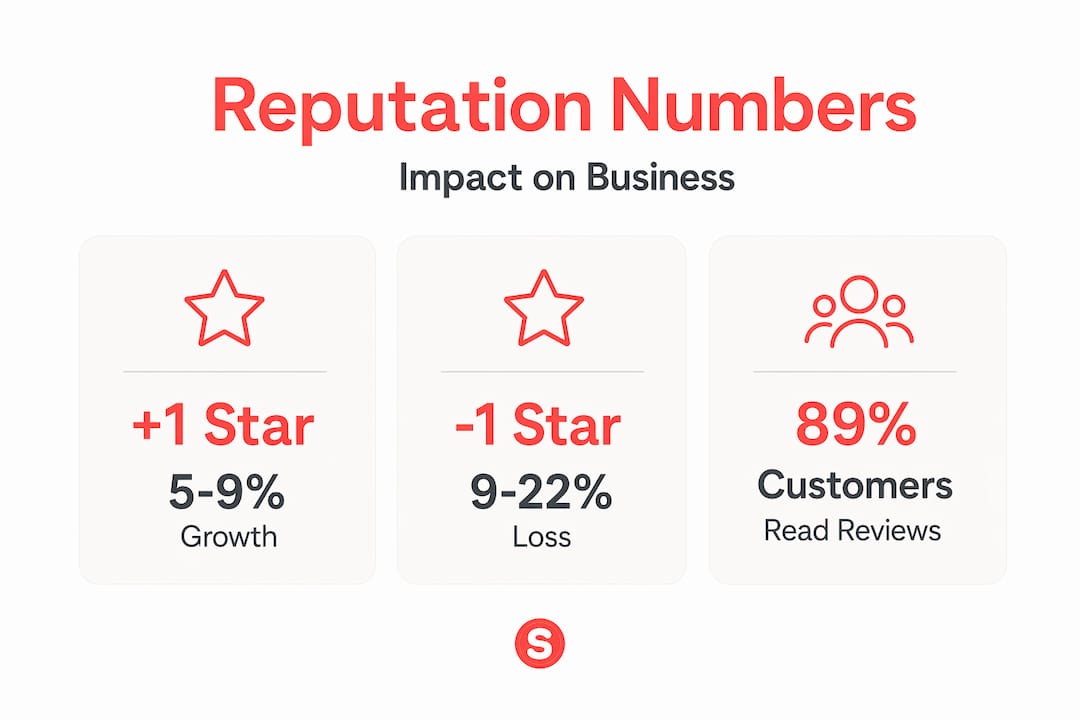
A one-star rating increase can drive a 5-9% revenue increase. For a business generating $500,000 annually, that means $25,000 to $45,000 in additional revenue without spending a dollar on advertising. Harvard Business School research backs this finding, making it one of the most compelling arguments for treating reputation as an operational priority.
The downside is equally stark. Losing one star on your rating can cut sales by 9-22% and push your customer acquisition costs up by 40%. That last number matters because it means a declining reputation makes every marketing dollar you spend work harder for smaller returns.
| Reputation action | Business impact |
|---|---|
| +1 star increase | 5-9% revenue growth |
| -1 star decrease | 9-22% sales decline |
| Consistent review responses | Higher purchase intent from 89% of consumers |
| Proactive review generation | Lower customer acquisition costs over time |
Consumer behavior reinforces this. 89% of consumers read how businesses respond to reviews before making a purchase decision. And 47% will actively avoid a business that ignores its feedback entirely. That means your silence on a negative review is itself a public message.
The importance of reputation management is also reflected in how fast the industry is growing. The reputation management sector is currently valued at $5.1 billion and is projected to surpass $21.9 billion by 2035. Yet only 17% of businesses have an active, proactive plan in place. That gap represents a genuine opportunity for business owners who move first.
Proven reputation management strategies that work
Knowing the stakes is one thing. Knowing how to act is another. These strategies are what sustainable reputation growth actually looks like in practice.
1. Build review generation into daily operations. The businesses with the highest review volumes didn’t get there through luck or one-time campaigns. Successful reputation management integrates review requests into everyday customer interactions. Train your front-of-house staff to ask satisfied guests before they leave. Set up automated follow-up texts or emails after a transaction. Make it a habit, not an event.
2. Respond to every review within 24 hours. Both positive and negative reviews deserve a response. For positive reviews, a brief, personalized thank-you reinforces loyalty. For negative reviews, acknowledge the issue, apologize sincerely, and offer to resolve it offline. This isn’t about winning arguments. It’s about showing every future customer reading that exchange that you take your service seriously.
3. Use feedback as an operational tool. The restaurants and businesses with the strongest reputations treat reviews as free market research. When three people in one week mention slow service on a Saturday night, that’s a staffing signal. When guests repeatedly praise a specific dish or team member, that’s something worth amplifying.
4. Focus on volume, not just damage control. Effective reputation strategies focus less on trying to remove negative reviews, which is difficult and often ineffective, and more on generating consistent positive reviews to lift your overall rating naturally.
5. Stay compliant with platform policies. Review gating, the practice of filtering customers before asking them to review based on whether they seem happy, violates Google’s policies and risks profile suspension. Ask every customer, not just the ones who seem satisfied. Authentic volume is what creates sustainable results.
Pro Tip: Train your frontline staff with a simple script. Something like “We’d love to hear your feedback on Google, it takes about 30 seconds” converts real-world satisfaction into digital credibility without pressure or policy risk.
For a detailed operational checklist, Sorbey’s review management checklist is built specifically for restaurants and local businesses navigating this process for the first time.
Tools and technology that scale your efforts
Manual reputation management works when you have one location and moderate review volume. Beyond that, it becomes unsustainable without software support.
Good reputation management tools handle the work you can’t afford to forget:
- Automated review requests sent via SMS or email after each transaction, increasing response rates without requiring manual follow-up.
- Real-time alerts when new reviews are posted so you never miss a response window.
- AI-assisted response templates that help you reply to reviews faster while maintaining a consistent, human tone.
- Centralized dashboards that aggregate reviews from Google, Yelp, Facebook, and other platforms in one place.
- Sentiment analysis that flags trends in customer feedback before they become visible problems.
- Competitor monitoring to benchmark your rating and review velocity against businesses in your area.
Your Google Business Profile is the anchor of all of this. Review responses are a direct ranking factor in local search, and consistent positive review volume helps suppress negative content organically. Tools that keep your profile active and well-maintained also support local SEO directly.
Pro Tip: When evaluating reputation management software, look for platforms that handle review requests and responses across multiple channels from a single interface. Switching between five tabs to manage your reputation is a fast road to inconsistency.
Measuring what’s working
Reputation management without measurement is guesswork. You need clear signals to know whether your efforts are gaining traction.
The metrics worth tracking on a monthly basis include:
- Average star rating trend across each major platform
- Total review volume and growth rate over the past 30, 60, and 90 days
- Response rate and average response time for new reviews
- Sentiment ratio (positive versus negative mentions over time)
- Local search ranking position for your primary keywords
Beyond the numbers, reading your reviews regularly keeps you close to what customers actually experience. A dashboard can tell you your rating dropped 0.2 points. Only reading the reviews tells you why. Treat your reputation data the way a good operator treats financial metrics for restaurants: review it regularly, act on what you find, and build it into your weekly management rhythm.
One more thing worth noting: reputation management is not a project with an end date. It’s an ongoing operational discipline. The businesses that see compounding results are the ones that commit to it over years, not weeks.
My take on why most businesses get this wrong
I’ve worked with enough local business owners to see the same pattern repeat itself. Reputation management gets treated as something to address when there’s a problem. A bad review shows up, there’s a brief flurry of activity, and then things go quiet until the next crisis.
That approach is expensive. What I’ve learned is that reputation is less like a fire you put out and more like a financial asset you build. Consistent investment in reputation compounds over time and creates a kind of resilience that actually reduces your long-term marketing spend. The businesses that respond to every review, generate feedback systematically, and treat the data as operational intelligence are the ones that end up dominating local search and retaining customers at higher rates.
The other mistake I see is treating reputation management as a marketing function separate from operations. It’s not. When your reviews consistently mention slow service or a specific quality issue, that’s a management signal. The best operators I know use their reputation data the way they use their sales numbers. They look at it regularly, take it seriously, and let it drive real decisions.
My honest recommendation: start small, start now, and build the habit before you try to build the system.
— Barthelemy
How Sorbey helps you take control of your reputation
Managing your reputation across every review platform, responding promptly, and generating consistent new reviews is a lot to maintain on top of running a business. That’s exactly what Sorbey is built to simplify.
Sorbey’s marketing solutions include reputation management tools designed specifically for restaurants and local businesses. From automated review requests to centralized response management, Sorbey handles the operational side so you can focus on the customer experience that drives reviews in the first place. If you’re looking to build a stronger, more visible presence in local search while protecting the trust you’ve worked hard to earn, Sorbey gives you the infrastructure to do it at scale. You can also explore our restaurant reputation guide to see how other local businesses have put these strategies to work.
FAQ
What is reputation management in simple terms?
Reputation management is the practice of monitoring and influencing what customers find when they search for your business online. It covers review generation, response, and monitoring across platforms like Google and Yelp.
How much does a bad review actually cost a business?
Losing just one star on your rating can reduce sales by 9-22% and increase customer acquisition costs by 40%, based on published industry research.
How do I manage my reputation online without a big budget?
Start by responding to every review within 24 hours and training staff to ask satisfied customers for feedback directly. Free tools like Google Business Profile give you a strong foundation before investing in paid software.
Does responding to reviews help with local search rankings?
Yes. Review responses are a direct ranking factor in Google’s local search algorithm. Consistent responses combined with high review volume improve your visibility in local search results.
What’s the difference between proactive and reactive reputation management?
Proactive reputation management means continuously generating reviews and monitoring your brand before issues arise. Reactive management only kicks in after negative feedback appears, which limits how much control you have over your overall rating.
Recommended
You might also like

Best Restaurant Loyalty Programs 2026: ROI Guide
Discover the best restaurant loyalty programs 2026 that boost repeat visits. Learn how Sorbey’s platform can transform your guest data strategy!

Why Mobile Marketing Matters for Business Growth
Discover why mobile marketing matters for business growth. Learn how optimizing for mobile drives traffic, conversions, and customer retention.

SF Dim Sum Restaurant Marketing Checklist for 2026
Transform your SF dim sum with our 2026 marketing checklist. Optimize your profile, showcase dishes, and attract customers fast!