
Blog
What Is Reputation Monitoring for Your Business?
Discover what reputation monitoring is and why it’s essential for your business. Track mentions, manage your brand, and make informed decisions!

What Is Reputation Monitoring for Your Business?
TL;DR:
- Reputation monitoring involves continuously tracking online mentions across all digital channels, not just responding to reviews. It provides real-time insights into customer sentiments and emerging issues, enabling proactive management and business growth. Effective monitoring requires comprehensive coverage, the right tools, and consistent updates to prevent reputation damage and capitalize on positive feedback.
Most business owners think reputation monitoring means checking Google reviews once a week and responding to the bad ones. That’s not monitoring. That’s damage control after the fact. What is reputation monitoring, really? It’s a continuous, systematic process of tracking every mention of your business across social media, review platforms, news sites, and forums, so you always know what customers are saying, where they’re saying it, and what it could cost you if you ignore it. This article breaks down how it works, what tools you need, and why it’s the foundation every business decision should be built on.
Table of Contents
- Key Takeaways
- What reputation monitoring actually means
- Where reputation monitoring happens
- Why monitoring pays off in real dollars
- How to set up reputation monitoring
- Common pitfalls in reputation monitoring
- My take on reputation monitoring
- How Sorbey makes reputation monitoring work for you
- FAQ
Key Takeaways
| Point | Details |
|---|---|
| Monitoring is reactive tracking | It captures what’s being said about your brand right now, across all digital channels. |
| Coverage must be comprehensive | Track review platforms, social media, forums, and even misspellings of your brand name. |
| Strong reputations drive revenue | A one-star Yelp rating improvement links to a 5-9% revenue increase for local businesses. |
| Setup takes less time than expected | A basic audit and Google Alerts configuration can be done in under an hour. |
| Monitoring enables smarter management | You cannot build a proactive reputation strategy without first knowing what people are saying. |
What reputation monitoring actually means
Reputation monitoring is the ongoing process of tracking brand mentions, customer reviews, and public conversations about your business in real time. It covers social media channels, review platforms like Yelp and Google Business Profile, news sites, and online forums. The goal is simple: know what’s being said before it becomes a problem you’re scrambling to fix.
Here’s where most business owners get confused. Monitoring is reactive, meaning it tracks what is happening right now. Reputation intelligence, by contrast, is proactive. It analyzes trends and uses data interpretation to forecast potential threats before they materialize. Monitoring tells you that three customers complained about slow service at your location yesterday. Intelligence tells you that complaints about wait times are trending upward industry-wide and will likely affect you next quarter.
For day-to-day operations, monitoring is where you start. It relies on three core mechanisms:
- Alerts and notifications: Tools like Google Alerts send you an email whenever your brand name appears in a new web page or article.
- Sentiment analysis: Software scans the emotional tone of mentions, flagging negative, neutral, or positive language automatically.
- Keyword tracking: You define specific terms, whether your business name, a competitor, or a product, and the tool reports every time those terms appear online.
Pro Tip: Set up alerts not just for your business name, but also for your owner’s name and your top menu items or services. This captures a much wider slice of the real conversation happening around your brand.
Understanding this distinction matters because many reputation management tools sell you on intelligence features when what you actually need first is solid, consistent monitoring coverage.
Where reputation monitoring happens
You might assume monitoring means watching your own social media pages and Google reviews. That’s a starting point, but effective monitoring spans social media, Reddit, niche forums, and industry-specific platforms where the most candid feedback originates.

Think about how your customers actually talk about their experience. A diner who had a bad experience at your restaurant might not leave a Google review. They might post in a local Facebook community group, complain on Reddit, or share a story on a food-focused forum. If you’re only watching your own channels, you miss all of that.
The main channels your monitoring system should cover include:
- Review platforms: Google Business Profile, Yelp, TripAdvisor, Glassdoor for employer reputation
- Social media: Facebook, Instagram, X (formerly Twitter), TikTok mentions and tags, including posts that don’t tag your account directly
- News and media: Local news outlets, food bloggers, and industry publications
- Forums and communities: Reddit threads, local Facebook groups, niche industry boards
- Your own channels: Responses on your own posts, comments, and direct messages
One underused tactic is monitoring misspellings and modifier phrases. If your restaurant is called “Cafe Nola,” you should track “Cafe Nolla,” “Cafe Nola complaint,” and “Cafe Nola lawsuit.” Investors, job candidates, and potential customers search these combinations. Knowing what they find shapes how you respond and how you build content to counter negative signals.
Pro Tip: Create a simple spreadsheet listing every variation of your business name, key staff names, and your most popular products. Run all of them through your monitoring setup. This one step catches reputation signals that most businesses miss entirely.
Why monitoring pays off in real dollars
This is where reputation monitoring stops being abstract and starts being a business decision you can justify to any stakeholder or partner.
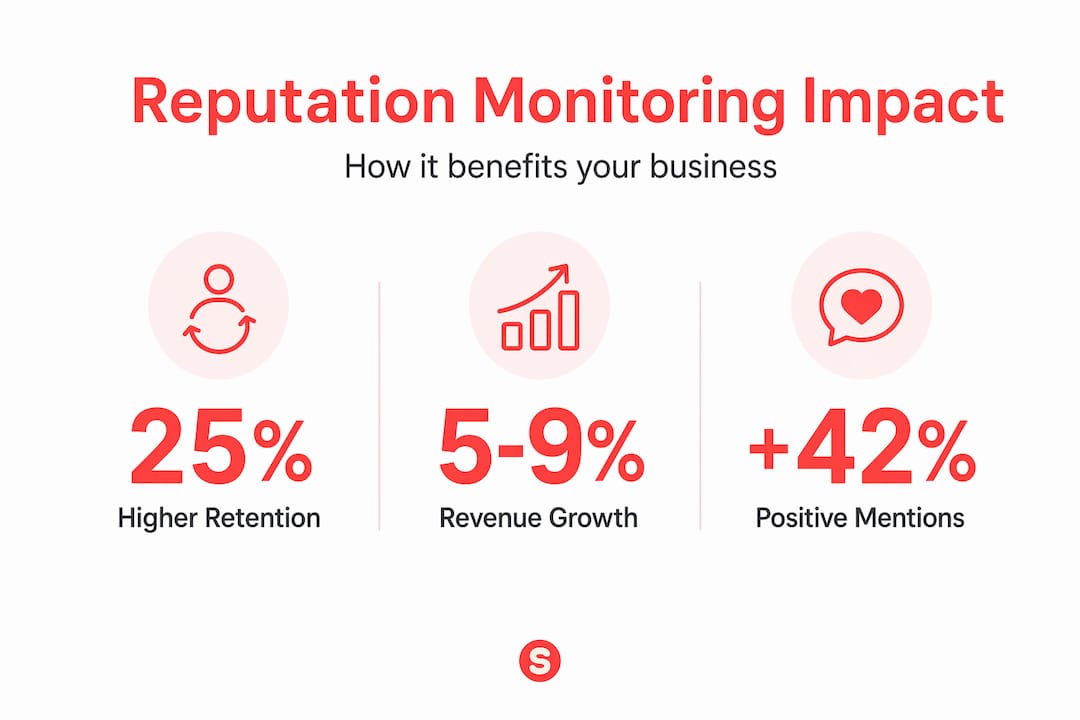
Businesses with strong online reputations see, on average, a 25% increase in customer retention and a 5-9% revenue increase per one-star Yelp rating improvement. Strong reputations also reduce customer acquisition costs by up to 18%. For a local restaurant or retail business, those numbers translate directly into margin. A single star on Yelp is not a vanity metric. It’s a revenue lever.
Beyond revenue, consider the risk side. 84% of executives rank brand reputation risk as their top external concern. They understand that missed reputation issues carry costs that far exceed what a proper monitoring setup would have cost to prevent.
Effective monitoring creates three specific business advantages:
- Early crisis detection: A pattern of complaints about one staff member or one dish can be caught and corrected before it spirals into a wave of one-star reviews.
- Competitive benchmarking: When you monitor your brand alongside relevant keywords and competitors in your category, you gain visibility into what customers prefer about similar businesses, which is market research you’re getting for free.
- Customer feedback loops: Monitoring surfaces unsolicited feedback that’s often more honest than survey responses. Customers tell each other the truth in ways they don’t always tell you directly.
When monitoring transforms from defensive tactic to growth strategy, it’s because you start using what you find. You see a cluster of compliments about your outdoor seating, and you feature it in your next marketing push. You catch a trend of comments about parking difficulty and add a note to your Google Business Profile about the nearby lot. Small moves with data behind them.
How to set up reputation monitoring
A common objection from business owners is that monitoring sounds expensive and technical. Neither has to be true. A basic reputation audit can be done in under an hour, and free tools exist for foundational setup. Here’s a practical path to get started:
- Audit your current presence. Search your business name on Google, Yelp, Facebook, and TripAdvisor. Note the first page of results. That’s what your next customer sees. Repeat this for your owner’s name and your top products or services.
- Claim and complete every listing. You can’t monitor what you don’t own access to. Claim your Google Business Profile, your Yelp listing, and any industry-specific directories relevant to your business.
- Set up Google Alerts. It’s free. Go to alerts.google.com and create alerts for your business name, owner name, and key service terms. Set the delivery frequency to daily at minimum, more often if you’re in a high-volume review environment like hospitality.
- Layer in a dedicated platform. Free tools have limits. Paid reputation tracking services scan a wider range of sources, provide sentiment analysis, and organize alerts in a dashboard rather than your inbox.
- Define your response workflow. Decide who on your team handles which type of alert. Negative reviews need a timely response. Positive mentions deserve acknowledgment. Assign ownership before you need it.
| Tool type | Best for | Limitations |
|---|---|---|
| Google Alerts | Free, basic monitoring of web mentions | Misses social media and many review sites |
| Review platform dashboards | Direct monitoring of specific platforms | Siloed, requires checking each one separately |
| Dedicated monitoring platforms | Centralized, multi-channel sentiment tracking | Monthly cost, learning curve for setup |
Pro Tip: Review your monitoring alerts every morning before checking email. It takes five minutes and puts you in a position to respond that day, not three days later when the conversation has already moved on.
Common pitfalls in reputation monitoring
Even when businesses commit to monitoring, there are patterns that consistently limit its effectiveness.
The biggest mistake is monitoring only owned channels. Your Facebook page comments represent a fraction of what people say about you. Forums and community groups are where candid, unfiltered feedback lives. Ignoring them doesn’t make the conversation go away. It just means you’re not in it.
A second limitation is confusing monitoring with management. Reputation management is a strategic layer that involves content strategy, search engine optimization, and crisis response built on what monitoring reveals. Monitoring gives you the data. Management determines what you do with it. Businesses that treat alerts as the finish line instead of the starting line miss the strategic value entirely.
Other common gaps include:
- Setting up alerts once and never reviewing or updating them as your business evolves
- Relying on incomplete tools that cover only one or two platforms and calling it a full monitoring program
- Failing to document what you find, which makes it impossible to spot trends over time
- Not integrating monitoring findings into weekly operations or staff briefings
Monitoring is also not a replacement for building a good reputation through the service, products, and experiences you deliver. It amplifies what’s already there. If the underlying customer experience is poor, faster visibility into the complaints doesn’t fix the problem. It just shows you the fire faster.
My take on reputation monitoring
In my experience, the businesses that struggle most with their online reputation are not the ones getting bad reviews. They’re the ones who have no idea what’s being said about them until the damage is already done. I’ve seen restaurateurs blindsided by a Reddit thread with 200 comments about a hygiene issue that had been circulating for two weeks before anyone on their team noticed.
What I’ve learned is that monitoring is not something you set up once and forget. It’s a discipline. The owners who treat it like a morning ritual, five minutes reviewing alerts before the lunch rush, are the ones who catch small problems before they become expensive ones. They also tend to be faster at spotting what’s working, which shapes smarter marketing decisions.
The misconception I encounter most often is that monitoring is only useful when things go wrong. That framing misses the point. Monitoring your restaurant’s online reputation gives you a live feed of what customers value, what they’re confused by, and what delights them enough to tell their friends. That’s not defensive intelligence. That’s a growth asset you’re not using if you’re not watching.
My advice: start simple. Google Alerts and a dedicated 20 minutes per week will beat zero monitoring every time. Build from there as you understand what you’re actually looking at.
— Barthelemy
How Sorbey makes reputation monitoring work for you
Monitoring is only as powerful as the system behind it. Without a way to organize what you find, prioritize responses, and connect insights to actual marketing action, you end up with an inbox full of alerts and no clear path forward.
Sorbey is built specifically for local businesses like restaurants that need more than just generic marketing software. Sorbey’s marketing and reputation services bring your review monitoring, customer feedback, and local visibility into one place, so your team spends less time hunting for signals and more time acting on them. If you want to see where your reputation stands today before investing in a full system, Sorbey’s free restaurant tools give you a fast, practical starting point. Understanding what your customers are saying is the first step toward making sure more of them stay, spend, and come back.
FAQ
What is reputation monitoring in simple terms?
Reputation monitoring is the process of continuously tracking what people say about your business online, across review sites, social media, forums, and news outlets. It gives you real-time visibility into your brand’s public perception.
How is reputation monitoring different from reputation management?
Monitoring is reactive, capturing current mentions and sentiment data. Management is the strategic response layer, using that data to create content, respond to crises, and improve your brand position over time.
What tools do I need to start monitoring my reputation?
Google Alerts is a free starting point for web mentions. For deeper coverage across review platforms and social media, dedicated reputation tracking services provide centralized dashboards and sentiment analysis in one place.
How often should I check my reputation monitoring alerts?
Daily is the recommended minimum, especially for businesses in hospitality or retail where review volume is high. Reviewing alerts each morning lets you respond within hours rather than days, which matters for both customers and search rankings.
Why do local businesses miss important reputation signals?
Most businesses monitor only their own pages and listings while feedback on forums and community groups goes unseen. Expanding coverage to unowned channels captures the most candid, unfiltered customer opinions.
Recommended
- Review Management Checklist: Boost Restaurant Reputation | Sorbey Blog | Sorbey
- Liste de Contrôle Gestion d’Avis : Boostez la Réputation de Votre Restaurant | Sorbey Blog | Sorbey
- Services - Sorbey | Restaurant Marketing Solutions | Sorbey
- Restaurant Reputation Management: A Complete How-To Guide | Sorbey Blog | Sorbey
You might also like

Best Restaurant Loyalty Programs 2026: ROI Guide
Discover the best restaurant loyalty programs 2026 that boost repeat visits. Learn how Sorbey’s platform can transform your guest data strategy!

Why Mobile Marketing Matters for Business Growth
Discover why mobile marketing matters for business growth. Learn how optimizing for mobile drives traffic, conversions, and customer retention.

SF Dim Sum Restaurant Marketing Checklist for 2026
Transform your SF dim sum with our 2026 marketing checklist. Optimize your profile, showcase dishes, and attract customers fast!