
Blog
Digital Presence Explained: Build Your Business Online in 2026
Discover what digital presence truly means and how to build your online reputation effectively by leveraging diverse platforms and content.

Digital Presence Explained: Build Your Business Online in 2026
What is digital presence and why does it go beyond your website?
Your digital presence is the complete picture of everything the internet surfaces about your business: your website, social profiles, review listings, directory entries, press coverage, and what AI tools like ChatGPT or Google Gemini generate when someone asks about your category. Simply owning a website does not constitute a digital presence. As one widely cited definition puts it, managing your entire footprint with intention is what separates a real presence from a placeholder.
Think of it as two distinct but overlapping things. First, there is the inventory: every piece of online content connected to your brand. Second, there is the sentiment attached to that inventory, which is your online reputation. A business can have a large inventory with mostly negative reviews, or a strong reputation with too little content to dominate branded search. Effective presence management builds both at once.
The four qualities that make a digital presence actually work:
- Visible: Your business appears where customers are searching, including Google, Yelp, and AI-generated responses.
- Accurate: Your name, address, phone number, and hours are consistent everywhere they appear.
- Authoritative: Third-party sources, press coverage, and structured content back your claims.
- Positive: The overall sentiment of what surfaces about you is favorable.
Most businesses achieve only two or three of these qualities. Getting all four requires a systematic approach, not a one-time setup.
Table of Contents
- Why a strong digital presence determines whether you win or lose customers
- Core components that make up a complete digital presence
- Practical strategies to build and enhance your digital presence effectively
- How online reputation fits inside your digital presence
- How to measure whether your digital presence is actually working
- Common challenges that undermine digital presence management
- What strong digital presence looks like across different industries
- Key Takeaways
Why a strong digital presence determines whether you win or lose customers
Consumers research brands online before they ever make contact. 74% of consumers check a company’s website before a purchase decision, and 38% turn to social media. That means your digital footprint is doing sales work around the clock, whether you are managing it or not.
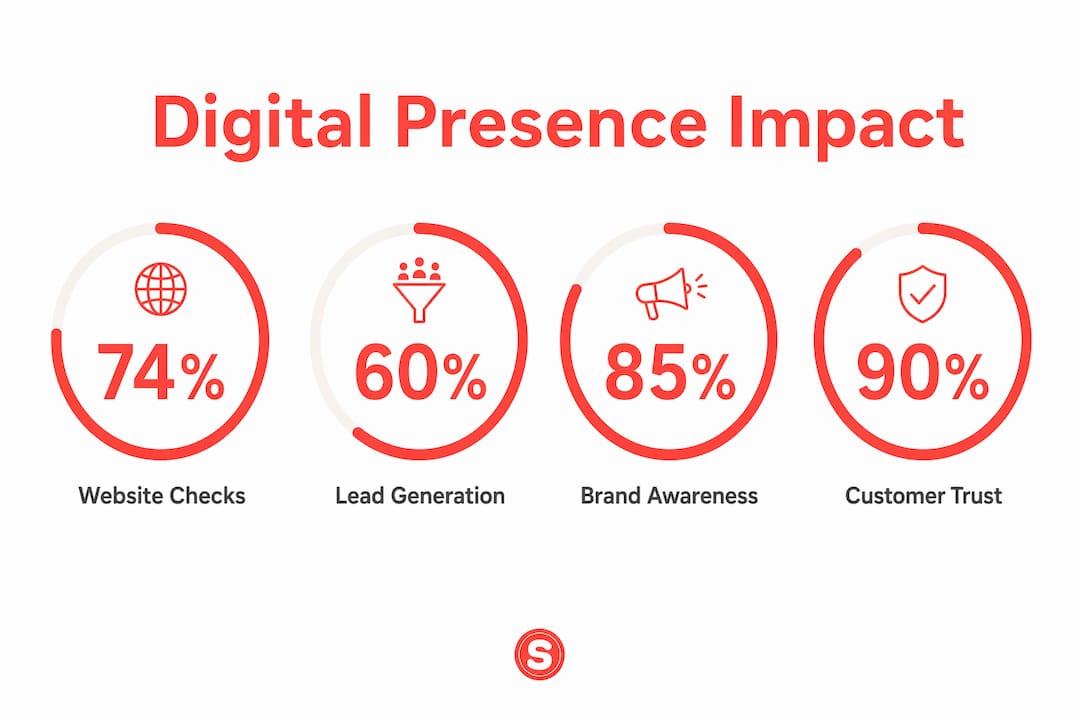
The concept of “silent rejection” captures what happens when you are not. Potential clients silently discard a business based on a weak or outdated online presence, long before any direct contact. No angry email, no phone call. They just move on. You never know it happened.
A well-managed presence does the opposite. It drives brand awareness, pulls in qualified leads, builds customer loyalty, and creates the kind of trust that makes someone choose you over a competitor they found in the same search. AI-powered research tools have added a new layer to this: when someone asks ChatGPT or Perplexity which local restaurant or service provider to use, the answer comes from the same authoritative sources that traditional SEO has always rewarded, but the bar for appearing in those answers is higher.

Core components that make up a complete digital presence
Every strong digital presence is built on a set of specific, manageable properties. Here is what each one does and why it belongs in your strategy.
| Component | Primary Role |
|---|---|
| Website (About page) | Central anchor for branded search and AI citations |
| Google Business Profile | Controls local search pack and map visibility |
| Social media profiles | Brand voice, engagement, and audience reach |
| Online review platforms | Reputation validation and customer trust signals |
| Directory listings | NAP consistency and local authority |
| Earned media coverage | Third-party authority that owned content cannot replicate |
| Schema markup | Structured data that improves AI discoverability |
Your website’s About page deserves special attention. It ranks first for branded search and is the page most frequently cited in AI-generated summaries. Most businesses treat it as an afterthought. Treat it as a primary sales asset.
For local and regional businesses, Google Business Profile is the highest-leverage single property you can manage. It controls what appears in Google Maps, the local search pack, and AI-generated responses to location-based queries. A restaurant with an incomplete or unverified profile is invisible to a huge portion of nearby customers.
Earned media carries weight that owned content simply cannot. A single trade publication article outweighs a dozen blog posts when it comes to authority transfer. This is true for traditional search and even more pronounced in AI-generated results, which pull heavily from established third-party sources.
Practical strategies to build and enhance your digital presence effectively
Building a presence that performs in both traditional search and AI-generated results requires six parallel workstreams running at the same time.
-
Audit for entity consistency. Your name, address, and phone number must be identical across every platform. This is the foundational technical requirement with the highest return on investment and the most common failure point for local businesses.
-
Build out your About page. Write it with the same care you would give a homepage. Include schema markup, clear descriptions of what you do and who you serve, and links to credible third-party mentions.
-
Fully optimize your Google Business Profile. Add photos, respond to reviews, keep hours current, and use the posts feature. An incomplete profile signals neglect to both Google and potential customers.
-
Create a review generation process. Ask satisfied customers for reviews on Google and relevant platforms. Respond to every review, positive or negative. Reviews are a trust signal for humans and a data source for AI tools.
-
Pursue earned media. Pitch local publications, industry blogs, and trade outlets. A mention in a credible external source does more for your authority than any amount of self-published content.
-
Integrate SEO with content marketing. Tactics like SEO, social media marketing, content marketing, and email marketing enhance visibility and attract leads when applied consistently. They are not separate strategies; they feed the same presence.
-
Build for AI search specifically. Structure your website content so AI tools can parse and cite it. Use clear headers, factual statements, and link to authoritative external sources. This is what practitioners call GEO (generative engine optimization), and it is a distinct layer on top of traditional SEO.
Pro Tip: Managing your AI search visibility is not the same as managing your Google rankings. AI tools like ChatGPT and Google Gemini synthesize from authoritative third-party sources, so a press mention or a well-structured directory profile can influence your AI visibility more than a new blog post will.
For restaurants and food businesses specifically, mobile marketing strategies have become a core part of presence building, since most local searches happen on a phone.
How online reputation fits inside your digital presence
Online reputation is not a separate discipline. It is the sentiment layer sitting on top of your presence inventory. You can have a large presence with a poor reputation, or a thin presence with glowing reviews that not enough people ever see.
Monitoring matters as much as building. Set up Google Alerts for your brand name. Check your review platforms weekly. When inaccurate information appears, whether a wrong address on a directory or a misleading third-party description, correct it immediately. Outdated or inconsistent information is one of the fastest ways to trigger silent rejection.
Reputation management for restaurants follows the same principles, with the added pressure of high review volume and real-time customer feedback. The businesses that handle it well treat reputation management as an ongoing operation, not a crisis response.
Customer reviews in hospitality carry particular weight. Research on how reviews influence trust in the hospitality sector shows that third-party validation shapes purchase decisions more reliably than any owned content a brand produces.
How to measure whether your digital presence is actually working
You cannot manage what you do not measure. These are the metrics that tell you whether your presence is gaining ground.
- Branded search volume: Are more people searching your business name over time? Rising branded search is a reliable indicator of growing awareness.
- Google Business Profile views and actions: How many people saw your profile, clicked for directions, or called? This is direct local intent data.
- Review count and average rating: Track both the number and the trend. A declining average rating is an early warning sign.
- Website organic traffic: Specifically, traffic from branded queries and from the local area you serve.
- AI search appearances: Search for your business category in ChatGPT or Perplexity. Does your business appear? If not, that is a gap worth addressing.
- Share of voice in local search: How often does your business appear in the local pack for relevant queries compared to competitors?
Set a monthly review cadence. Presence building is slow, and the metrics reflect that. What you are looking for is directional improvement over three to six months, not week-to-week swings.
Common challenges that undermine digital presence management
Most businesses run into the same problems, and most of them are fixable.
Inconsistent NAP data is the most common technical failure. A business that moved locations two years ago and never updated every directory listing is actively hurting its local search performance. An audit using a tool like Moz Local or BrightLocal surfaces these discrepancies quickly.
Neglected Google Business Profile is a close second. An unverified profile, missing photos, or unanswered reviews signals to both Google and customers that the business is not paying attention.
No review strategy leaves reputation to chance. Businesses that actively ask for reviews consistently outperform those that wait and hope.
Ignoring AI search is the newest and fastest-growing gap. Most businesses have not yet thought about how they appear in ChatGPT or Gemini responses. The businesses that address this now will have a meaningful head start.
Treating presence as a one-time project rather than an ongoing operation is the root cause behind most of the above. Digital presence decays without maintenance.
What strong digital presence looks like across different industries
Restaurants with strong presence maintain a fully verified Google Business Profile with current photos and hours, respond to every review on Google and Yelp, and appear in AI-generated “best restaurants near me” responses. Their website includes schema markup for menu, location, and hours. Sorbey’s guide on why digital presence matters for restaurants breaks down exactly how this plays out in practice.
Professional services firms (law, accounting, consulting) build presence through a combination of a well-structured website, LinkedIn company and individual profiles, and earned media in trade publications. Their About page and team bios are optimized for both branded search and AI citation.

Retail businesses focus heavily on Google Shopping, local inventory ads, and review platforms like Google and Trustpilot. Consistent product data across platforms is their version of NAP consistency.
Healthcare providers rely on directory accuracy across platforms like Healthgrades and Zocdoc, combined with a strong review profile and a website that clearly communicates services, credentials, and location.
The common thread across every industry: the businesses with the strongest presence are not the ones with the biggest budgets. They are the ones managing their footprint consistently, across every channel where customers look.
Key Takeaways
A strong digital presence requires managing both the inventory of online content and the sentiment attached to it, across traditional search and AI-generated results simultaneously.
| Point | Details |
|---|---|
| Presence vs. reputation | Digital presence is the inventory; online reputation is the sentiment. Both require active management. |
| Four essential qualities | Effective presence must be visible, accurate, authoritative, and positive. Most businesses achieve only two or three. |
| About page priority | Your website’s About page ranks first for branded search and is cited most often in AI-generated summaries. |
| Google Business Profile | For local businesses, it is the single highest-leverage property for search pack and AI visibility. |
| AI search is a separate layer | Optimizing for ChatGPT and Gemini requires structured content and earned third-party citations, not just traditional SEO. |
Recommended
You might also like

Best Restaurant Loyalty Programs 2026: ROI Guide
Discover the best restaurant loyalty programs 2026 that boost repeat visits. Learn how Sorbey’s platform can transform your guest data strategy!

Why Mobile Marketing Matters for Business Growth
Discover why mobile marketing matters for business growth. Learn how optimizing for mobile drives traffic, conversions, and customer retention.

SF Dim Sum Restaurant Marketing Checklist for 2026
Transform your SF dim sum with our 2026 marketing checklist. Optimize your profile, showcase dishes, and attract customers fast!