
Blog
Why local reviews matter: unlock success for your restaurant
Discover why local reviews matter for your restaurant's success. Learn to transform feedback into revenue and attract more diners today.

Why local reviews matter: unlock success for your restaurant
TL;DR:
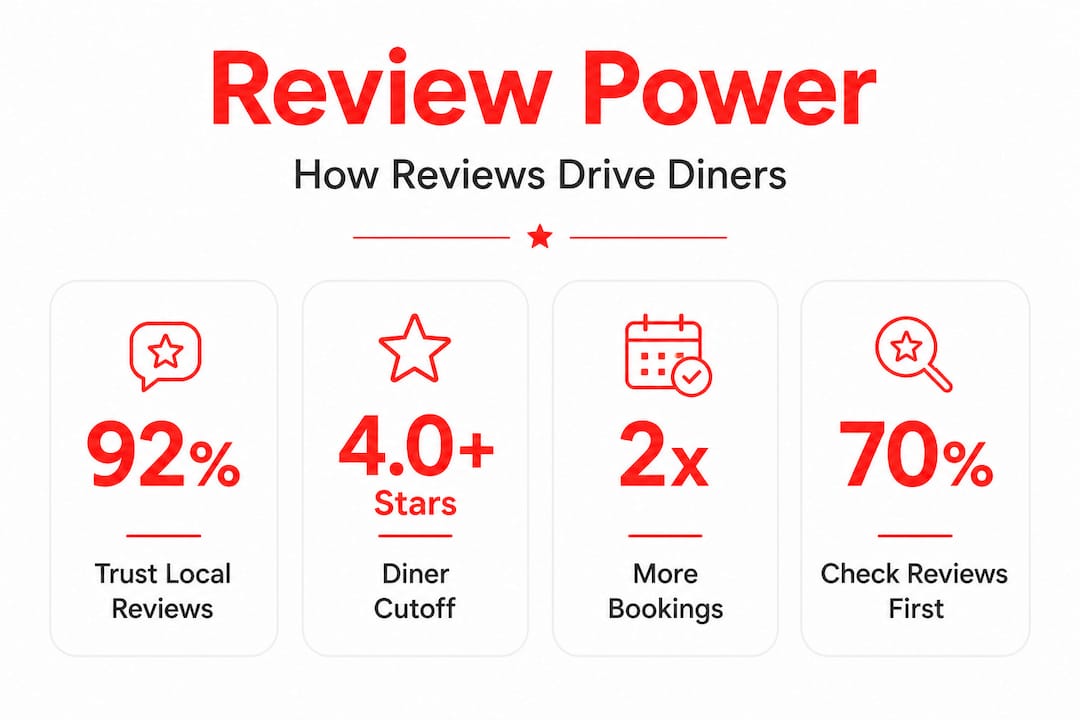
- Over 90% of diners read reviews before choosing a restaurant, yet many owners overlook their strategic importance.
- High-quality local reviews shape first impressions, trust, and search rankings, directly impacting revenue and visibility.
Over 90% of diners read reviews before choosing a restaurant, yet most owners treat feedback as background noise rather than front-of-house strategy. That gap is costing restaurants real tables, real revenue, and real regulars. This guide breaks down exactly why local reviews carry so much weight in 2026, what your guests are actually looking for when they scan ratings, and the practical steps you can take starting today to turn every review into a growth engine for your business.
Table of Contents
- Why local reviews can make or break your restaurant
- How local reviews boost visibility and sales
- What guests look for in local reviews
- Maximizing the power of local reviews: practical steps
- The real secret: reviews are your best (free) marketing channel
- Put review management to work for your restaurant
- Frequently asked questions
Key Takeaways
| Point | Details |
|---|---|
| Reviews shape reputation | Guest reviews are a top factor influencing how new diners perceive your restaurant. |
| Boosts visibility and sales | Restaurants with strong local reviews appear higher in search and get more new guests. |
| Review quality matters | Diners trust recent, personal, and detailed reviews when deciding where to eat. |
| Response strategies win | Responding well to reviews improves your reputation and encourages more feedback. |
| Leverage for long-term success | Consistently managing reviews becomes free, ongoing marketing for growing your business. |
Why local reviews can make or break your restaurant
Picture two Italian spots sitting side by side on the same block in Chicago. Same price point, similar menus, comparable ambiance. One has 340 Google reviews averaging 4.6 stars. The other has 28 reviews averaging 3.9 stars. Before a single guest walks through either door on a Friday night, the first restaurant has already won.
This is the reality of local reviews in 2026. They function as a first impression long before your host says hello. They shape expectations before a guest even looks at your menu. And they directly impact both reputation and sales in ways that paid advertising simply cannot replicate.
The stakes are genuinely high. Consider what a single star increase on Yelp can mean for a local restaurant: research has consistently pointed to revenue lifts in the 5 to 9 percent range following measurable rating improvements. For a restaurant doing $1.2 million annually, that is an extra $60,000 to $108,000 per year from better reviews alone. No ad spend required.
“Your online reputation is your restaurant’s public identity. Every review, positive or negative, shapes how thousands of potential guests perceive you before they ever taste your food.”
The key elements that local reviews influence include:
- First impressions: Guests form opinions about your restaurant within seconds of seeing your rating on Google Maps or Yelp.
- Trust signals: A higher volume of authentic reviews signals credibility that a polished website alone cannot build.
- Competitive positioning: In dense urban markets like New York, Los Angeles, or Houston, reviews are often the deciding factor when guests compare options.
- Feedback loops: Reviews reveal operational strengths and weaknesses that internal metrics might miss.
Understanding these dynamics is the foundation of any strong restaurant reputation management guide. Once you see reviews as living data rather than passive commentary, your entire approach shifts.
How local reviews boost visibility and sales
Here is something many restaurant owners do not realize: reviews do not just influence humans. They also influence algorithms. Search engines like Google use review signals, including volume, recency, average rating, and keyword content inside reviews, to rank local businesses. More reviews means more data for Google to work with, and more favorable data means higher placement.
Local reviews boost search engine visibility in a very concrete way. When a guest in Miami types “best tacos near me” into Google, the restaurants that show up in the top three map positions (the “local pack”) are almost always the ones with the strongest review profiles. That placement is free real estate that most restaurants never fully claim.
Let’s put some numbers to this:
| Review profile | Avg. monthly new guests | Search ranking position | Click-through rate |
|---|---|---|---|
| Under 50 reviews, 3.8 stars | Low (baseline) | Position 7 to 10 | ~2% |
| 100 to 200 reviews, 4.2 stars | Moderate | Position 4 to 6 | ~6% |
| 300+ reviews, 4.5+ stars | High | Position 1 to 3 | ~15 to 28% |
The difference in click-through rate between a weak review profile and a strong one is staggering. A restaurant in the local pack top three position can see 10 to 15 times more profile visits than a restaurant sitting outside that window.
Higher star ratings also directly influence first-time guest behavior. Most diners set a mental floor, typically 4.0 stars minimum before they will even click through to learn more about a restaurant. Dropping below that threshold effectively makes you invisible to a large segment of potential guests, no matter how good your food actually is.

Repeat business gets a boost too. When guests leave a positive review and see that the owner responds thoughtfully, they feel a connection. That small interaction increases the likelihood they will return, recommend the restaurant to friends, or follow your business on social media.
Pro Tip: Ask satisfied guests to mention a specific dish or experience in their review. Reviews containing keywords like “best wood-fired pizza in Brooklyn” or “gluten-free options in Austin” help your restaurant surface in niche searches and attract exactly the guests you want.
Pairing a strong review profile with strategic local advertising creates a compounding effect where your paid reach lands in front of prospects who then immediately see a trustworthy review history, turning curiosity into reservations much faster.
What guests look for in local reviews
Not all reviews carry equal weight in a diner’s mind. When someone is deciding whether to book your restaurant for a birthday dinner or a business lunch, they are not just looking at your star average. They are reading the actual content of reviews with a surprisingly critical eye.
Diners trust detailed, recent, and authentic reviews above all other types. A three-sentence review posted last week from someone who mentions the specific server by name and describes the pasta dish in detail carries far more influence than a glowing five-star review left two years ago with just the words “great place!”
Here is how the most impactful review types compare:
| Review type | Diner trust level | Conversion impact |
|---|---|---|
| Recent, detailed, specific | Very high | Strong booking intent |
| Older but detailed | Moderate | Some trust, some hesitation |
| Recent but vague | Low to moderate | Limited influence |
| Old and vague | Very low | Often dismissed |
| Owner responded to review | High (for engagement) | Signals credibility |
Notice that last row. Owner responses are a major trust signal. When potential guests see that a manager or owner engages with both positive and negative feedback in a professional, thoughtful way, it communicates something important: this restaurant actually cares.
The top factors diners evaluate when reading local reviews, in order of importance:
- Recency: Reviews from the past 90 days carry the most weight. Guests want to know what the experience is like now, not a year ago when you had a different chef.
- Specificity: Mentions of actual dishes, service details, or ambiance descriptions make reviews feel credible and useful.
- Tone and authenticity: Overly promotional language or reviews that feel scripted trigger skepticism. Genuine, conversational writing connects better.
- Owner response quality: A thoughtful reply to a one-star complaint often impresses prospective guests more than the five-star reviews surrounding it.
- Volume consistency: Steady review growth over time looks more legitimate than a sudden spike, which can suggest manipulation.
Building a strong review profile that hits all five of these factors is the goal of a solid review management checklist for any serious restaurant operator.
Maximizing the power of local reviews: practical steps
Knowing what matters in a review is useful. Knowing how to consistently generate and manage great reviews is where the real growth happens. The good news is that the process is not complicated. It just requires consistency and intentionality.
Getting more reviews without being pushy
The simplest, most effective method is also the most underused: just ask. Train your servers and managers to ask satisfied guests at the end of the meal if they would be willing to share their experience online. A warm, genuine request from a staff member the guest just connected with is remarkably effective.
Here is a simple process to make review requests systematic:
- Identify the right moment: Ask right after a positive interaction, when the guest expresses satisfaction or compliments the meal.
- Make it easy: Hand guests a small card with a QR code linking directly to your Google review page. Eliminating friction doubles follow-through.
- Use post-visit messaging: If you collect emails or have a loyalty program, send a follow-up message within 24 hours of a visit with a direct review link.
- Train every staff member: Make asking for reviews part of your standard closing script, just like upselling dessert.
- Respond to every review: Responding professionally to reviews encourages more positive feedback from future guests who see that their voice will be heard.
Turning reviews into marketing content
This step is where most restaurants leave money on the table. Your best reviews are marketing gold. Pull five-star quotes and feature them in your Instagram stories, on your website homepage, in your email newsletter, or even printed on table tents. Social proof from real guests is far more persuasive than any marketing copy your team could write.
Some additional high-impact tactics:
- Feature your best recent review on your Google Business Profile posts weekly.
- Screenshot and share detailed positive reviews on social media with a thank-you to the guest.
- Create a “guest favorites” section on your menu based on dishes frequently praised in reviews.
- Use review themes (common praises or complaints) to guide staff training priorities.
Following complete reputation management steps creates a system where reviews generate more reviews, positive reputation amplifies marketing, and the cycle keeps feeding your growth without requiring paid media at every stage.
Pro Tip: Set a weekly 15-minute calendar block dedicated to reading and responding to new reviews. Consistency compounds over time. Restaurants that respond to 80% or more of their reviews tend to accumulate higher ratings than those who respond sporadically.
The real secret: reviews are your best (free) marketing channel
Here is the view most articles skip: reviews are not just a reputation management task. They are a continuous, compounding, zero-cost marketing channel that most restaurants are barely tapping.
Think about paid advertising for a moment. You spend money on Facebook ads, the campaign runs, you get some traffic, and then it stops the moment you stop paying. Reviews work completely differently. A glowing review posted by a satisfied guest in 2024 is still attracting new diners in 2026. It never expires. It never needs a budget renewal. It keeps working while you sleep.
Restaurants with high review engagement see outsized returns compared to peers who neglect their review profiles, and those returns compound year after year because strong review profiles attract more guests, who leave more reviews, which attract even more guests.
The mindset shift we encourage at Sorbey is simple: stop treating reviews as something that happens to your restaurant and start treating them as something you actively build. Every satisfied guest who leaves without leaving a review is a missed opportunity to strengthen an asset that delivers returns indefinitely.
Reviews also give you operational intelligence that no survey tool can match. When four different reviewers in one month mention that the wait time on Saturdays is frustrating, that is a staffing signal. When guests repeatedly praise your sommelier by name, that is a retention risk if he leaves. Reviews tell you what your guests actually think, not what they tell your host on the way out.
The restaurants winning in competitive urban markets in 2026 are not necessarily the ones with the biggest marketing budgets. They are the ones treating review management as a core business function, right alongside food quality and service standards. Local restaurant success stories almost always include a deliberate, consistent approach to earning and managing reviews as part of the broader growth strategy.
Put review management to work for your restaurant
Managing reviews consistently takes time, especially when you are already running a full dining room, handling staff, and managing food costs. That is exactly why having the right tools and support in place makes such a measurable difference.
At Sorbey, we build all-in-one marketing solutions specifically for local restaurants like yours. Our platform helps you monitor and respond to reviews across Google, Yelp, and other key platforms from a single dashboard, track your reputation trends over time, and use your best guest feedback as ready-to-deploy marketing content. Whether you are managing one location or scaling across multiple neighborhoods in your city, Sorbey gives you the structure and strategy to make reviews work as hard as the rest of your team. Explore what Sorbey can do for your restaurant at sorbey.co.
Frequently asked questions
How do local reviews affect search engine results for restaurants?
Local reviews boost search engine visibility by giving Google signals like review volume, recency, and rating quality, all of which influence your placement in local search results and map listings, directly increasing how many new guests discover your restaurant.
What’s the best way to handle a negative local review?
Respond promptly and professionally within 24 to 48 hours, acknowledge the guest’s experience specifically, and invite them to reconnect directly. Responding professionally to reviews shows prospective guests you take feedback seriously, which often matters more than the negative review itself.
How often should I ask guests for reviews?
Ask consistently after every visit where a positive interaction occurs, without turning it into a scripted demand. Consistent review requests combined with easy access links (like QR codes) maximize your response rate and keep your review profile growing steadily.
Which review details do diners care about most?
Diners trust detailed, recent, and authentic reviews that mention specific dishes, staff interactions, or experiences over vague or outdated feedback. Recency and specificity are the two qualities that most strongly drive a prospective guest’s decision to book.
Recommended
- Boost local restaurant success with strategic local advertising | Sorbey Blog | Sorbey
- Benefits of online reviews for restaurants in 2026 | Sorbey Blog | Sorbey
- Digital marketing checklist for restaurants: boost local visibility | Sorbey Blog | Sorbey
- Why invest in local search for restaurants in 2026 | Sorbey Blog | Sorbey
También te puede interesar

Best Restaurant Loyalty Programs 2026: ROI Guide
Discover the best restaurant loyalty programs 2026 that boost repeat visits. Learn how Sorbey’s platform can transform your guest data strategy!

Why Mobile Marketing Matters for Business Growth
Discover why mobile marketing matters for business growth. Learn how optimizing for mobile drives traffic, conversions, and customer retention.

SF Dim Sum Restaurant Marketing Checklist for 2026
Transform your SF dim sum with our 2026 marketing checklist. Optimize your profile, showcase dishes, and attract customers fast!