
Blog
Email marketing for restaurants: $36 ROI per $1 spent
Learn how restaurant email marketing delivers $36 ROI per $1 spent. Build your list, write better emails, and measure results that fill more seats.
Email marketing for restaurants: $36 ROI per $1 spent
TL;DR:
- Email marketing offers higher ROI and control compared to social media for restaurants.
- Building an engaged, permission-based email list is essential for effective campaigns.
- Consistent, personalized emails strengthen guest loyalty and drive repeat visits long-term.
Most restaurant owners pour time and money into Instagram and Facebook, chasing likes while their competitors quietly fill tables through email. Email marketing is direct, personal, and measurable in ways social media simply cannot match. It lands in your guest’s inbox with their permission, not buried under an algorithm. This guide walks you through exactly how to build, write, and optimize email campaigns that bring diners back, fill slow nights, and build the kind of loyalty that keeps your restaurant thriving long-term.
Table of Contents
- Why email marketing works for restaurants
- Building your restaurant email list effectively
- Crafting emails that drive repeat visits
- Measuring success: Key metrics and optimization strategies
- Our take: Why consistency in email matters more than hype
- Get expert help with restaurant email marketing
- Frequently asked questions
Key Takeaways
| Point | Details |
|---|---|
| Direct customer engagement | Email marketing lets restaurants reach guests with timely offers and messages. |
| Cost-effective loyalty tool | Building an engaged email list costs less and delivers more ROI than social media or ads. |
| Personalization boosts results | Personalized emails drive more repeat visits and higher offer redemption rates. |
| Measure and optimize | Track open, click, and conversion rates to refine your campaigns for better results. |
Why email marketing works for restaurants
Social channels are crowded and unpredictable. One algorithm change can cut your organic reach overnight. Email is different. When a guest gives you their email address, they are inviting you into a space they check every single day. That permission is powerful.
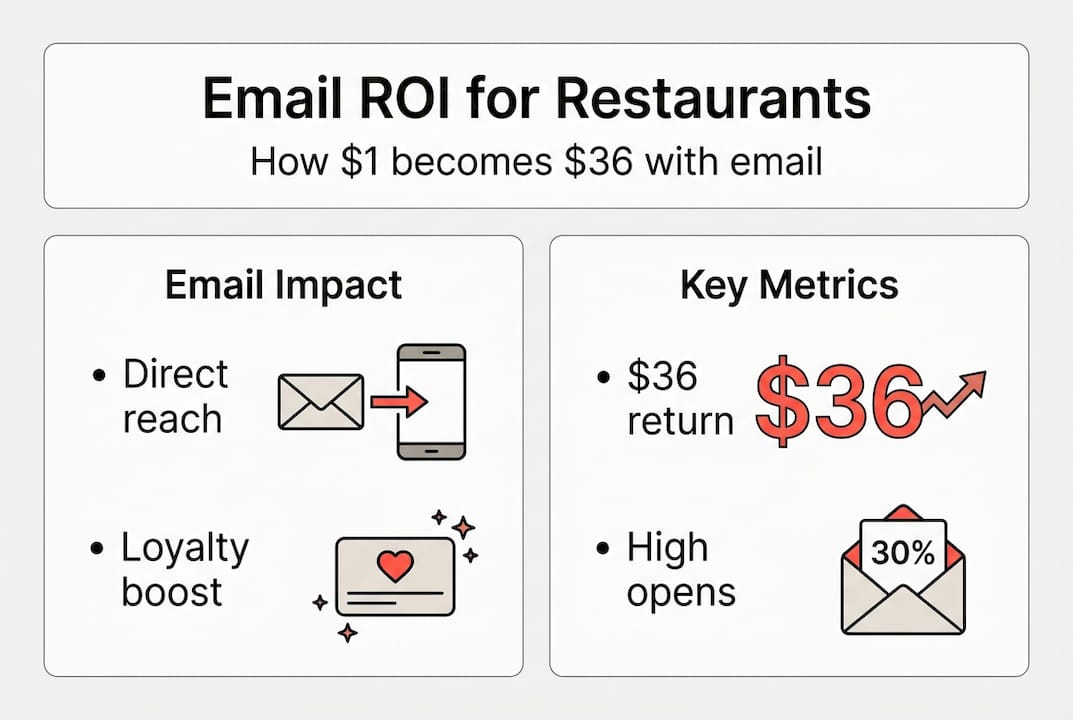
The numbers back this up. Email marketing delivers an average ROI of $36 for every $1 spent. No paid ad platform or social media campaign comes close to that return. For a restaurant with tight margins, that efficiency matters enormously.
Beyond ROI, email gives you control. You decide when your message goes out, who receives it, and what it says. You can boost repeat visits by targeting guests who have not been in for 30 days. You can fill a slow Tuesday by sending a flash deal to your most engaged subscribers. You can remind guests about your new seasonal menu before the weekend rush.
Segmentation is where email really separates itself. Instead of broadcasting the same message to everyone, you can split your list into groups:
- Regulars who visit weekly and deserve VIP treatment
- Lapsed guests who have not visited in 60 or 90 days
- Birthday guests who are primed for a special offer
- New subscribers who need a warm welcome and a reason to visit
- Event attendees who have shown interest in your private dining or special nights
Each group gets a message that feels personal and relevant. That relevance drives action.
Pro Tip: Collect emails at every customer touchpoint. Add a sign-up field to your reservation system, your online ordering platform, your guest wifi login, and your event registration pages. Every interaction is an opportunity to grow your list.
Building your restaurant email list effectively
Knowing email’s potential, the next step is building an engaged list. And the single most important word there is “engaged.” A list of 500 people who actually want to hear from you will outperform a list of 5,000 strangers every time.
This is why buying email addresses is a trap. Purchased lists destroy your sender reputation, trigger spam filters, and produce near-zero engagement. Permission-based lists outperform purchased lists by a significant margin, and they keep your brand in good standing with email providers like Gmail and Outlook.
Here is how to build your list the right way:
- Add a sign-up form to your website. Place it on your homepage, menu page, and reservation confirmation page. Keep it simple: name and email address.
- Capture emails during online orders. Most ordering platforms let you add an opt-in checkbox at checkout. Make the benefit clear: “Join our list for exclusive deals and early access to new menu items.”
- Use your wifi network. Offer free guest wifi in exchange for an email address. Guests are already on their phones, so the friction is minimal.
- Run a loyalty program. Email is a natural entry point for any points-based or rewards program. Guests expect to share their contact info when signing up.
- Promote sign-ups at events. Private dinners, wine tastings, and holiday parties are perfect moments to collect emails from engaged, high-value guests.
Incentives accelerate growth. A free appetizer on the next visit, a birthday dessert, or early access to a new menu launch all give people a concrete reason to subscribe. As part of your broader digital marketing for restaurants strategy, a growing email list is one of the most valuable assets you can build.
Pro Tip: Always tell subscribers exactly what they will receive and how often. And make unsubscribing easy. Guests who stay on your list because they want to are far more valuable than those who feel trapped.
Crafting emails that drive repeat visits
Once you have subscribers, compelling emails are the key to more visits. The best restaurant email is not the fanciest one. It is the one that makes a guest think, “I need to go back there.”

Start with the subject line. It is the single most important element of any email because it determines whether the message gets opened at all. Keep it short, specific, and benefit-driven. “Your free birthday dessert is waiting” outperforms “Monthly newsletter from our restaurant” every single time.
Well-designed restaurant emails can boost repeat visits by up to 25%. The difference between average and effective often comes down to personalization. Here is a quick comparison:
| Element | Generic email | Personalized email |
|---|---|---|
| Subject line | “Check out our new menu” | “Maria, your favorite pasta is back” |
| Opening | “Dear valued guest” | “Hi Maria, it’s been a while!” |
| Offer | “10% off your next visit” | “10% off your next linguine order” |
| Timing | Random send | Sent 30 days after last visit |
| Result | Low open rate | Higher engagement and redemption |
Personalization does not require a huge tech stack. Even using a guest’s first name and referencing their last visit creates a warmer, more effective message. Strong restaurant guest loyalty programs feed this data directly into your email platform.
The best occasions to send restaurant emails include birthdays, limited-time seasonal menus, new chef specials, holiday reservations, and slow-night flash deals. Each has a clear reason to reach out and a clear call to action.
Avoid these common mistakes:
- Sending too many emails and burning out your list
- Using vague calls to action like “Learn more” instead of “Reserve your table”
- Skipping mobile optimization when most guests read email on their phones
- Forgetting to include an image of the food or event
- Sending the same message to your entire list regardless of their history
Measuring success: Key metrics and optimization strategies
Great emails deserve measurement. Here is how to track and improve results over time.
Four metrics matter most for restaurant email campaigns. Open rates, click rates, and redemption rates are crucial to understanding how your campaigns perform. Add unsubscribe rate as your fourth indicator of list health.
| Metric | Restaurant industry benchmark |
|---|---|
| Open rate | 20 to 25 percent |
| Click-through rate | 2 to 3 percent |
| Conversion or redemption rate | 1 to 2 percent |
| Unsubscribe rate | Below 0.5 percent |
If your open rates are below 20 percent, your subject lines need work. If your click-through rate is low, your offer or call to action is not compelling enough. If your unsubscribe rate spikes, you are either sending too often or your content is missing the mark.
Here is how to set up proper tracking for measuring restaurant marketing ROI:
- Use UTM parameters on every link in your emails so you can track clicks in Google Analytics.
- Create a unique promo code for each campaign so you can measure actual redemptions at the point of sale.
- Track reservation sources by asking your booking platform to log which reservations came from email links.
- Review results within 48 hours of sending, since most email engagement happens in the first two days.
- Run A/B tests on subject lines, send times, and offers. Test one variable at a time so you know what actually moved the needle.
The best time to send restaurant emails is typically Tuesday through Thursday between 10 a.m. and 2 p.m. But your audience may behave differently. Test it. The data from your own list is always more valuable than industry averages.
Our take: Why consistency in email matters more than hype
Here is something most marketing advice gets wrong: restaurants chase the “perfect” viral email campaign when the real wins come from showing up consistently. We have seen restaurants pour weeks into one elaborate holiday email and then go silent for three months. That silence erases the goodwill the big send created.
Consistency is what builds trust. When guests hear from you regularly with genuinely useful content, whether that is a new dish, a reservation reminder, or a behind-the-scenes story from the kitchen, they start to feel connected to your restaurant. That connection is what brings them back.
Regular sending also gives you something priceless: data. Every campaign teaches you something about your audience. Over time, you build a clear picture of what your guests respond to, and that knowledge compounds.
Special campaigns and creative one-offs absolutely have their place. But they work best when they land in the context of an ongoing relationship. Think of remarketing for restaurants the same way: the strategy only pays off when there is a foundation of consistent communication underneath it. Build the foundation first.
Get expert help with restaurant email marketing
Ready to apply these strategies? Building an email program from scratch takes time, and optimizing it for real results takes even more. That is where having the right support makes all the difference.
Sorbey offers restaurant marketing services built specifically for local restaurants that want to grow without wasting budget. From list-building tools to automated campaign templates, everything is designed to help you get more guests back through the door. You can also explore free restaurant tools to calculate your email ROI, plan your campaigns, and benchmark your results against industry standards. Start with one tool, see the difference, and scale from there.
Frequently asked questions
How often should my restaurant send marketing emails?
Aim for one to two emails per month, adjusting based on your audience’s preferences and any upcoming events or promotions. Bi-monthly emails are effective for most restaurants without overwhelming guests.
What makes a restaurant email campaign successful?
Personalization, a clear and enticing offer, and regular review of your key metrics are the core drivers of success. Relevant offers increase engagement and redemption rates significantly.
Are emails better than social media for restaurant marketing?
Email gives you direct access to your audience without algorithm interference and delivers a much higher ROI. Email ROI significantly outperforms social media for most local businesses.
How can I collect more emails from dine-in or takeout guests?
Offer a clear incentive at checkout, such as a free appetizer or birthday reward, and keep the sign-up process to one or two fields. Incentivized sign-ups consistently boost list growth for local restaurants.
Recommended
Vous pourriez aussi aimer

Best Restaurant Loyalty Programs 2026: ROI Guide
Discover the best restaurant loyalty programs 2026 that boost repeat visits. Learn how Sorbey’s platform can transform your guest data strategy!

Why Mobile Marketing Matters for Business Growth
Discover why mobile marketing matters for business growth. Learn how optimizing for mobile drives traffic, conversions, and customer retention.

SF Dim Sum Restaurant Marketing Checklist for 2026
Transform your SF dim sum with our 2026 marketing checklist. Optimize your profile, showcase dishes, and attract customers fast!