
Blog
Restaurant marketing trends for explosive growth in 2026
Discover the top restaurant marketing trends for 2026, including retention strategies, AI tools, and the inverted funnel approach to boost loyalty and ROI.
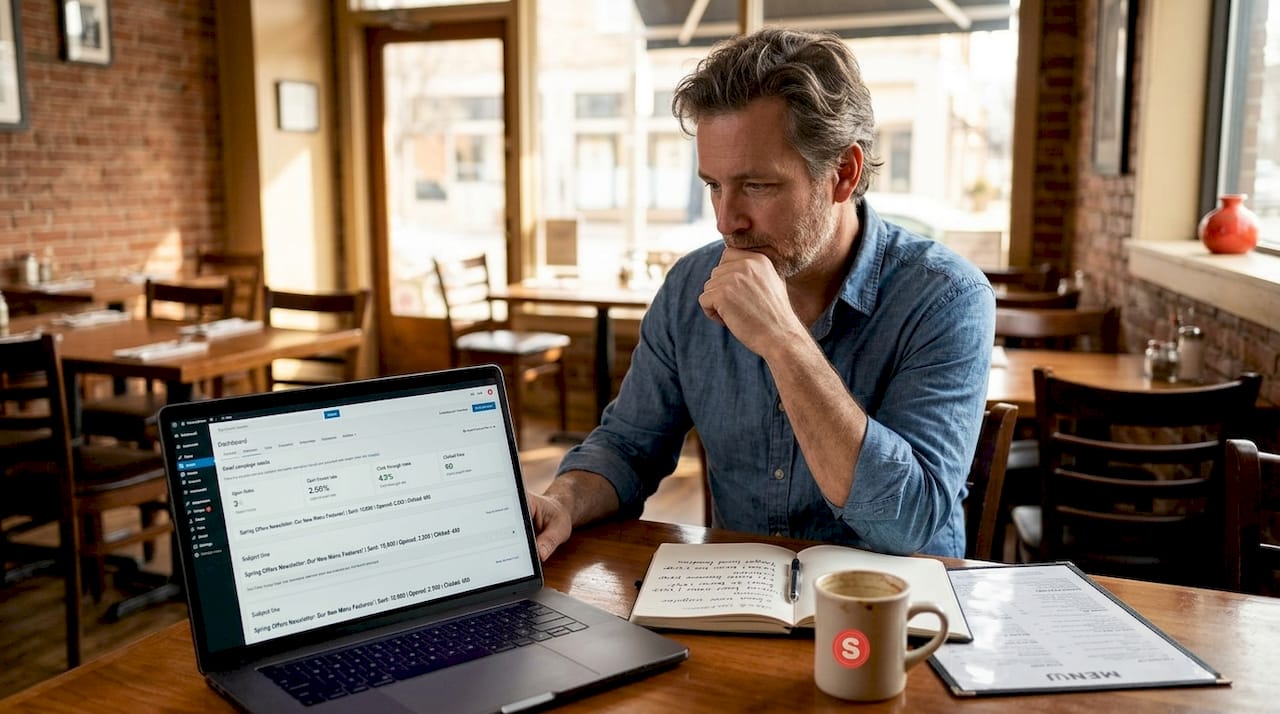
Restaurant marketing trends for explosive growth in 2026
TL;DR:
- Retention marketing now delivers 3.3 times more value than acquisition efforts.
- Personalized email and SMS campaigns generate higher ROI and customer loyalty.
- Focusing on existing guests and brand consistency is key to sustainable growth.
Most restaurant owners spend the bulk of their marketing budget chasing strangers. New ads, new platforms, new promotions aimed at people who have never walked through the door. But retention marketing outperforms acquisition by 3.3 times in value, and the restaurants winning in 2026 already know it. The playbook has shifted dramatically, and if you are still running the same campaigns you ran two years ago, you are leaving serious money on the table. This guide breaks down the four biggest marketing shifts shaping the restaurant industry right now, with practical steps you can apply this week.
Table of Contents
- Why retention marketing dominates restaurant strategies in 2026
- How AI is transforming restaurant marketing—cautiously
- Maximizing brand identity in a trend-driven world
- The inverted funnel: Turn first-timers into loyal regulars
- Perspective: Why ‘doing it all’ really means focusing smart in 2026
- Accelerate your marketing: Tools and strategies for success
- Frequently asked questions
Key Takeaways
| Point | Details |
|---|---|
| Retention marketing wins | Personalized follow-up via email and SMS now returns more value than chasing new customers. |
| AI is a helper, not a replacement | Human oversight ensures AI-driven campaigns stay accurate and reinforce your brand’s personality. |
| Brand identity matters | In a fast-changing digital world, a strong, unique brand keeps guests returning and loyal. |
| Inverted funnel effectiveness | Turning first-timers into regulars immediately is the new way to maximize marketing ROI in restaurants. |
Why retention marketing dominates restaurant strategies in 2026
The numbers are hard to argue with. Restaurant email marketing ROI sits between $36 and $44 for every dollar spent, and SMS campaigns are converting at an average rate of 45%. These are not vanity metrics. They represent real repeat visits, real revenue, and real relationships with guests who already trust you.
What makes 2026 different is the scale of adoption. 81% of operators are ramping up their marketing activity this year, and the ones seeing the best results are reaching guests weekly with personalized messages rather than blasting generic promotions once a month. Frequency matters, but only when the message feels relevant to the person receiving it.
Here is what the data tells us about channel performance:
| Channel | Average ROI | Conversion rate |
|---|---|---|
| Email marketing | $36 to $44 per $1 | 15 to 25% |
| SMS marketing | $5 to $10 per $1 | 45% |
| Paid social ads | $2 to $4 per $1 | 2 to 5% |
| Print/direct mail | $1 to $3 per $1 | 1 to 3% |
The gap between retention channels and traditional acquisition channels is not small. It is enormous. And yet most restaurants still allocate the majority of their budget to the bottom two rows of that table.
The shift to retention marketing also means rethinking what success looks like. Instead of measuring cost per new customer, you start measuring lifetime value, repeat visit rate, and average spend per loyal guest. These numbers tell a much more honest story about your marketing health.
Key retention tactics that are working right now:
- Birthday and anniversary offers sent 3 to 5 days before the occasion
- Post-visit thank-you messages within 24 hours of a guest’s first visit
- Personalized menu recommendations based on past orders
- Milestone rewards for guests who hit 5, 10, or 20 visits
- Reactivation campaigns for guests who have not visited in 60 or 90 days
Pro Tip: Segment your guest list into at least three groups: new visitors, regulars, and lapsed guests. Each group needs a completely different message. Sending a “we miss you” offer to someone who visited yesterday is just noise. Sending it to someone who has not been in 90 days could bring them back tonight.
How AI is transforming restaurant marketing—cautiously
With retention as the focus, technology, especially AI, is reshaping how restaurants execute their marketing, but not without risks. AI-driven tools can now automate content creation, generate personalized offers, and segment your guest list in seconds. What used to take a marketing manager an entire afternoon can happen automatically before you finish your morning coffee.
But here is the part most vendors will not tell you. AI needs human oversight to prevent errors in critical details like menus, hours, and pricing. An AI tool that confidently sends an email promoting a dish you stopped serving three months ago is not a time-saver. It is a trust-breaker.
The smartest operators are using restaurant AI tools as a first draft engine, not a final answer. They let the AI generate the campaign, then a human reviews it for accuracy, tone, and brand fit before anything goes out. This hybrid approach captures most of the efficiency gains while protecting the guest experience.
| Task | AI excels | Human oversight needed |
|---|---|---|
| Writing promotional copy | Fast, varied, scalable | Tone and brand voice check |
| Guest segmentation | Data-driven, consistent | Strategy and segment logic |
| Scheduling campaigns | Reliable, automated | Timing based on local events |
| Menu accuracy | Poor without live data | Always review before sending |
| Responding to reviews | Quick drafts | Empathy and nuance required |
The restaurant digital trends shaping 2026 all point toward AI as infrastructure, not strategy. The strategy still has to come from you. AI can tell you when to send a message. It cannot tell you what your restaurant stands for.
“The restaurants getting the most from AI are the ones treating it like a very fast intern, not a replacement for their marketing brain.” This framing matters because it keeps accountability where it belongs: with the operator.
Pro Tip: Set a monthly calendar reminder to audit your AI-generated campaigns. Check for outdated menu items, incorrect hours, and any language that sounds robotic or off-brand. Fifteen minutes of review can save you a week of guest complaints.
Maximizing brand identity in a trend-driven world
As you integrate powerful new tools like AI, your most enduring competitive asset is still your brand. Not your logo. Not your color palette. Your brand is the feeling guests get when they think about your restaurant, and it is either getting stronger or weaker with every message you send.
The risk in a trend-heavy year like 2026 is that you start chasing every new platform, format, and tactic, and in doing so, you stop sounding like yourself. Prioritize brand identity over chasing trends to avoid alienating the loyal guests who already love you. This is not conservative advice. It is the most aggressive growth strategy available to you.
The highest-performing restaurants this year are not the ones with the most marketing channels. They are the ones with the clearest sense of who they are and who they serve. Every piece of content, every promotion, every automated message reinforces a single coherent identity.
Five ways to reinforce your brand amid digital noise:
- Write all marketing copy in a consistent voice, whether playful, warm, or bold, and document it in a one-page brand guide
- Use branding strategies that connect your visual identity to your guest experience, not just your logo
- Before adopting any new trend, ask: does this fit who we are, or does it just look good on someone else’s feed
- Train your front-of-house team to deliver the same experience your marketing promises
- Review your branding explained fundamentals annually to make sure your message has not drifted
“The restaurants that survive trend cycles are the ones guests feel loyal to, not just familiar with. Loyalty is earned through consistency, not novelty.”
If you operate in a competitive urban market, innovative branding does not mean being louder than everyone else. It means being more specific. The more clearly you define your niche, the more powerfully you attract the exact guests who will become your most loyal regulars.
The inverted funnel: Turn first-timers into loyal regulars
With these brand and tech strategies in place, it is time to rethink how you convert one-time visitors into your restaurant’s biggest fans. Traditional marketing funnels spend heavily at the top, running ads and promotions to pull in first-time guests, then hoping those guests come back on their own. Most do not.
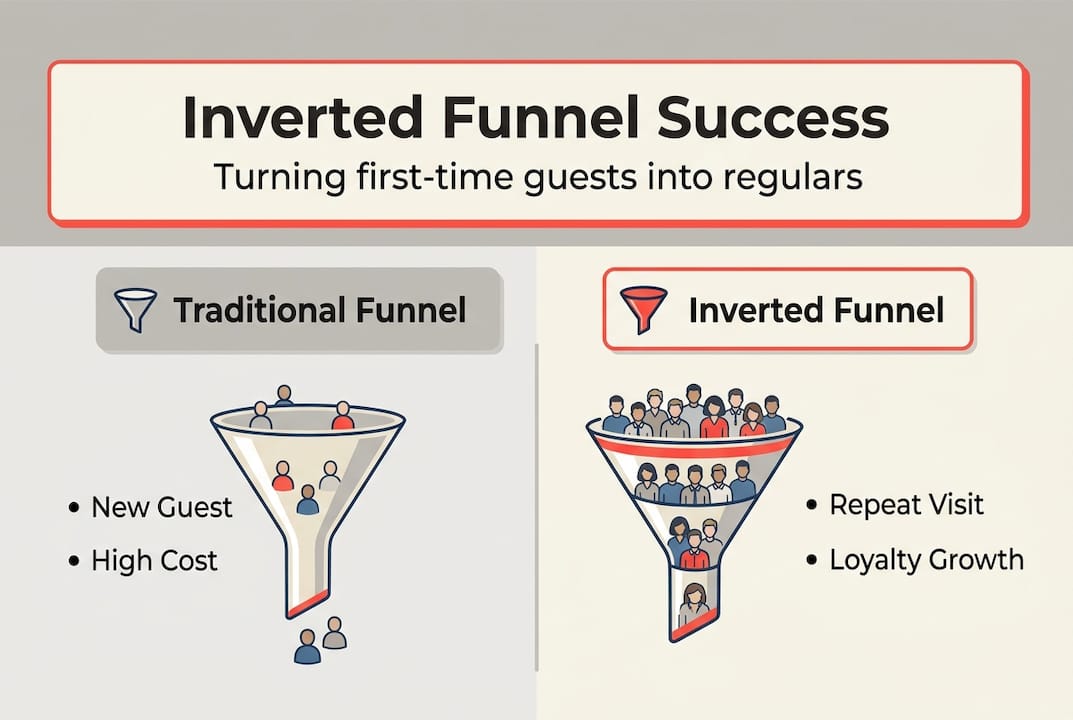
The inverted funnel flips this model. Focusing on turning first visits into second visits increases ROI and dramatically reduces wasteful acquisition spend. Instead of spending $50 to acquire a guest who visits once, you spend $5 to convert that same guest into a regular who visits 20 times.
Three-step in-house follow-up system:
- Capture contact info during the first visit. Use a simple table-side sign-up, a WiFi login, or a loyalty program enrollment. The goal is a name and either an email or phone number before they leave.
- Send a personalized follow-up within 24 hours. Thank them by name, mention something specific if possible, and include a reason to return, such as a limited-time offer or an upcoming event.
- Automate a 30-day nurture sequence. Three to four messages over the next month, each adding value, whether a recipe tip, a staff spotlight, or an exclusive offer, keeps your restaurant top of mind.
| Metric | Traditional funnel | Inverted funnel |
|---|---|---|
| Cost per new guest | $40 to $80 | $40 to $80 |
| Second-visit conversion rate | 15 to 20% | 55 to 70% |
| 12-month guest value | $120 | $380 to $500 |
| Marketing spend per loyal guest | $120 | $25 to $40 |
Use the customer lifetime value calculator to run these numbers for your specific restaurant. The results will likely change how you think about every marketing dollar you spend.
Pro Tip: Train your servers to mention your loyalty program or sign-up offer naturally during the meal, not as a script, but as a genuine recommendation. A personal invite from a server converts at three to four times the rate of a table tent alone.
Perspective: Why ‘doing it all’ really means focusing smart in 2026
Every January, the marketing industry publishes a list of things you absolutely must do this year. AI chatbots, short-form video, influencer partnerships, loyalty apps, QR menus, and on and on. The list never gets shorter. And if you try to do all of it, you will do none of it well.
What years of watching restaurants succeed and fail has made clear is this: the operators who thrive are not the ones who adopt the most trends. They are the ones who pick two or three strategies that fit their brand and their guests, then execute those strategies with real consistency and care.
Spread thin, restaurants waste budget, confuse their guests, and lose the identity that made them worth visiting in the first place. Focused investment, even in just email and SMS retention, consistently outperforms scattered efforts across ten channels.
“The best trend is making regulars feel remembered.”
That quote should be on every restaurant’s marketing plan. Before you add anything new to your 2026 strategy, deepen engagement with the guests you already have. Review your marketing wishlist and cut anything that does not directly build loyalty or brand equity. What remains is your real strategy.
Accelerate your marketing: Tools and strategies for success
Ready to put these trends into action? The strategies in this article work best when you have the right infrastructure behind them, and that is exactly what we built at Sorbey.
Our AI-powered restaurant marketing platform handles the heavy lifting, from automated email and SMS campaigns to guest segmentation and personalized follow-up sequences, so you can focus on running your restaurant. You can also use our free SMS ROI calculator to project exactly what a retention-focused SMS campaign would return for your specific volume, and our customer lifetime value tools to see how much each loyal guest is actually worth. Real numbers, real decisions, real growth.
Frequently asked questions
What is the most effective restaurant marketing channel in 2026?
Personalized retention marketing via email and SMS is producing the highest ROI, with conversion rates and customer value far surpassing traditional acquisition tactics. Email alone returns up to $44 for every dollar spent.
How should restaurants use AI without losing their brand’s personality?
Restaurants should use AI to automate repetitive marketing tasks but always review content for accuracy and consistency with their unique brand identity. AI requires human oversight to maintain brand standards and prevent errors in menu details or hours.
Are loyalty programs still important with so much focus on new technology?
Yes. Loyalty programs remain a proven driver of repeat business and work best when integrated with modern marketing tools and personalized follow-up. Retention and follow-up are the core of what makes loyalty programs actually profitable.
What’s an ‘inverted funnel’ in restaurant marketing?
The inverted funnel means prioritizing the conversion of first-time guests into loyal regulars before investing heavily in acquiring more new customers. It shifts budget from top-of-funnel ads to post-visit follow-up and relationship building.
Recommended
Vous pourriez aussi aimer
Best Restaurant Loyalty Programs 2026: ROI Guide
Discover the best restaurant loyalty programs 2026 that boost repeat visits. Learn how Sorbey’s platform can transform your guest data strategy!

Why Mobile Marketing Matters for Business Growth
Discover why mobile marketing matters for business growth. Learn how optimizing for mobile drives traffic, conversions, and customer retention.

SF Dim Sum Restaurant Marketing Checklist for 2026
Transform your SF dim sum with our 2026 marketing checklist. Optimize your profile, showcase dishes, and attract customers fast!