
Blog
Streamline your restaurant marketing workflow for results
Learn how to build a restaurant marketing workflow that saves time, reduces waste, and drives measurable ROI through automation and smart measurement.
Streamline your restaurant marketing workflow for results
TL;DR:
- Effective restaurant marketing relies on automated workflows aligned with the customer journey.
- Diversify marketing channels and focus on retention to maximize ROI and guest loyalty.
- Tracking and measuring key metrics enable continuous optimization of marketing efforts.
Running a restaurant means you’re already stretched thin. Between managing staff, sourcing ingredients, and keeping guests happy, your marketing often ends up scattered across a dozen tools with no clear system tying it together. You post on social media one day, send an email blast the next, and hope something sticks. That approach burns time and budget without delivering real returns. This guide walks you through exactly what you need, how to build it, what to avoid, and how to measure whether it’s actually working. The goal is a lean, automated marketing workflow that drives repeat visits and real revenue.
Table of Contents
- What you need for an efficient restaurant marketing workflow
- How to build a streamlined restaurant marketing workflow
- Common mistakes to avoid in your marketing process
- How to measure and optimize your marketing workflow
- What most experts miss about restaurant marketing workflows
- Ready to simplify your restaurant marketing workflow?
- Frequently asked questions
Key Takeaways
| Point | Details |
|---|---|
| Invest in automation | Use automated email and SMS workflows to save time and boost customer retention. |
| Focus on high-ROI channels | Google, email, and SMS consistently deliver the best returns for restaurants. |
| Measure and optimize | Track your marketing metrics and adjust strategies for ongoing improvement. |
| Avoid discount wars | Retain profits by prioritizing loyalty over unsustainable discounts. |
What you need for an efficient restaurant marketing workflow
Before you build anything, you need the right foundation. Think of it like opening a kitchen: you wouldn’t start cooking without the right equipment in place. The same logic applies to your marketing setup.
Start with your budget. According to industry stats, most established restaurants allocate 3-6% of revenue to marketing, while newer locations should invest closer to 7-8% of revenue to build awareness fast. Of that spend, 60-70% should go toward digital channels, and you should target a minimum 3:1 return on every dollar spent.
Your core platform stack should include:
- A POS system that captures transaction data
- A CRM or guest database to track visit frequency and spend
- A mobile-optimized website with online ordering or reservations
- A verified and complete Google Business Profile
- Email and SMS automation tools connected to your guest data
Why does mobile matter so much? Because 78% of restaurant traffic now comes from mobile devices, and 48% of discovery happens through organic search. If your Google Business Profile is incomplete or your site loads slowly on a phone, you’re losing guests before they ever walk in the door.
Staffing your workflow doesn’t require a full marketing team. In most independent restaurants, the owner or operator sets strategy, a marketing manager or designated staff member executes campaigns, and front-of-house staff like hosts collect guest data at the point of contact. Clarity on who owns each task prevents things from falling through the cracks.
Staying current on 2026 marketing trends will also help you prioritize where to invest as platforms and guest behavior continue to shift.
| Resource | Established restaurants | New locations |
|---|---|---|
| Marketing budget | 3-6% of revenue | 7-8% of revenue |
| Digital spend share | 60-70% | 60-70% |
| Minimum ROI target | 3:1 | 3:1 |
| Mobile traffic share | 78% | 78% |
Pro Tip: If you operate multiple locations or plan to grow, invest early in data integration. A unified CRM that pulls from every POS terminal saves you enormous time when you need to segment and personalize at scale.
How to build a streamlined restaurant marketing workflow
With your tools and teams in place, here’s how to create a workflow that actually runs itself and gets results.
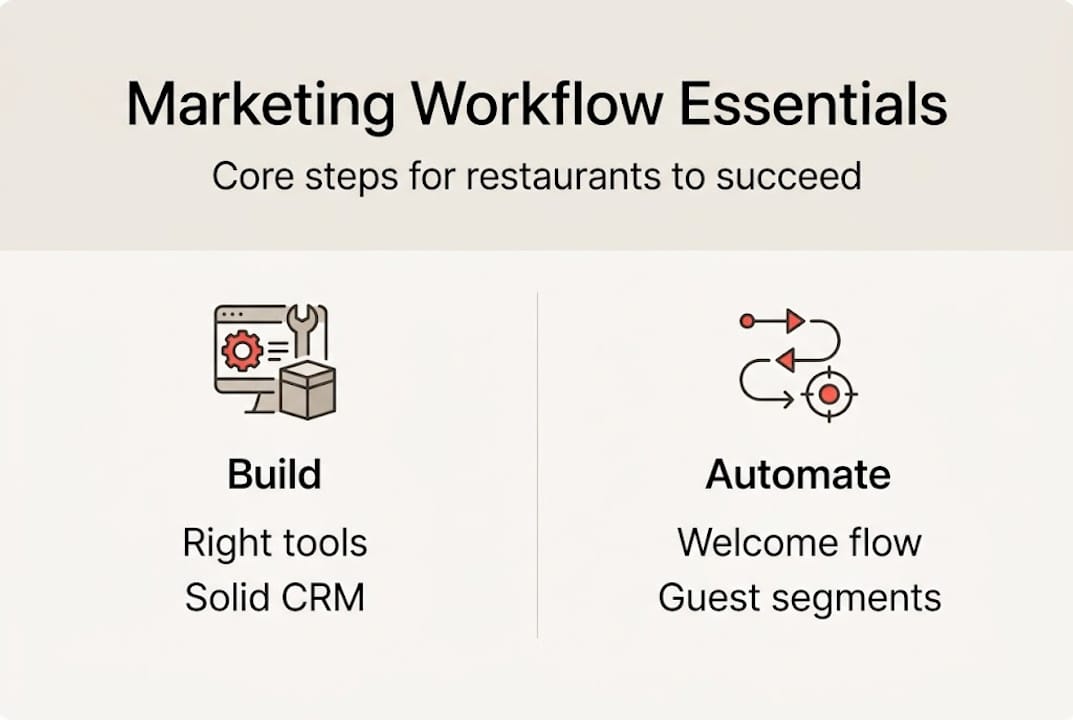
The most effective restaurant marketing workflows are built around the customer journey. Every guest moves through awareness, first visit, repeat visit, and loyalty. Your job is to place the right message at each stage automatically.
The four workflows every restaurant needs are the welcome series, birthday and anniversary campaigns, re-engagement sequences, and review or feedback requests. The email marketing ROI on these automated sequences is hard to beat: email delivers $42 for every $1 spent, while SMS returns $21 to $41 per dollar. That’s not a typo.
Here’s how to set each one up:
- Welcome workflow: Trigger immediately after a guest opts in. Send a warm message within 24 hours, then a follow-up with an offer or story about your restaurant within 7-14 days. This is your first impression, make it personal.
- Birthday and anniversary workflow: Pull guest birth month data from your CRM or reservation system. Send a personalized offer 7-14 days before the occasion so they have time to plan a visit.
- Re-engagement workflow: Flag guests who haven’t visited in 60-90 days. Send a “we miss you” message with a reason to return. Keep it genuine, not desperate.
- Review and feedback workflow: Trigger 1-2 hours after a confirmed visit. A short, friendly message asking for a Google review or quick feedback captures responses while the experience is fresh.
Using a solid restaurant CRM makes all of this manageable without a large team.
| Task | Manual approach | Automated approach |
|---|---|---|
| Welcome message | Staff sends individually | Triggered instantly on opt-in |
| Birthday offer | Calendar reminders, easy to miss | Auto-sent 7-14 days before |
| Re-engagement | Periodic bulk blasts | Triggered by inactivity window |
| Review request | Verbal ask, inconsistent | Sent 1-2 hours post-visit |
Pro Tip: Segment your audience from day one. Regulars, first-timers, and high-value guests should receive different messages. A guest who visits three times a week doesn’t need a “come back” offer. Personalized triggers feel human and convert far better than generic blasts. Use your SMS ROI calculator to model expected returns before you launch.
Common mistakes to avoid in your marketing process
Executing your workflow is crucial, but knowing what NOT to do can save you costly headaches.
The most common mistake is channel dependency. Restaurants that rely entirely on Instagram or email alone are one algorithm change away from losing their audience. Diversify across email, SMS, search, and review platforms.
The second biggest mistake is ignoring your Google Business Profile. GBP outperforms websites for local discovery, especially on mobile. An incomplete profile with outdated hours or missing photos costs you reservations every single week. Pair that with a consistent review management practice and you’ll outrank competitors who are spending more but showing up less.
Other critical mistakes to avoid:
- Skipping A/B testing on subject lines, offers, and send times. Small changes in a subject line can shift open rates by 20% or more.
- Running marketing without connecting your POS and CRM. Without that integration, you can’t attribute revenue to specific campaigns, so you’re flying blind.
- Chasing micro-influencer partnerships without tracking results. Done right, micro-influencers deliver 500-800% ROI. Done wrong, they’re expensive content with no measurable return.
- Sending the same message to every guest regardless of their history with your restaurant.
“The biggest trap in restaurant marketing is the discount spiral. You train guests to wait for deals instead of valuing the experience. Once you start, it’s hard to stop.”
Pro Tip: Avoid value wars. Deep discounts feel like quick wins but erode your margins over time and attract guests who won’t return at full price. Instead, invest in experience-based offers like exclusive tastings, chef’s table events, or loyalty perks that build emotional connection without gutting your bottom line.
How to measure and optimize your marketing workflow
Avoiding mistakes is only half the battle. Here’s how to know your workflow is working and how to make it work even harder.
Start by defining your core KPIs before you launch anything. The metrics that matter most for restaurant marketing are retention rate, customer acquisition cost, lifetime value, email open and click-through rates, and churn rate. Without these benchmarks, you can’t tell what’s improving.
Benchmark targets to aim for:
| Metric | Benchmark target |
|---|---|
| Email open rate | 35-45% |
| SMS open rate | 90-98% |
| Email ROI | $42 per $1 spent |
| Customer acquisition cost | $15-30 |
| Retention vs. acquisition value | 3.3x higher |
| ROI target | 3-5x spend |
Setting up basic tracking in four steps:
- Build a simple dashboard in a spreadsheet or your CRM tracking weekly opens, clicks, redemptions, and revenue tied to each campaign.
- Tag every campaign with a unique UTM code so you can see exactly which email or SMS drove a reservation or online order.
- Add a simple “How did you hear about us?” question to your reservation flow or post-visit survey. Response attribution is underrated and often more accurate than digital tracking alone.
- Review your dashboard every two weeks and adjust the lowest-performing workflow first. Don’t try to fix everything at once.
The SMS campaign performance data you collect over the first 60 days will tell you more about your guests than any industry report. Use it.
Email open rates of 35-45% are achievable for restaurants with a clean list and personalized subject lines. SMS open rates routinely hit 90-98%, making it the highest-attention channel you have access to right now.
What most experts miss about restaurant marketing workflows
Most marketing guides focus on tactics: which platform, which tool, which campaign type. That’s useful, but it misses the bigger picture.
The restaurants that consistently outperform their competitors aren’t running the most creative campaigns. They’re measuring more precisely and investing in retention over acquisition. A retained guest is worth 3.3 times more than a new one, yet most operators spend the majority of their budget chasing new customers while loyal guests quietly drift away.
Personalized, consistent communication beats generalized discounts every time. A birthday message with a genuine offer lands differently than a mass coupon blast. Guests notice when communication feels like it was written for them versus sent to a list of thousands.
Precise measurement is the real competitive edge. When you know your CAC, your LTV, and your target 3-5x ROI on every campaign, you stop guessing and start making decisions that compound over time. Most of your competitors are not doing this. That gap is your opportunity.
Chasing 2026 growth trends matters less than building a system that reliably brings guests back. Shiny new platforms come and go. A guest who visits twice a month for three years is worth more than any viral moment.
Ready to simplify your restaurant marketing workflow?
Putting all of this into practice takes the right tools working together. Sorbey brings email, SMS, review management, and guest data into one platform built specifically for restaurants and local businesses like yours.
Instead of stitching together five different apps and hoping the data syncs, you get a single workflow that captures guests, nurtures them automatically, and shows you exactly what’s driving revenue. Explore restaurant marketing services designed for operators who want results without the complexity, or visit Sorbey to see how the platform fits your restaurant’s specific needs. No hard pitch, just a smarter way to run your marketing.
Frequently asked questions
What is the most effective restaurant marketing workflow for boosting customer retention?
A workflow using automated welcome, birthday, and re-engagement emails or SMS combined with timely review requests delivers the highest retention and ROI. Retention delivers 3.3x the value of new customer acquisition.
How much should restaurants budget for marketing in 2026?
Most established restaurants should budget 3-6% of revenue for marketing, while new locations should invest 7-8% to build momentum quickly.
Does Google Business Profile matter more than the restaurant’s website?
For local discovery, a complete Google Business Profile often outperforms a website, especially for mobile and map-based searches where 78% of restaurant traffic originates.
What is a good ROI for restaurant email and SMS marketing?
Aim for at least $15 return per $1 spent, with top-performing operators reaching $42 per dollar on email and $21-41 on SMS campaigns.
Recommended
- Services - Sorbey | Restaurant Marketing Solutions | Sorbey
- Optimize your restaurant website for more customers in 2026 | Sorbey Blog | Sorbey
- Digital marketing checklist for restaurants: boost visibility | Sorbey Blog | Sorbey
- Digital Marketing Workflow for Maximum ROI Success - Ads Daddy. Advertise on All Plattforms.
Vous pourriez aussi aimer
Best Restaurant Loyalty Programs 2026: ROI Guide
Discover the best restaurant loyalty programs 2026 that boost repeat visits. Learn how Sorbey’s platform can transform your guest data strategy!

Why Mobile Marketing Matters for Business Growth
Discover why mobile marketing matters for business growth. Learn how optimizing for mobile drives traffic, conversions, and customer retention.
SF Dim Sum Restaurant Marketing Checklist for 2026
Transform your SF dim sum with our 2026 marketing checklist. Optimize your profile, showcase dishes, and attract customers fast!