
Blog
Restaurant Reputation Management: A Complete How-To Guide
Learn how to monitor, respond to, and grow your restaurant's online reviews with this step-by-step reputation management guide built for restaurant owners and managers.

Restaurant Reputation Management: A Complete How-To Guide
TL;DR:
- Managing online reviews is crucial for restaurant reputation and guest trust.
- Consistent listing information and timely responses improve visibility and score.
- Ethical review gathering through QR codes and emails supports genuine positive feedback.
Nine out of ten diners check reviews before booking, which means your restaurant’s online reputation is doing sales work around the clock, whether you’re watching it or not. A single unanswered one-star review can quietly cost you dozens of covers a week, while a steady stream of glowing responses builds the kind of trust that fills tables on a Tuesday night. This guide walks you through the exact steps to monitor, manage, and grow your reputation across every major platform, from Google Business Profile to delivery apps, so you can turn guest feedback into a genuine competitive advantage.
Table of Contents
- What you need before you start
- Daily review monitoring and response process
- Optimizing your business listings for credibility and reach
- How to encourage and leverage positive reviews (ethically)
- Dealing with negative, fake, and complex reviews
- Taking control: What most restaurants miss about reputation management
- Level up: Smart tools to scale your reputation management
- Frequently asked questions
Key Takeaways
| Point | Details |
|---|---|
| Monitor daily | Check and reply to all reviews across major platforms every day to protect and boost your reputation. |
| Optimize listings | Keep your business profiles complete and accurate to drive more new customer discovery and trust. |
| Encourage reviews ethically | Ask for customer feedback using QR codes and staff prompts but avoid any incentives to stay within guidelines. |
| Fix root causes | Use negative and positive feedback to upgrade your food quality, service speed, or guest experience directly. |
What you need before you start
Having established why reputation matters, let’s make sure you’re set up for success with the right foundation. Jumping into review management without the right setup is like opening your doors without a trained front-of-house team. You’ll be reactive, inconsistent, and constantly playing catch-up.
Start by claiming and logging into your accounts on every platform where guests leave feedback. That means Google Business Profile, Yelp, TripAdvisor, Facebook, and any delivery apps you use, like DoorDash, Uber Eats, or Grubhub. Write down the login credentials and store them somewhere your team can access securely. If you haven’t already, use this review checklist to make sure nothing slips through the cracks.
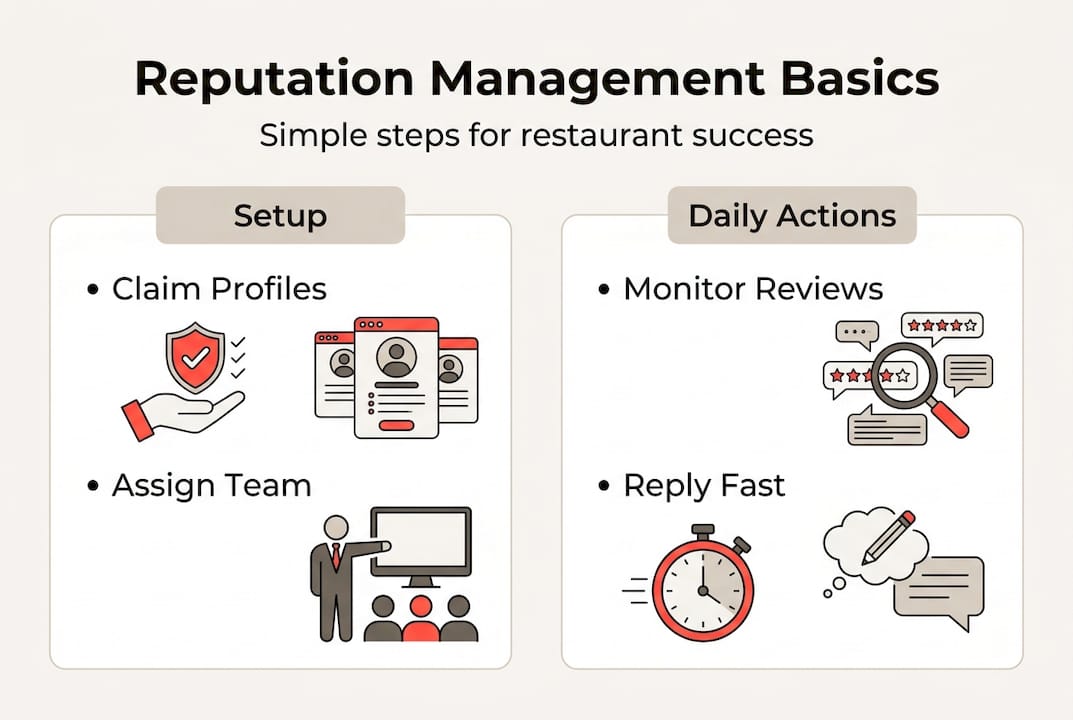
Next, assign clear ownership. Decide which team members are responsible for monitoring and replying to reviews. In most restaurants, this falls on the opening manager or a designated shift lead. Clarity here prevents the “I thought you handled it” problem that lets negative reviews sit unanswered for days.
The core mechanics of reputation management include monitoring reviews across all platforms and using tools like dashboards, email alerts, and reputation management software to stay on top of incoming feedback. Here’s a quick comparison of your main options:
| Tool type | Best for | Cost range |
|---|---|---|
| Native platform alerts | Single-location basics | Free |
| Google Alerts | Mention tracking | Free |
| Reputation software (e.g., Sorbey) | Multi-platform automation | Paid |
| Social listening tools | Brand sentiment tracking | Paid |
Before your first response goes live, make sure these basics are locked in:
- NAP consistency: Your business name, address, and phone number must match exactly on every platform
- Photos: Upload high-quality images of your food, interior, and team
- Menu: Keep it current, including prices and seasonal items
- Hours: Update for holidays, special events, and any temporary changes
- Restaurant reservation best practices: Align your booking info across listings
Pro Tip: Assign review response as a daily five-minute ritual for the opening manager, right after the morning walkthrough. Consistency beats intensity every time.
Daily review monitoring and response process
Now that your tools and team are set, let’s break down day-to-day review management into a repeatable habit. The goal is a system so simple that any manager can run it without thinking too hard before their first coffee.
Here are five daily steps that keep your reputation clean and responsive:
- Log in to each platform (or open your dashboard if you use software) and check for new reviews since yesterday
- Scan email alerts from Google, Yelp, and TripAdvisor for any notifications you may have missed overnight
- Write personalized replies to every new review, positive or negative, using the guest’s name when possible and referencing specific details they mentioned
- Flag or report any reviews that appear fake, abusive, or violate platform guidelines before they gain traction
- Note recurring themes in a shared log so you can spot trends and bring them to your weekly team meeting
You can run this manually or lean on automation. Both approaches have real trade-offs:
| Approach | Pros | Cons |
|---|---|---|
| Manual monitoring | Full control, personal tone | Time-intensive, easy to miss alerts |
| Automated software | Fast, consistent, scalable | Requires setup, subscription cost |
For response tone, follow the review reply steps that match the situation. A glowing five-star review deserves genuine warmth and a specific thank-you. A one-star complaint needs acknowledgment, an apology without excuses, and an invitation to return or contact you directly. Keep every reply under 150 words. Long responses read as defensive.
The 24-hour response window is the professional standard for public replies, and it signals to future readers that you take guest experience seriously. Pair your Google Business Profile monitoring with Yelp and TripAdvisor alerts so nothing falls through the cracks. You can also learn from hospitality best practices used by top-rated restaurants to refine your tone and phrasing.
Pro Tip: Build a template library with 8 to 10 pre-written response starters for common scenarios, like slow service complaints or compliments on a specific dish. Staff can personalize them quickly without starting from a blank page every time.
Optimizing your business listings for credibility and reach
A solid daily response process works best when your digital storefronts are credible and up-to-date. Think of your listings as your restaurant’s front door online. If the hours are wrong or the photos are three years old, you’re losing guests before they ever pick up the phone.

The five platforms that matter most for restaurant discovery are Google Business Profile, Yelp, TripAdvisor, Facebook, and your delivery app profiles. Each one serves a slightly different audience, so treat them as individual assets, not afterthoughts. Use this listing optimization guide to prioritize your effort by platform impact.
GBP drives 60% of new customer discovery for local restaurants, making it the single most important listing to get right. That means photos, posts, Q&A responses, and accurate hours updated at least once a month. Check out the 2026 GMB optimization guide for the latest best practices.
Here’s what to keep current across all platforms:
- Photos: Add new food shots monthly and remove anything blurry or outdated
- Menu: Reflect current pricing, seasonal specials, and any items you’ve retired
- Holiday hours: Update at least two weeks before any closure or change
- Specials and events: Post these as updates or offers where the platform allows
- NAP consistency: Name, address, and phone must be identical everywhere, including punctuation
Inconsistency across listings confuses both guests and search engines. A mismatched phone number on Yelp versus Google can quietly tank your local search ranking and send potential diners to a competitor. Treat every listing like a live menu: it needs regular attention to stay accurate and appetizing.
How to encourage and leverage positive reviews (ethically)
With your listings mastered, you can now proactively build a positive reputation, legally and effectively. The key word is ethically. Platform algorithms are sophisticated, and guests can smell a fake review from a mile away.
Here’s a four-step flow for generating authentic reviews:
- Train your staff to mention reviews naturally at the end of a great meal, something like, “We’d love to hear what you thought of your experience tonight”
- Place QR code cards on tables and at the register that link directly to your Google or Yelp review page
- Set up post-visit emails for guests who book through your reservation system, with a simple, low-pressure ask for honest feedback
- Rotate your prompts seasonally so returning guests don’t see the same message every visit
Platform-specific rules matter here. Know them before you ask:
- Google: Asking for reviews is fine; incentivizing them is not
- Yelp: Never ask customers to review you directly; let organic reviews come to you
- TripAdvisor: You can share a review link but must not request a specific star rating
- Delivery apps: Respond to ratings in-app but avoid pressuring drivers or customers
“Yelp strictly prohibits any form of incentive for reviews, including discounts, free items, or cash rewards.”
The ethical review generation approach using QR codes and post-visit emails keeps you compliant while building volume steadily. Beyond generating reviews, use the feedback itself. If five guests in one week mention slow dessert service, that’s an operational signal, not just a PR problem. Check the review generation steps to build this into your weekly operations review. You can also borrow smart ideas from reservation follow-up tips to make your post-visit outreach feel warm rather than automated.
Dealing with negative, fake, and complex reviews
Even with the best systems, tough review scenarios can trip up even seasoned managers. Here’s how to stay resilient when things get messy.
Not every bad review is a fair one. Some are fake, some are from competitors, and some come from guests with expectations no restaurant could realistically meet. Multi-location chains face fragmentation, delivery-related complaints, and a higher volume of fake or abusive reviews that need active management. Knowing how to triage these situations protects your rating and your team’s morale.
For suspicious reviews, follow this three-step process:
- Screen for history: Check if the reviewer has other reviews or a complete profile. A brand-new account with one review is a red flag
- Check the language: Vague, generic complaints with no specific details often signal a fake post
- Report if suspicious: Use the platform’s flagging tool and document your report in case you need to escalate
Delivery-related reviews are a special case. If a guest complains about cold food or a missing item on DoorDash, that may have nothing to do with your kitchen. Respond publicly with empathy, clarify what you control, and direct them to the delivery platform for order issues.
“Service sentiment is most affected negatively after a Michelin star, often due to higher guest expectations rather than any actual drop in quality.”
This insight from Michelin review trends is a useful reminder that context shapes perception. If your restaurant earns an award or gets press coverage, expect a short-term spike in critical reviews from guests with elevated expectations. Plan your response strategy in advance so your team isn’t caught off guard.
Taking control: What most restaurants miss about reputation management
Here’s the uncomfortable truth: most reputation management guides stop at digital responses. They treat reviews like a PR problem to be managed, not a business signal to be acted on. That’s a costly mistake.
The restaurants with the strongest reputations aren’t the ones with the fastest reply times. They’re the ones that use review data to change how they operate. One operational fix, like cutting server greeting time from four minutes to ninety seconds, can shift your average rating more than fifty polished replies ever will. Guests notice the experience, not the response.
The best managers we’ve seen use their full reputation management approach to run a weekly “complaint audit,” pulling the three most common criticisms from that week’s reviews and assigning each one an owner on the team. No blame, just accountability.
Pro Tip: Share positive review highlights with your staff at the start of each shift. It reinforces what’s working and motivates your team in a way that no training manual can replicate.
Reputation management is ultimately an operations discipline disguised as a marketing task. The restaurants that treat it that way consistently outperform those that hand it off to a social media intern and hope for the best.
Level up: Smart tools to scale your reputation management
For those ready to scale their efforts, here’s how Sorbey can help you win the reputation game with less effort.
Managing reviews manually across five or more platforms is exhausting, and it becomes nearly impossible as you grow. Sorbey’s AI-powered marketing platform automates multi-site monitoring, flags urgent reviews instantly, and helps your team respond faster without sacrificing the personal touch that guests appreciate.
With Sorbey’s restaurant marketing services, you get a single dashboard that pulls in reviews from Google, Yelp, TripAdvisor, and delivery apps so nothing slips through. You can set up automated alerts, track sentiment trends over time, and even schedule listing updates across all your profiles at once. It’s built specifically for local restaurants that want to compete like a big brand without the big-brand overhead. Request a demo today and see how much time your team gets back.
Frequently asked questions
How often should I check and respond to restaurant reviews?
Aim to review and reply to all new feedback at least once daily. The 24-hour response standard signals professionalism to future diners reading your replies.
What should I do about fake or abusive reviews?
Flag and report them immediately using the platform’s built-in tools. Check for vague language or no visit history as the clearest signs a review is not legitimate.
What’s the best way to get more positive reviews without breaking platform rules?
Use QR codes and post-visit emails to invite honest feedback, and never offer incentives. Ethical review generation with no strings attached keeps you compliant on every platform.
Why is NAP consistency important for my restaurant listings?
Matching your name, address, and phone number across all platforms builds guest trust and helps search engines surface your restaurant accurately. NAP inconsistencies can quietly suppress your local search ranking over time.
Recommended
Vous pourriez aussi aimer

Best Restaurant Loyalty Programs 2026: ROI Guide
Discover the best restaurant loyalty programs 2026 that boost repeat visits. Learn how Sorbey’s platform can transform your guest data strategy!

Why Mobile Marketing Matters for Business Growth
Discover why mobile marketing matters for business growth. Learn how optimizing for mobile drives traffic, conversions, and customer retention.

SF Dim Sum Restaurant Marketing Checklist for 2026
Transform your SF dim sum with our 2026 marketing checklist. Optimize your profile, showcase dishes, and attract customers fast!