
Blog
The Role of Analytics in Restaurants: 2026 Guide
Discover the crucial role of analytics in restaurants. Learn how data-driven insights can enhance profitability and streamline operations in 2026.
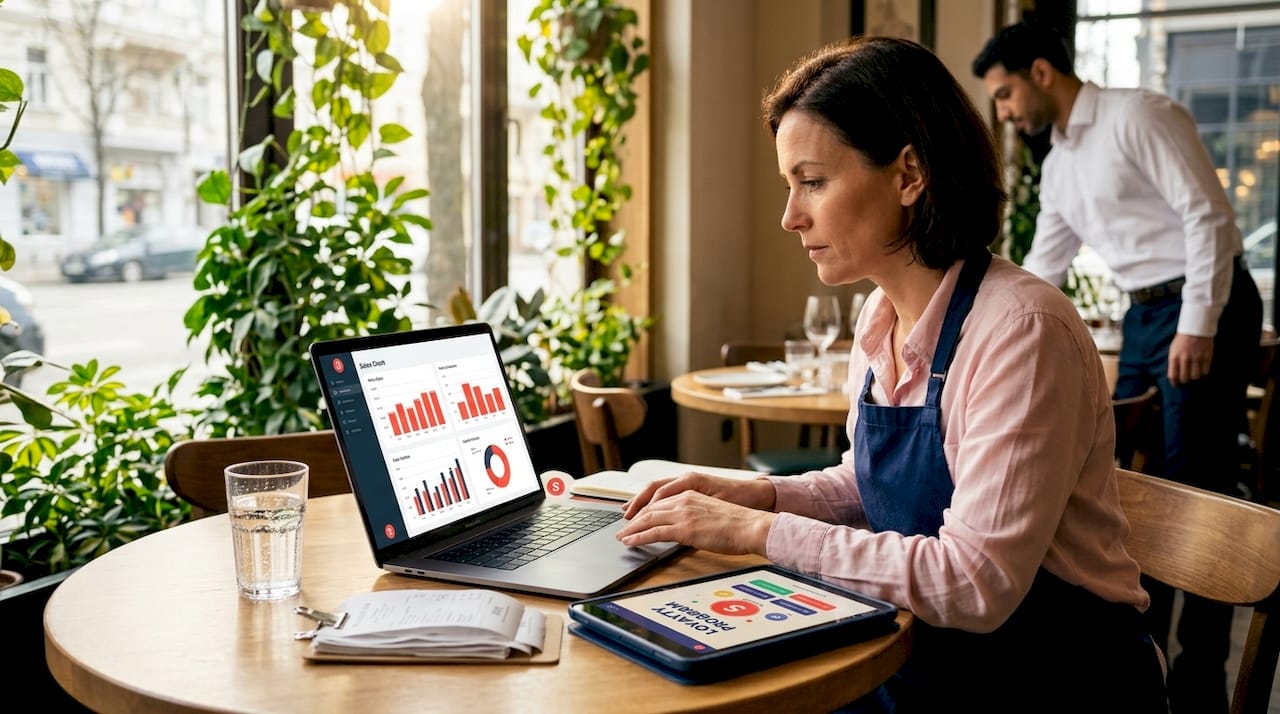
The Role of Analytics in Restaurants: 2026 Guide
TL;DR:
- Analytics has shifted from a luxury to a vital survival tool for restaurant operators seeking higher profitability amidst declining margins. It enables data-driven decisions in operations, customer segmentation, menu engineering, and targeted promotions, significantly enhancing efficiency and revenue. Most restaurants underuse analytics because they treat it as mere reporting rather than a practical decision-making instrument, but simple adoption of key metrics can lead to substantial improvements.
Most restaurant owners rely on gut instinct far longer than they should. The role of analytics in restaurants has shifted from a nice-to-have for corporate chains to a survival tool for independent operators. With 71% of restaurant operators reporting lower profitability in 2026 despite raising prices, the operators who are holding margins together share one thing in common: they are letting data lead decisions their instincts used to make alone.
Table of Contents
- Key takeaways
- The role of analytics in restaurants: what it actually means
- How analytics improves operational efficiency and profitability
- Using customer analytics to improve loyalty and retention
- Connecting fragmented data with AI and automation
- Key performance metrics every restaurant should track
- My honest take on analytics and why most restaurants underuse it
- Put your data to work with Sorbey
- FAQ
Key takeaways
| Point | Details |
|---|---|
| Analytics types matter | Know the difference between descriptive, diagnostic, predictive, and prescriptive analytics to act on data rather than just read it. |
| Operations are the biggest win | Real-time labor, inventory, and menu data directly cut costs and recover lost margin faster than any pricing change. |
| Customers need segmentation | RFM modeling and predictive churn scoring help you spend marketing dollars on guests who are most likely to come back. |
| KPIs require daily attention | 78% of successful restaurateurs check their metrics every day. Sporadic reviews miss the signals that matter. |
| AI assists, not replaces | Integrated AI tools reduce manual work and help new managers make faster decisions without years of experience. |
The role of analytics in restaurants: what it actually means
Most people hear “analytics” and picture spreadsheets or complex software that requires an IT team. The reality is much more practical. Restaurant analytics integrates data from your POS system, online ordering platform, reservations, loyalty program, reviews, and inventory into a set of decision frameworks. These frameworks fall into four types, and understanding them changes how you use the information you already have.
Descriptive analytics answers the question “what happened?” It covers your standard sales reports, customer visit trends, and weekly revenue summaries. Most restaurants already do this without calling it analytics.
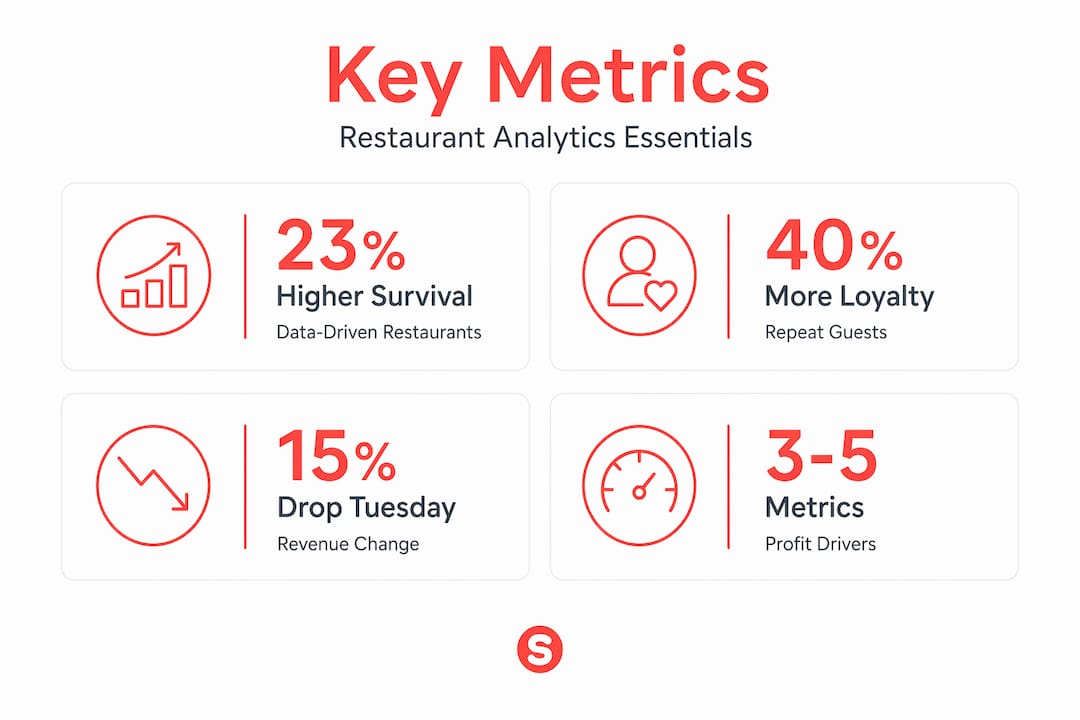
Diagnostic analytics goes one level deeper and asks “why did it happen?” If Tuesday dinner revenue dropped 15%, diagnostic tools help you trace it back to a menu item removal, a staffing shortage, or a cluster of negative reviews that week.
Predictive analytics uses historical patterns to forecast what is likely to happen next. This means projecting weekend demand three days out, estimating how many covers you will do on a rainy Thursday, or flagging a customer who has not returned in 45 days as a churn risk.
Prescriptive analytics goes furthest and recommends specific actions. It might tell you to schedule two fewer line cooks on Monday nights, drop the price on a slow-moving appetizer, or send a discount to a specific customer segment before they go elsewhere.
- POS transaction data: volume, timing, item mix, modifiers
- Reservation and waitlist data: no-show rates, party size trends, peak demand windows
- Inventory data: usage rates, waste percentages, ordering patterns
- Loyalty and CRM data: visit frequency, average spend, recency
- Review and sentiment data: complaint categories, keyword trends, satisfaction scores
Pro Tip: Start with descriptive and diagnostic analytics before chasing predictive tools. Most restaurants have far more insight locked in their existing POS data than they have ever extracted.
How analytics improves operational efficiency and profitability
This is where the return on investment becomes concrete. A multi-unit chain processing 40 million daily transactions found that real-time analytics allowed them to measure profitability hour by hour, per location. That granularity is not just a luxury for large chains. A single location can apply the same logic at a smaller scale and find margin it did not know it was losing.
Here are the four operational areas where analytics in food service delivers the clearest results:
-
Labor scheduling. When your analytics platform connects POS sales data to your scheduling software, you stop guessing how many staff you need on a Tuesday night. Hourly sales patterns show you exactly when traffic builds and drops, so you schedule to actual demand rather than habit. Labor cost ratios become a managed number rather than a surprise on your P&L.
-
Inventory and waste reduction. Predictive ordering models calculate what you will need based on forecasted covers, weather, and historical consumption. Operators who use this approach reduce over-ordering and food waste without running short on prep. For high-cost proteins especially, the savings stack up fast.
-
Menu engineering. Analytics for menu optimization means ranking every item by two variables: how much it contributes to your margin and how often guests order it. Items with high margin and high popularity are your stars. Items with low margin and low popularity are the ones quietly draining your kitchen time and food cost. Removing or redesigning those items is one of the fastest ways to improve profitability. The menu optimization guide from Sorbey breaks down exactly how to run this analysis.
-
Targeted promotions and dynamic pricing. Rather than running a blanket 20% off promotion to drive traffic, data-driven decisions in restaurants allow you to target slow days specifically, reach the right customer segments, and measure whether the promotion actually increased net revenue or just discounted loyal customers who would have come anyway.
The breakfast hours case study from the 40-million-transaction chain is worth noting. Rather than assuming demand for breakfast based on manager intuition, the team analyzed transactional data and found clear evidence that demand existed at hours they were not staffed. Extending those hours became a revenue decision backed by data, not a guess.
Using customer analytics to improve loyalty and retention
Guest acquisition costs several times more than retaining the guests you already have. That math makes customer analytics one of the highest-value investments in your analytics stack. The foundation is understanding who your customers are at a behavioral level, not just a demographic one.
The most practical customer segmentation framework is RFM: Recency (when did they last visit?), Frequency (how often do they come?), and Monetary value (how much do they spend?). Scoring your guest database by these three variables tells you which customers are your core loyalists, which are at risk of churning, and which are occasional visitors you could convert to regulars with the right offer.
Predictive customer models take this further. Customer churn modeling forecasts visit likelihood, order preferences, and lifetime value for each guest, creating a 360-degree profile that your marketing can act on directly. A customer who visited every two weeks for three months and then went silent for six weeks is sending a clear signal. A triggered offer at the four-week mark costs almost nothing and can pull them back before the relationship is gone.
- Identify your top 20% of guests by spend and protect that relationship with exclusive recognition
- Flag guests who have not visited in 30 to 45 days for a re-engagement campaign
- Tailor loyalty rewards to behavior. A frequent lunch guest should get a different offer than a weekend dinner customer
Pro Tip: Customer insights for restaurant success depend on data quality. Spend time cleaning your loyalty and POS data before you build segments. Garbage in, garbage out applies here as much as anywhere.
40% of consumers actively manage their spending through deals and comparisons. That means your analytics needs to capture value perception signals, not just sales volume. Guests who visit frequently but always order the lowest-margin items are telling you something about pricing sensitivity that should shape your retention strategy.
Connecting fragmented data with AI and automation
Here is the honest challenge most independent restaurants face: your data lives in five different systems that do not talk to each other. Your POS is separate from your inventory tool, your reservations platform does not connect to your loyalty program, and your staffing app has no idea what your sales forecast looks like. That fragmentation is the primary challenge in restaurant data, not a lack of data.
| Fragmented system approach | Unified analytics platform |
|---|---|
| Manual exports and spreadsheet consolidation | Automatic data sync across all systems |
| Delayed decisions based on yesterday’s reports | Real-time dashboards for same-day action |
| Inconsistent KPI definitions across managers | Single source of truth for all metrics |
| No anomaly detection until problems surface | AI alerts flag margin leakage as it happens |
AI tools are now filling the integration gap. Anomaly detection surfaces unusual patterns automatically. A sudden drop in average check size at a specific location triggers an alert before it shows up in your weekly report. Voice inventory tools let kitchen staff update stock counts by speaking rather than entering data manually. Photo validation tools can check plate presentation or portion sizes against standards.
One of the most underappreciated AI applications is mentoring for new managers. When a manager opens a location for the first time, an AI-driven analytics system can walk them through what their numbers mean, compare their performance to benchmarks, and suggest specific actions. That compresses years of learning into weeks.
Pro Tip: Before investing in a new analytics platform, audit what integrations it offers for the systems you already use. A tool that requires manual imports defeats the purpose.
Key performance metrics every restaurant should track
Data-driven restaurants have a 23% higher survival rate. The difference usually comes down to which numbers managers actually check and how often. The following table covers the metrics that directly tie to profitability and operational health.
| Metric | Why it matters | Review frequency |
|---|---|---|
| Food cost percentage | Measures ingredient spend as a share of revenue | Daily |
| Labor cost ratio | Tracks staff expense vs. sales | Daily |
| Average order value | Indicates upsell performance and menu mix | Weekly |
| Repeat customer rate | Measures loyalty and retention effectiveness | Weekly |
| Customer lifetime value (CLV) | Projects long-term revenue per guest | Monthly |
| Net Promoter Score (NPS) | Tracks overall guest satisfaction | Monthly |
Beyond the table above, pre-loss intelligence systems now monitor EBITDA-critical KPIs in real time and alert managers to margin leakage as it happens during service. Early deployments recovered up to 11% additional revenue just from catching issues that previously went unnoticed until the end-of-week review.
The goal is not to track everything. It is to track the right things frequently enough to act. A metric you review monthly cannot help you fix a problem that surfaced on Wednesday night.
My honest take on analytics and why most restaurants underuse it
I have worked with enough restaurant operators to see a clear pattern. The ones who struggle with analytics are not struggling because the data is too complex. They are struggling because nobody simplified it for them at the start.
The biggest mistake I see is treating analytics as a reporting tool rather than a decision tool. Analytics value is realized when it influences what your team does on the floor today, not what you reflect on at your next monthly review. A dashboard nobody checks is just expensive wallpaper.
What actually works is picking three to five metrics that directly connect to your biggest profit challenge right now, making them visible every morning, and building a habit of acting on them before noon. That discipline is more valuable than any AI platform you could subscribe to.
I also want to push back on the idea that analytics is for chains with data science teams. The tools available in 2026 are genuinely accessible for a single-location operator. The issue is not access. It is adoption. Moving from static reports to self-service interactive dashboards is what turns a skeptical manager into someone who cannot imagine running a shift without checking their numbers first.
Analytics will not replace your experienced kitchen team or your front-of-house instincts. What it will do is make those instincts more accurate, more confident, and more consistently right.
— Barthelemy
Put your data to work with Sorbey
Understanding your numbers is step one. Turning them into revenue is where most restaurant operators get stuck. Sorbey’s restaurant marketing solutions are built specifically to help local restaurants convert analytics insights into campaigns that actually fill seats and build repeat business. Whether you need help segmenting your customer base, running targeted promotions, or measuring the ROI of every marketing dollar you spend, Sorbey connects the analytics dots with execution.
Start with the numbers you already have. Use the free marketing ROI calculator to see what your current campaigns are actually returning, and the customer lifetime value calculator to understand which guests are worth the most to your business. Both tools take under five minutes and give you a clearer financial picture than most operators have ever seen.
FAQ
What is the role of analytics in restaurants?
Analytics helps restaurant operators collect and interpret data from sales, inventory, staffing, and customer behavior to make faster, more accurate decisions. It improves profitability, reduces waste, and personalizes the guest experience.
How does data improve restaurant profitability?
Data identifies where margin is leaking, such as over-staffing slow shifts, over-ordering perishables, or running promotions that discount loyal customers unnecessarily. Fixing those gaps directly improves your bottom line.
What metrics should restaurant managers track daily?
Food cost percentage and labor cost ratio are the two highest-priority daily metrics. Average order value and repeat customer rate should be reviewed weekly to catch trends before they become problems.
Can small restaurants benefit from analytics?
Yes. Single-location restaurants can start with POS data alone and find significant insight into staffing patterns, best-selling items, and customer visit trends without any advanced software investment.
How does analytics support restaurant marketing?
Analytics segments customers by behavior, identifies who is at risk of churning, and measures which promotions drive real incremental revenue versus simply discounting existing demand. That makes every marketing dollar go further.
Recommended
Vous pourriez aussi aimer

Best Restaurant Loyalty Programs 2026: ROI Guide
Discover the best restaurant loyalty programs 2026 that boost repeat visits. Learn how Sorbey’s platform can transform your guest data strategy!

Why Mobile Marketing Matters for Business Growth
Discover why mobile marketing matters for business growth. Learn how optimizing for mobile drives traffic, conversions, and customer retention.

SF Dim Sum Restaurant Marketing Checklist for 2026
Transform your SF dim sum with our 2026 marketing checklist. Optimize your profile, showcase dishes, and attract customers fast!