
Blog
What Is Remarketing? A Guide for Marketers in 2026
Discover what is remarketing and how it can boost your conversions. Learn key strategies for effective digital advertising in 2026!

What Is Remarketing? A Guide for Marketers in 2026
TL;DR:
- Remarketing is a digital advertising strategy that targets previous visitors to recover lost opportunities and increase conversions. It relies on audience segmentation, first-party data, and strategic bid adjustments to maximize ROI. Effective remarketing requires ongoing testing, privacy compliance, and treating it as a dynamic funnel within a funnel.
Remarketing is a digital advertising strategy that targets users who previously visited your website or app with tailored ads designed to bring them back and complete a conversion. Only 2-3% of visitors convert on their first visit, which means the other 97% leave without taking action. Remarketing exists to recover that lost opportunity. Platforms like Google Ads and Meta make it possible to follow those visitors across the web, serving ads that reflect what they already looked at. For marketing professionals and small business owners, this is one of the highest-return tactics in paid media.
What is remarketing and how does it work?
Remarketing works by placing a small piece of code, called a tracking pixel or tag, on your website. When a visitor lands on a page, that pixel fires and drops a cookie in their browser, adding them to an audience list. From that point forward, ad platforms like Google Ads can serve that person ads across Search, Display, YouTube, and Demand Gen campaigns. The mechanics are straightforward, but the strategy behind them is where most marketers either win or waste budget.

The most important strategic layer is audience segmentation. Not every visitor deserves the same ad. A person who read a blog post is far less ready to buy than someone who added a product to their cart and left. Segmenting by intent and matching your message to where each group sits in the funnel is what separates a profitable remarketing program from a generic one. Cart abandoners get urgency-driven offers. Blog readers get educational content that moves them closer to a decision.
Remarketing vs retargeting: what is the actual difference?
These two terms are used interchangeably in most conversations, but there is a meaningful distinction. Remarketing is broader and includes email re-engagement, CRM-based outreach, and owned-data strategies. Retargeting refers specifically to pixel-based ad delivery to anonymous users across third-party platforms. In practice, integrating both gives you full funnel coverage. You reach known contacts through CRM lists and anonymous visitors through pixel audiences.
Google Ads Observation mode and bid adjustments
One underused tactic in Google Ads is running remarketing audiences in Observation mode rather than Targeting mode. Observation mode lets you monitor how your remarketing audiences perform within a broader campaign without restricting who sees your ads. Once you see that cart abandoners convert at three times the rate of general visitors, you apply a bid adjustment to that segment. This approach scales efficiently because you are not limiting reach while still prioritizing your highest-intent users.
Pro Tip: Set up exclusion lists from day one. Excluding recent purchasers and current customers from your acquisition campaigns prevents wasted spend and stops you from annoying people who already converted.
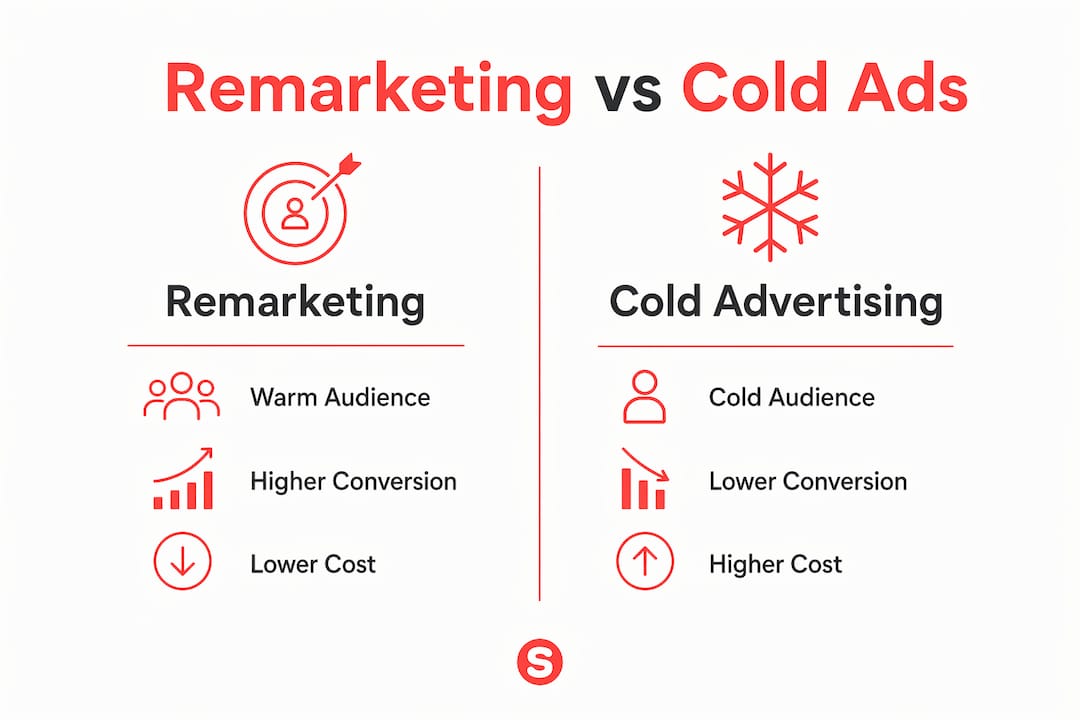
What are the benefits of remarketing vs. cold advertising?
The core advantage of remarketing is that you are advertising to people who already know you. Warm audiences convert at significantly higher rates than cold prospects because the trust barrier is lower and the intent signal is already present. You are not introducing your brand. You are reminding someone of a decision they were already considering.
The table below compares remarketing against standard prospecting campaigns across the metrics that matter most to small business owners and marketing teams.
| Metric | Remarketing campaigns | Prospecting campaigns |
|---|---|---|
| Audience familiarity | High (prior site visitors) | Low (no prior brand exposure) |
| Conversion likelihood | Higher due to existing intent | Lower, requires trust-building |
| Cost per acquisition | Generally lower | Generally higher |
| Ad relevance | Personalized to prior behavior | Broad, category-level targeting |
| Brand recall | Reinforces existing awareness | Builds awareness from scratch |
Beyond conversion rates, remarketing keeps your brand visible while prospects are still in their decision window. A user who visited your restaurant’s online menu on Monday and sees your ad on Wednesday is far more likely to book a table than someone encountering your brand for the first time. This is what makes digital remarketing particularly powerful for local businesses where the consideration cycle is short and repeat visits drive revenue.
The efficiency gains also compound across your entire paid media program. When remarketing campaigns carry a lower cost per acquisition, you free up budget to invest in prospecting, which feeds new visitors into the top of your funnel. The two campaign types work together rather than competing.
Best practices for remarketing campaigns in 2026
Executing remarketing well requires more than installing a pixel and launching a campaign. These are the steps that separate high-performing programs from ones that burn budget without results.
-
Build your audiences with first-party data. First-party data and CRM lists are now the foundation of sustainable remarketing as third-party cookies continue to phase out. Use Google Tag Manager to fire your tracking tags reliably and upload customer lists directly from your CRM into Google Ads and Meta.
-
Segment by behavior and intent. Create separate audience lists for blog readers, product page viewers, cart abandoners, and checkout drop-offs. Each group gets a different message with different urgency and creative. A one-size-fits-all remarketing ad is almost always a wasted impression.
-
Apply frequency caps immediately. Display ads perform best at 3 to 5 impressions per user per day, or 15 to 20 per week. Video ads should be capped at 2 to 3 impressions per week. Exceeding these thresholds creates ad fatigue and negative brand associations that undo the goodwill you built during the first visit.
-
Build exclusion lists before you launch. Audience exclusions prevent converted users, existing customers, and irrelevant segments from seeing ads that do not apply to them. This is one of the highest-leverage optimizations available and most campaigns skip it entirely.
-
Use dynamic creatives where possible. Dynamic remarketing ads automatically pull in the specific product or page a user viewed, making the ad feel personally relevant rather than generic. Google Ads and Meta both support dynamic ad formats that connect directly to your product catalog or menu.
-
Stay compliant with privacy regulations. Consent management platforms like OneTrust or Cookiebot are not optional in 2026. Your remarketing audiences are only as reliable as your consent signals. Collecting data without proper consent exposes you to legal risk and corrupts your audience quality.
Pro Tip: Audit your audience hierarchy every 30 days. Users who qualify for multiple lists should receive the most relevant ad for their current funnel stage, not whichever list happens to win the auction by default.
How to measure remarketing effectiveness beyond platform metrics
Platform-reported conversions are not the full story. Google Ads and Meta both attribute conversions to their own campaigns, which means if a user saw a remarketing ad and also received a retargeting email, both platforms may claim the conversion. This overlap inflates reported performance and leads to poor budget decisions.
The most reliable way to measure true remarketing lift is incrementality testing. Geographic holdout tests split your market into regions where remarketing runs normally and regions where it is paused. The conversion difference between those groups represents the actual incremental lift your campaigns are generating. This method removes the attribution noise that platform dashboards introduce.
The table below outlines the key measurement approaches and what each one actually tells you.
| Measurement method | What it measures | Limitation |
|---|---|---|
| Platform-reported conversions | Attributed conversions per campaign | Prone to overlap and double-counting |
| Geographic holdout testing | True incremental lift from remarketing | Requires sufficient geographic volume |
| Audience overlap analysis | Budget waste from overlapping lists | Does not measure conversion impact |
| CRM match-back analysis | Revenue from known contacts re-engaged | Limited to identified users only |
Beyond testing, optimize your audience hierarchies regularly. Users sitting in multiple lists should receive the most relevant creative for their current intent level. A person who viewed your menu three days ago and then visited your catering inquiry page has moved up the funnel. Their ad should reflect that progression, not repeat the same message they saw on day one. Pairing restaurant website optimization with your remarketing setup also improves the quality of the audiences you build in the first place.
Key takeaways
Remarketing converts warm audiences at higher rates than cold prospecting because it targets users who already demonstrated intent by visiting your site or app.
| Point | Details |
|---|---|
| First-visit conversion gap | Only 2-3% of visitors convert on the first visit, making remarketing critical for the other 97%. |
| Segment by intent | Separate cart abandoners, product viewers, and blog readers into distinct lists with tailored messaging. |
| Frequency caps protect ROI | Cap display ads at 3-5 impressions per day to prevent ad fatigue and brand damage. |
| First-party data is the foundation | CRM lists and server-side tracking sustain remarketing performance as third-party cookies disappear. |
| Measure with holdout tests | Geographic holdout testing reveals true conversion lift beyond what platform dashboards report. |
Why I think most businesses are running remarketing backwards
After years of watching remarketing campaigns across industries, the most common mistake I see is treating remarketing as a single audience. Businesses install a pixel, create one “all website visitors” list, and run the same ad to everyone who ever landed on any page. That approach produces mediocre results and leads people to conclude that remarketing does not work for their business. The problem is not remarketing. The problem is the absence of segmentation.
The businesses that get real results from remarketing treat it as a funnel within a funnel. They know that a cart abandoner from yesterday is worth ten times more ad spend than someone who bounced off the homepage two weeks ago. They build exclusion lists with the same care they build audience lists. And they test incrementally rather than trusting platform dashboards to tell them what is working.
The other shift I have seen matter enormously is the move toward first-party data strategies. Businesses that built their remarketing programs on third-party pixels alone are now scrambling as browser privacy restrictions tighten. The ones who invested in CRM integration, email capture, and server-side tracking two years ago are running circles around them. If you have not started building your owned audience data, that is the single most important thing you can do for your remarketing program right now.
Remarketing is not a set-it-and-forget-it tactic. It rewards the marketers who treat it as a living system, one that gets refined based on real performance data rather than platform-reported metrics that flatter the platform.
— Barthelemy
How Sorbey helps local businesses run smarter remarketing
Sorbey is built for local businesses like restaurants that need marketing to work without a full agency team behind them. The platform handles audience building, campaign setup, and performance tracking so you can focus on running your business rather than managing ad accounts. For restaurant owners who want to recover lost visitors and turn one-time guests into regulars, Sorbey’s remarketing capabilities connect your customer data directly to your ad campaigns. You get the segmentation, frequency controls, and CRM integration that enterprise marketers use, built for the scale and budget of a local business. See what Sorbey’s restaurant marketing solutions can do for your next campaign.
FAQ
What is remarketing in simple terms?
Remarketing is a paid advertising strategy that shows ads to people who previously visited your website or app. The goal is to bring them back and encourage them to complete a purchase or booking they did not finish the first time.
How is remarketing different from retargeting?
Remarketing is a broader term that includes email and CRM-based re-engagement, while retargeting refers specifically to pixel-based ads served across third-party platforms. Both tactics target previous visitors, but through different channels and data sources.
What platforms support remarketing campaigns?
Google Ads supports remarketing across Search, Display, YouTube, and Demand Gen. Meta runs remarketing through Facebook and Instagram using the Meta Pixel. Both platforms allow audience uploads from CRM data for first-party targeting.
How often should remarketing ads be shown to the same person?
Display remarketing ads should be capped at 3 to 5 impressions per user per day. Video ads perform best at 2 to 3 impressions per week. Exceeding these limits causes ad fatigue and can create negative associations with your brand.
Does remarketing still work with privacy changes in 2026?
Yes, but it requires a shift to first-party data. Businesses that rely on CRM lists, email capture, and server-side tracking maintain strong remarketing performance even as third-party cookies phase out across major browsers.
Recommended
Vous pourriez aussi aimer

How to Improve Digital Presence for Your Restaurant
Discover how to improve digital presence for your restaurant, boost visibility, and fill seats with practical strategies that drive revenue.

Why Digital Marketing Matters for Your Business Growth
Discover why digital marketing matters for your business growth. Unlock precise customer engagement and measurable results today!

How to Build a Restaurant Email List in 2026
Discover how to build a restaurant email list in 2026 with proven methods. Capture customer data and boost your revenue today!