
Blog
Why use paid ads locally? Boost restaurant sales
Discover why use paid ads locally to maximize your restaurant's sales. Target the right audience and see real revenue growth!
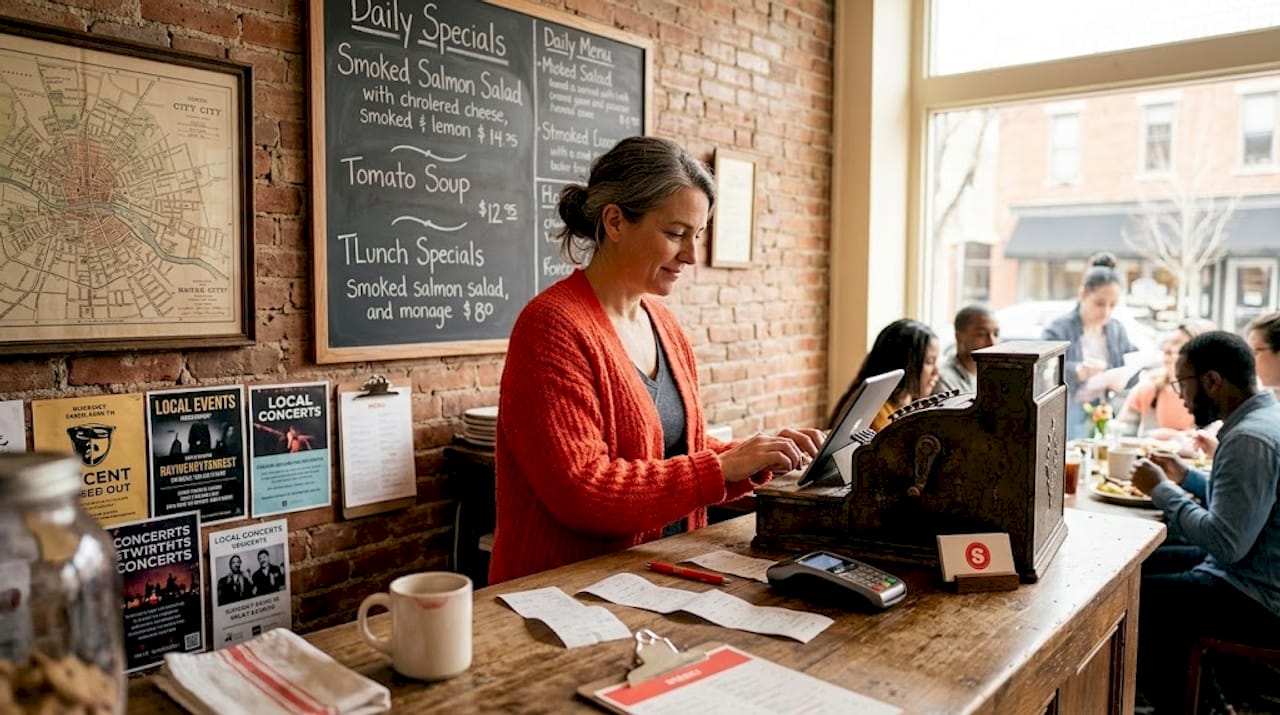
Why use paid ads locally? Boost restaurant sales
TL;DR:
- Precise location targeting maximizes ad spend by focusing on nearby potential customers.
- Ongoing optimization and conversion tracking improve ROI and lead to more restaurant visits.
- Layering geotargeting and regularly adjusting campaigns are key to successful local advertising.
Running paid ads without precise location targeting is one of the most expensive mistakes a restaurant can make. You might be paying to show your dinner special to someone 40 miles away who will never drive to your neighborhood, let alone sit at your tables. Google Ads location targeting lets you set a radius around your location so your budget reaches only the diners who can actually visit. This article breaks down how local paid ads work, why they outperform broad campaigns, the mistakes that drain budgets, and how to connect every ad dollar to real restaurant revenue.
Table of Contents
- How local paid ads work for restaurants
- The real benefits: Control, efficiency, and better ROI
- Common pitfalls and how to avoid wasted budget
- Turn local ad clicks into actual sales
- Why most restaurants misuse local paid ads (and how to be smarter)
- Get more from your local paid ads with expert restaurant tools
- Frequently asked questions
Key Takeaways
| Point | Details |
|---|---|
| Target real diners | Local paid ads ensure your budget only goes to people who can actually visit your restaurant. |
| Increase ROI efficiently | Fine-tuned local targeting reduces wasted spend and delivers measurable sales impact. |
| Track what matters | Connect every ad click to an order or reservation for true marketing effectiveness. |
| Avoid common mistakes | Avoid one-size-fits-all radius targeting and focus on layered, granular geotargeting. |
How local paid ads work for restaurants
Now that we’ve seen why unfocused ads lead to waste, let’s clarify how local paid ads give you control and results.
Local paid advertising means running ads on platforms like Google, Facebook, and Instagram while restricting who sees them based on geography. That geography can be a city, a ZIP code, or a specific radius around your restaurant. The result is simple: your ad budget goes toward people who are physically close enough to walk in, call for a reservation, or order online.
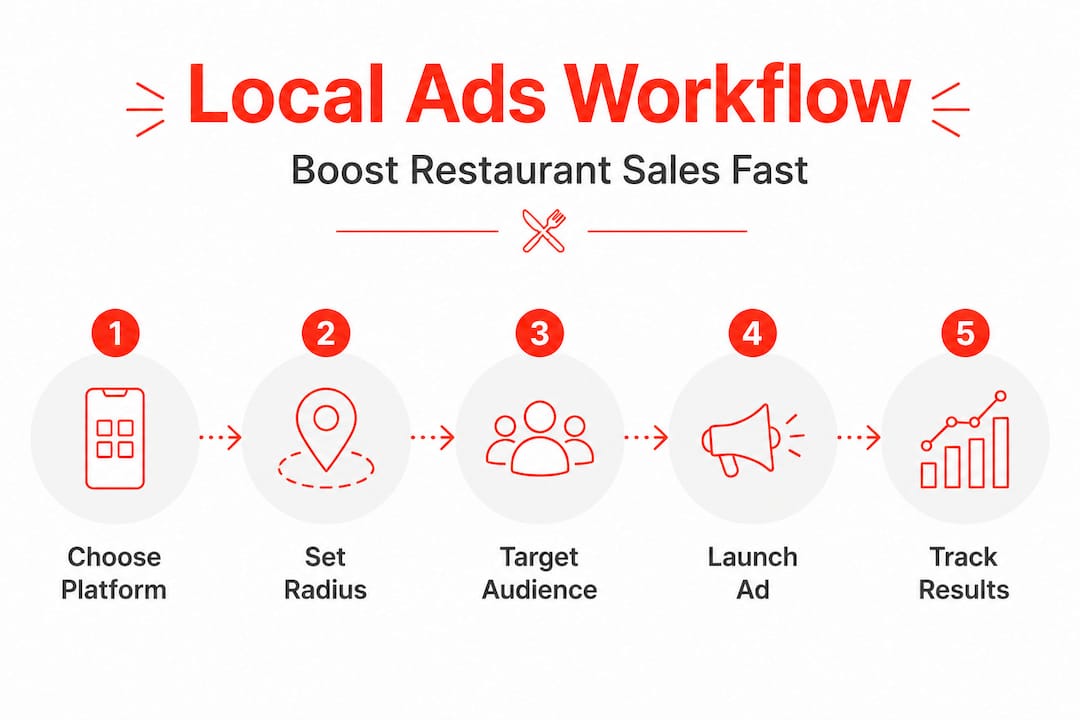
Most restaurants serve a trade area of less than five miles. Think about it. A great taco spot in Logan Square, Chicago, is not competing for diners in Evanston. Yet without location controls, a basic Google or Facebook campaign will happily burn money showing your ad to users across the entire metro area. The local advertising guide for restaurants shows exactly how this geographic waste adds up over a month.
Here is a quick look at how the major platforms handle local targeting:
| Platform | Targeting options | Best use for restaurants |
|---|---|---|
| Google Ads | Radius, city, ZIP code, region | Search intent (“pizza near me”) |
| Facebook Ads | Radius, city, age, interests | Brand awareness and event promos |
| Instagram Ads | Same as Facebook (shared platform) | Visual food content and offers |
| Google Maps Ads | Near-location, proximity | Walk-in traffic and directions |
Each platform has its strengths. Google captures people actively searching for food right now. Facebook and Instagram let you build awareness among local residents before they even get hungry. Google Maps ads are perfect for capturing someone already in your neighborhood looking for a place to eat.
Key benefits of platform-level location targeting include:
- Radius targeting: Show ads only within 1, 3, or 5 miles of your address
- ZIP code targeting: Focus spend on specific neighborhoods where your best customers live
- City-level targeting: Useful if you operate in one city with multiple ZIP codes
- Location exclusions: Remove areas that don’t convert, saving real money
That last point matters more than most owners realize. Google advises refining targeting when you do not serve every region or city, because even small amounts of wasted impressions compound into significant budget losses over weeks and months.
The real benefits: Control, efficiency, and better ROI
Understanding the mechanics is step one. But what do restaurants actually get by using local paid ads? Let’s compare and draw out the concrete benefits.
The biggest win is control. Broad national or metro-wide campaigns give you volume, but local campaigns give you precision. Precision is what puts people in seats.
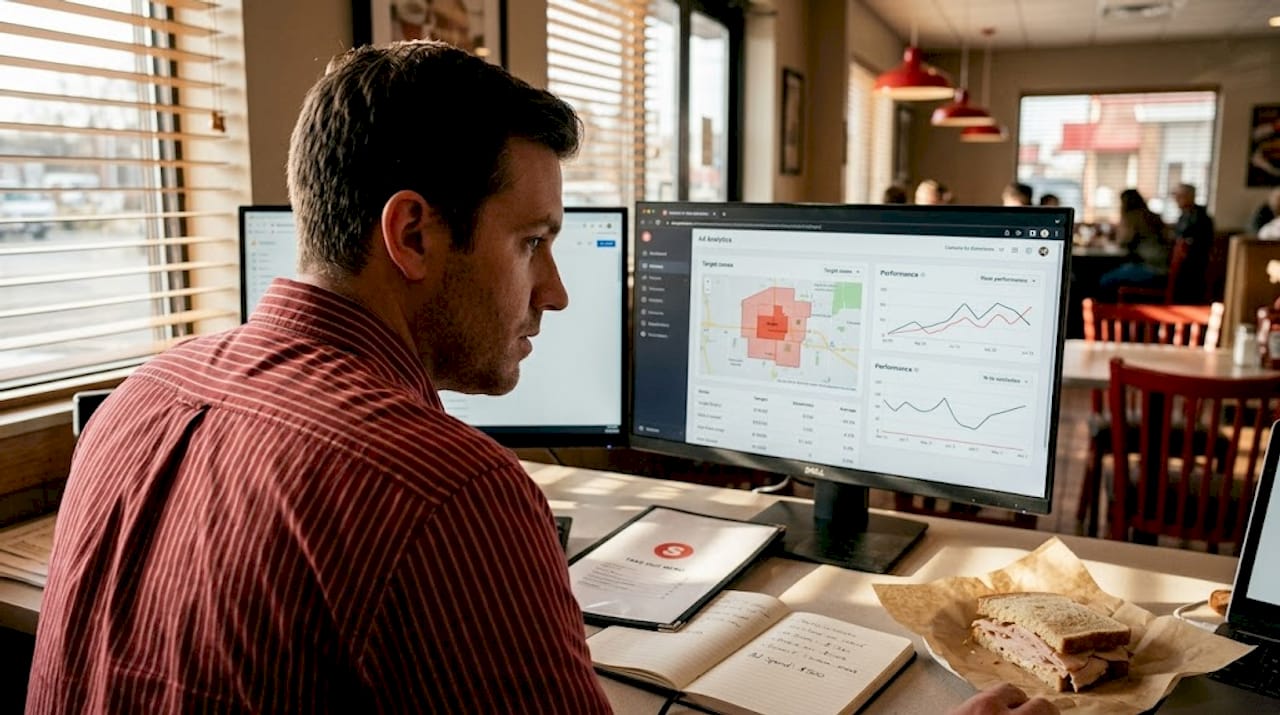
Here is a direct comparison to make this concrete:
| Factor | Broad targeting | Local targeting |
|---|---|---|
| Audience reach | Metro-wide or national | Within miles of your restaurant |
| Wasted impressions | High (most won’t visit) | Low (most can visit) |
| Cost per relevant click | Higher | Lower |
| Ability to promote lunch specials | Limited | Yes, by time of day and location |
| Seasonal/event adjustment | Slow and complex | Fast and precise |
When you control who sees your ad, you also control your cost per result. A campaign targeting 100,000 people within three miles of your restaurant is far more efficient than one targeting 1 million people across a full metro area. The spend is the same but the conversion rate climbs because the audience is real and reachable.
Here are four ways local targeting directly boosts ROI:
- Saves money: Eliminating irrelevant impressions means every dollar works harder toward a real potential customer.
- Increases walk-ins: Location-based ads can trigger when users are near your restaurant, making impulse visits more likely.
- Enables time-specific promos: Running a happy hour ad only between 3 and 6 p.m. to people within two miles is something broad campaigns simply cannot do efficiently.
- Adapts to seasonal changes: You can tighten or expand your radius depending on the season, event calendar, or local foot traffic patterns.
Pro Tip: Don’t assume every neighborhood within your radius converts equally. According to PPC Hero’s analysis, radius targeting is easy to set up but can be a common mistake because customers don’t convert uniformly at equal distances. Layering geo-bids and adjusting bids by sub-area or ZIP code can materially improve your efficiency. A ZIP code two miles away might generate three times more reservations than one that is the same distance in a different direction. Dig into your data and bid accordingly.
Strategic local advertising also gives you the flexibility to respond fast. If a competitor closes, a new event venue opens nearby, or a neighborhood is suddenly trending, you can shift your targeting in minutes rather than rebuilding an entire campaign.
Common pitfalls and how to avoid wasted budget
Maximizing ROI isn’t just about the tools; it also means avoiding common errors. Here’s how to keep your spend working hard.
Even restaurant owners who understand local targeting make costly mistakes. The good news is that these mistakes are predictable and fixable. Knowing them upfront saves you from learning the hard way with real money.
The most common pitfalls are:
- Setting and forgetting: Launching a campaign and never reviewing it is a fast path to wasted budget. Platforms will keep spending even if your ads stop performing. Check performance at least weekly.
- Using too broad a radius: A 20-mile radius might feel like “casting a wide net,” but for most sit-down restaurants, it means paying for impressions from people who will never make a 20-minute drive for dinner.
- Not layering geotargeting: Running one flat radius without bid adjustments by area is like charging the same price for the best seat in the house and the table next to the bathroom. Your best-performing neighborhoods deserve higher bids.
- Failing to track orders and calls: This is the biggest one. If you only track clicks and page views, you have no idea whether your ads are actually bringing in revenue.
Pro Tip: Link your ad platforms to your POS system or reservation tool from day one. Tools like OpenTable, Resy, or even a simple Google Analytics goal tied to your online order confirmation page can show you exactly which campaigns generate actual revenue.
“If you can’t track orders or reservations, you’re just paying for clicks, not customers.”
That quote is blunt but accurate. As restaurant Google Ads case studies repeatedly show, local paid search can look like a win based on click metrics while quietly failing on profit. A campaign with a 5% click-through rate but zero tracked reservations is not a success. It is an expense.
The restaurant PPC and local visibility breakdown explains how to set up proper conversion tracking so you measure what actually matters: people showing up and spending money.
Another underused tactic is negative geotargeting. If your restaurant is in downtown Seattle and you know that users from the Eastside suburbs rarely convert, you can explicitly exclude those ZIP codes. This sharpens your targeting without reducing your radius, keeping costs focused where results live.
Finally, watch out for platform defaults. Google and Meta both default to settings that maximize reach, not precision. Always override those defaults. Set your location targeting to “people in or regularly in your targeted location” rather than “people who show interest in your targeted location,” which can pull in users from across the country who browsed something related to your city once.
Turn local ad clicks into actual sales
To truly benefit from local ads, it’s essential to tie each click to real sales. Here’s how to do it properly.
Clicks are a vanity metric unless they lead to revenue. The mindset shift from “how many people clicked” to “how many people ordered or reserved” is what separates restaurants that profit from local ads and those that simply spend on them.
Here is a three-step process to connect your local ads directly to revenue:
-
Define your conversions clearly. Before launching any campaign, decide what a conversion is. For most restaurants, it is one of three things: an online order placed, a reservation completed, or a phone call made. Set up tracking for each of these events separately so you know which ad, which platform, and which audience is producing real results.
-
Link your tracking tools. Connect Google Ads to Google Analytics. Install the Meta Pixel on your website. If you use an online ordering platform like Toast or ChowNow, check whether they support UTM parameter tracking so you can trace an order back to a specific ad. This setup takes a few hours but pays off every single week going forward.
-
Analyze and adjust regularly. Review your conversion data weekly, not monthly. If a neighborhood is producing orders at $3 per conversion, increase bids there. If another ZIP code is generating clicks but zero orders, reduce bids or exclude it. This cycle of test, learn, and optimize is how local ad campaigns compound in effectiveness over time.
Restaurants that track revenue from ads see up to 40% higher ROI than those measuring only traffic. That gap is not surprising. When you know what works, you put more money there. When you don’t, you spread budget evenly across things that work and things that don’t.
Tying ad performance to investing in local search creates a feedback loop that improves both your paid and organic visibility over time. Every insight you get from paid ad data, which neighborhoods respond, which offers convert, which times drive calls, can inform your broader marketing strategy.
One practical detail that helps: use call tracking numbers in your ads. Services like CallRail give you a unique phone number that appears in your ad, so when someone calls, you know the call came from that specific campaign. This is especially valuable for restaurants that take reservations or catering inquiries by phone.
Why most restaurants misuse local paid ads (and how to be smarter)
Here is an uncomfortable truth: most restaurants that run local paid ads are not failing because of budget. They are failing because of habits. The setup happens once, someone clicks “go,” and the campaign runs for months without a single meaningful adjustment. The platform keeps spending. The clicks keep coming. And the owner keeps wondering why the tables aren’t filling.
The core problem is treating local paid ads as a one-time setup rather than an ongoing practice. Platforms like Google and Meta are constantly learning from your audience data. If you never update your targeting, adjust your bids, or refine your creative, you are essentially freezing that learning at the earliest and least accurate point in the campaign’s life.
The smarter approach is to build a test-learn-optimize cycle into your routine. Run a campaign for two weeks, review the conversion data by location and time, shift budget toward what works, and cut what doesn’t. That cycle, repeated consistently, is what separates the restaurants that get three times the walk-ins from their ad spend and those that quietly overpay for mediocre results.
Layered geotargeting is the specific tactic that makes the biggest difference. As PPC Hero’s research confirms, customers don’t convert uniformly at equal distances from your restaurant. A flat radius treats every block the same. Layered targeting, adjusting bids by ZIP code or sub-area, reflects reality. It rewards the neighborhoods that produce revenue and reduces investment in those that don’t.
Conversion tracking is the other non-negotiable. If you haven’t connected your ad platforms to your actual revenue events, every insight you have is incomplete. You might be cutting campaigns that are working and doubling down on ones that only look good on paper. The advanced local ad strategies worth deploying all depend on having clean, accurate conversion data as the foundation.
The restaurants that win with local paid ads aren’t necessarily spending more. They are spending smarter, adjusting faster, and measuring better. That is a discipline, not a budget line item.
Get more from your local paid ads with expert restaurant tools
If you’ve read this far, you already understand more about local paid ads than most restaurant owners in your city. But knowing the strategy and executing it consistently while running a busy restaurant are two very different things.
Sorbey is built specifically for local restaurants that want to stop guessing and start growing. From ROI calculators that show you exactly what your ad spend should be generating, to expert support that helps you set up conversion tracking and layered geotargeting from day one, Sorbey’s restaurant marketing tools are designed to turn ad clicks into full tables. Whether you need help building your first local campaign or refining one that isn’t hitting its numbers, a customized, local-first strategy is ready when you are.
Frequently asked questions
How do I choose the best platforms for local paid ads?
Choose platforms like Google or Facebook that let you target by city or ZIP code so your budget only reaches local diners. Google works best for capturing active searchers, while Facebook and Instagram build awareness among nearby residents.
What is the most common mistake with local paid restaurant ads?
The most common error is radius targeting mistakes like setting too wide a radius, which pushes ads to people who are unlikely to visit. Customers don’t convert evenly across a radius, so layering bids by sub-area dramatically improves results.
How do I measure the real impact of local ads?
Track actual revenue events like orders and reservations rather than clicks or impressions. Connect your ad platforms to your POS system or reservation tool so every conversion ties back to real money earned.
Can local paid ads help during slow periods?
Yes, you can run time- and location-specific ads to boost traffic during off-peak hours or special events. Setting your ads to appear only during slow lunch hours within two miles of your restaurant is a practical way to fill seats without overspending.
Recommended
Vous pourriez aussi aimer

Why Mobile Marketing Matters for Business Growth
Discover why mobile marketing matters for business growth. Learn how optimizing for mobile drives traffic, conversions, and customer retention.

SF Dim Sum Restaurant Marketing Checklist for 2026
Transform your SF dim sum with our 2026 marketing checklist. Optimize your profile, showcase dishes, and attract customers fast!
QR Code Menu Benefits Every Restaurant Owner Should Know
Unlock the la restaurant QR code menu benefits: enhance customer experience, save costs, and boost revenue with real-time updates!