
Blog
Boost restaurant loyalty with 10 proven engagement tips
Unlock restaurant success with 10 customer engagement tips that boost loyalty. Transform guest experiences and increase revenue today!
Boost restaurant loyalty with 10 proven engagement tips
TL;DR:
- Urban diners seek personalized and timely engagement that makes them feel valued and connected to the restaurant. Building unified guest profiles and leveraging segmentation enables restaurants to deliver relevant, automated messages that increase loyalty and revenue. Incorporating experience-driven rewards and context-aware outreach further enhances guest retention and brand loyalty in competitive city environments.
Urban diners expect more than a great plate of food. They want to feel known, surprised, and valued at every interaction, from the moment they browse your menu online to the second they walk out the door. Yet many restaurant owners are still running the same email blasts and punch card programs they used five years ago, watching guests slip away to competitors who are thinking smarter. New data shows that restaurants investing in personalized, tech-enabled engagement are seeing measurable gains in both visit frequency and revenue, and the strategies behind those wins are more accessible than you might think.
Table of Contents
- Know your regulars: Build unified guest profiles
- Segment and automate: Target the right guest at the right moment
- Go beyond discounts: Experience-driven loyalty rewards
- Empower your brand: Seamless digital touchpoints everywhere
- Unify your tech: CRM, POS, and data integration essentials
- What most restaurant engagement guides miss about urban diners
- Take engagement to the next level with expert support
- Frequently asked questions
Key Takeaways
| Point | Details |
|---|---|
| Unify guest profiles | Centralize all guest data to personalize the customer journey and boost digital engagement. |
| Segment and automate | Use real-time behavioral data for targeted, effective campaigns that bring guests back more often. |
| Emphasize experiences | Move beyond discounts with loyalty rewards that offer unique, memorable experiences for urban diners. |
| Integrate your tech stack | Connecting CRM, POS, and marketing platforms makes retention measurable and engagement scalable. |
| Personalize every digital touchpoint | Urban guests expect seamless, branded, and meaningful engagement no matter how they interact with you. |
Know your regulars: Build unified guest profiles
Every strong engagement strategy starts with knowing who is actually walking through your door. A unified guest profile pulls together data from your POS system, online ordering platform, kiosk, and loyalty program into one clear picture of each individual guest. Instead of scattered data points, you get a full view of order history, preferred seating, visit frequency, and average spend.
Why does this matter in practice? Because personalization is only possible when you actually know the person. When a guest who always orders a specific dish on Thursdays gets a targeted offer tied to exactly that behavior, they notice. When your team knows a regular prefers a corner booth, that small detail creates a memorable moment.
Here is what unified guest profiles allow you to do:
- Identify your highest-value guests and treat them accordingly
- Spot lapsed customers before you lose them permanently
- Create messaging that feels personal rather than generic
- Track which promotions actually drive repeat visits
California Fish Grill put this into practice and saw $7M in digital revenue from guest-triggered email campaigns powered by segmentation and automation based on unified profiles. That result is not a coincidence. It’s what happens when guest data becomes actionable.
Building strong customer engagement strategies starts at the data layer. If you’re serious about retention, you also need a proper restaurant CRM guide to understand how to structure and store that data for long-term use.
Pro Tip: Avoid depending entirely on third-party delivery platforms for guest insights. Those apps own the customer relationship. Build your own direct data capture systems so you control the conversation.
Segment and automate: Target the right guest at the right moment
Once unified profiles are established, the next step is leveraging segmentation and automation to put that data to work for tailored engagement. Sending the same message to every guest on your list is the fastest way to get ignored. Segmentation solves this by grouping guests based on actual behavior, then triggering relevant messages at exactly the right time.
Here is a simple approach to building effective guest segments:
- Define your segment criteria based on visit frequency, order size, daypart preferences, and location.
- Create named segments that your team can reference and track over time.
- Map a trigger for each segment, such as a birthday, a 30-day lapse, or a milestone order.
- Write messaging that speaks directly to that segment’s behavior, not generic copy.
- Set up automated delivery so messages go out without manual effort every single time.
Here is a sample breakdown of how this looks in practice:
| Guest segment | Trigger event | Example automation |
|---|---|---|
| Lunch rush regulars | Monday 8 a.m. | Weekday exclusive offer sent Sunday night |
| Lapsed guests (30 days) | No visit in 30 days | “We miss you” message with a soft incentive |
| Birthday guests | 7 days before birthday | Birthday reward plus a curated recommendation |
| High-value VIPs | After 10th visit | Exclusive event invite or chef’s table preview |
| First-time visitors | 48 hours after first visit | Thank you message and loyalty sign-up prompt |
The difference in results is significant. Automated, segmented campaigns consistently outperform broadcast emails for both open rates and digital order volume. Restaurants that boost loyalty with automation tend to see stronger retention metrics within the first 60 to 90 days of implementation.
Pro Tip: Urban diners have short attention spans and full inboxes. A message that arrives at the right moment with the right offer will always outperform one that just hits everyone on Tuesday at noon.
Go beyond discounts: Experience-driven loyalty rewards
While tech-enabled targeting gets your message to the right guest, it’s the reward experience, not just the discount, that turns visits into loyalty. Discounting is easy. It’s also expensive and trains guests to wait for the deal instead of simply showing up.
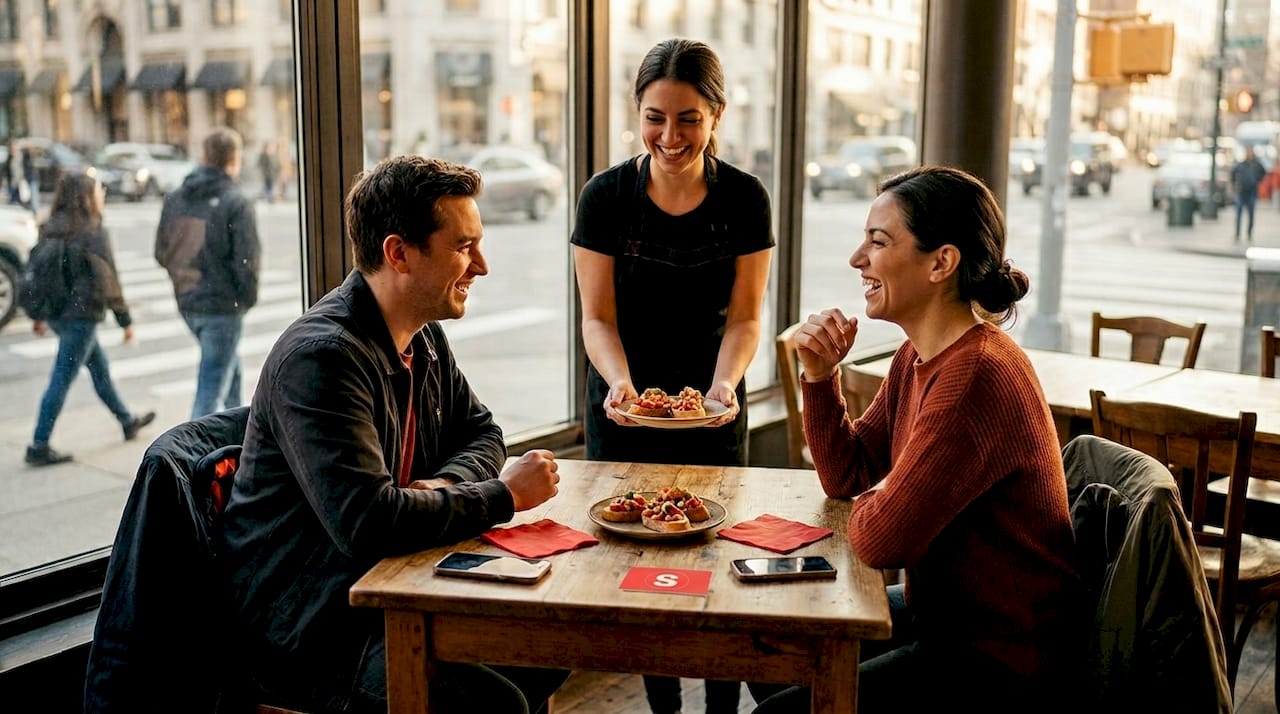
The most effective urban restaurant loyalty programs today build in tiered structures that reward different levels of engagement differently. A first-time visitor gets a welcome offer. A regular gets early access. A VIP gets something money can’t buy elsewhere.
Here are non-discount rewards that urban diners genuinely value:
- Priority reservations during peak hours or special events
- Early menu previews before seasonal launches go public
- Chef’s table experiences or behind-the-scenes kitchen visits
- Members-only event invites for food and beverage pairings
- Name recognition from staff, which feels surprisingly powerful
How do experience-driven rewards stack up against traditional discounts? Here is a direct comparison:
| Factor | Transactional discounts | Experience-driven rewards |
|---|---|---|
| Visit frequency impact | Moderate, offer-dependent | High, habit-forming |
| Guest perception of value | Savings-focused | Emotional connection |
| Margin impact | Reduces average check | Minimal direct cost |
| Long-term loyalty | Low, easy to switch | High, hard to replicate |
| Social sharing potential | Low | High, guests talk about it |
Targeted restaurant loyalty tips consistently show that tiered, experience-led programs deliver visit frequency and lifetime value that far exceeds what transactional programs can produce alone. Urban guests, in particular, are looking for brands they can connect with, not just places to save a few dollars.
Empower your brand: Seamless digital touchpoints everywhere
Delivering memorable loyalty experiences is amplified when your brand is instantly recognizable and accessible at every digital touchpoint. If a guest can’t find your online ordering link quickly, or your kiosk doesn’t reflect your brand identity, you’re losing connection at the moment it matters most.
Every urban restaurant should have these digital touchpoints locked in:
- Mobile ordering that is fast, branded, and tied to the loyalty system
- Branded self-service kiosks that recognize returning guests
- Smart waitlists that allow guests to track their table from their phone
- AI phone ordering for guests who still prefer to call
- Branded email and SMS flows triggered by guest behavior
“Personalization early in the customer journey sets standout restaurants apart in cities.”
That quote reflects a truth every urban operator feels. The restaurant that greets a guest by name at the kiosk and remembers their usual order wins a repeat visit almost automatically. California Fish Grill demonstrated this at scale, with roughly 70% of digital orders flowing through online, kiosk, and AI phone channels combined.
Strong branding for engagement means every digital channel looks, feels, and communicates like your restaurant, not like a generic ordering app. Consistency across channels is what keeps your restaurant top of mind between visits. Pair that with effective restaurant marketing tactics and you build a presence that compounds over time.
Unify your tech: CRM, POS, and data integration essentials
Behind every impressive digital experience lies a strategic tech stack that puts guest intelligence at your fingertips. Many urban restaurants run CRM tools, POS systems, loyalty programs, and marketing platforms as completely separate systems. That fragmentation is where guest data goes to die.
Here is a practical step-by-step approach to unifying your tech:
- Audit your current tools and identify where guest data lives in each system.
- Choose a central guest data platform or CRM that can receive feeds from your POS and loyalty tools.
- Connect your POS to your CRM so purchase history flows automatically without manual exports.
- Link your loyalty platform so points, tiers, and redemptions are reflected in the guest profile in real time.
- Integrate your marketing automation so campaigns trigger directly from guest behavior data in the CRM.
- Set up reporting dashboards that show retention rates, segment performance, and campaign ROI in one view.
Restaurants that achieve this level of CRM and POS integration consistently report first-visit return rates of 35 to 45 percent, compared to the industry average of around 25 percent. That gap represents real revenue. According to research on restaurant guest retention in 2025, integrated CRM and POS approaches are the foundation of every high-performing retention program.
Pro Tip: Run a data silo audit before investing in new tools. Urban restaurants relying heavily on third-party delivery apps often discover they have almost no usable first-party guest data. Fix that problem first, then build on top of it.
What most restaurant engagement guides miss about urban diners
Most guides cover the tactical playbook well enough. They tell you to build loyalty programs, automate your emails, and integrate your systems. What they rarely address is the timing and context that actually makes urban guests feel something worth coming back for.
Urban diners live in a high-stimulus environment. They get hundreds of brand messages every day. What cuts through is not a better subject line or a bigger discount. It’s the right moment. A warm message after a guest attends a nearby concert. A weekday lunch special pushed just before the noon rush when someone is already on their commute. An invitation to a private dinner that happens to fall the week before a guest’s anniversary, which you know because your CRM told you.
BCG research on customer experience in the age of AI highlights that urban restaurant engagement is increasingly about personalization at the right moment, with CX leaders emphasizing that showing up early and contextually in the customer journey is what separates high-loyalty brands from forgettable ones.
Most operators invest in the technology and then treat it like a broadcast channel. They automate the frequency but not the fit. The restaurants we see building genuinely loyal followings in competitive cities are the ones pairing their data tools with real-world context: local events, neighborhood rhythms, weather, and seasonality.
“Engagement is not only about digital touchpoints. It’s about moments guests want to repeat.”
Pro Tip: Test hyper-local triggers in your automation setup. If there’s a major event two blocks away, send a message to nearby regulars at the right time. That level of context is nearly impossible for big chains to replicate, which makes it a powerful advantage for independent and regional operators.
For deeper CRM insights on building this kind of contextual intelligence into your system, the investment is smaller than most operators expect, and the returns show up fast.
Take engagement to the next level with expert support
Pulling together unified guest profiles, automated campaigns, experience-driven loyalty, and seamless digital touchpoints is a meaningful project. The strategy is clear. The execution is where most urban restaurants get stuck, usually because the team is focused on running the restaurant, not building a marketing system.
That’s exactly where professional support makes the biggest difference. Working with a team that specializes in restaurant marketing solutions means you get a system built around your specific guests, your neighborhood, and your competitive landscape. From CRM integration to loyalty program design to automated campaign setup, the right partner accelerates everything you’ve read in this article from concept to measurable result. If you’re ready to move from tactics to real implementation, a strategy session is the fastest first step.
Frequently asked questions
What are the first steps to improve customer engagement in a restaurant?
Start by capturing unified guest data from all digital and in-person channels, then use that data to segment guests and tailor your communications. Restaurants that act on unified profiles see significantly stronger engagement results from day one.
Are loyalty programs really worth it for city restaurants?
Yes, and the evidence is clear. Targeted loyalty mechanics that reward high-frequency visits with experience-driven incentives outperform basic punch cards by a wide margin, especially in urban markets where guests have many options.
How does unified tech improve guest retention?
Integrating CRM, POS, and loyalty systems lets you track behavior, automate timely outreach, and build guest profiles that improve over time. Research on restaurant guest retention shows this integration directly supports measurable increases in return rates.
What’s a good example of an experience-driven loyalty reward?
Invite loyal guests to early access tastings before a menu launch, or offer priority seating during peak periods as a VIP perk. These experience-driven rewards create emotional connection that discounts simply cannot replicate.
How can smaller restaurants compete with bigger brands for engagement?
Focus on personalization, local context, and fast follow-up using unified data. Urban engagement research shows that showing up at the right moment with a relevant, personal message is something independent restaurants can do better than any chain.
Recommended
Potrebbe interessarti anche
Best Restaurant Loyalty Programs 2026: ROI Guide
Discover the best restaurant loyalty programs 2026 that boost repeat visits. Learn how Sorbey’s platform can transform your guest data strategy!
Why Mobile Marketing Matters for Business Growth
Discover why mobile marketing matters for business growth. Learn how optimizing for mobile drives traffic, conversions, and customer retention.
SF Dim Sum Restaurant Marketing Checklist for 2026
Transform your SF dim sum with our 2026 marketing checklist. Optimize your profile, showcase dishes, and attract customers fast!