
Blog
Role of Chatbots in Restaurants: 2026 Guide
Discover the role of chatbots in restaurants and how they boost reservations and improve guest interactions. Learn more in our 2026 guide!

Role of Chatbots in Restaurants: 2026 Guide
TL;DR:
- Chatbots in restaurants automate routine guest interactions and help recover lost after-hours revenue. They improve customer service speed, increase order accuracy, and free staff for more complex tasks. Proper implementation and governance turn chatbots into valuable operational infrastructure that drives measurable revenue growth.
Chatbots in restaurants are AI-powered digital hosts that automate routine guest interactions, from reservation requests to menu questions, around the clock. The role of chatbots in restaurants has shifted from novelty to necessity: 40% of restaurant website traffic happens after business hours, and without automation, those visitors leave without booking. Platforms like those built by Pragmatic Digital and BotHero show that structured conversational AI captures up to 15% additional reservations from after-hours traffic alone. For restaurant owners managing lean teams, that is not a feature. It is a revenue line.
What is the role of chatbots in restaurants?
A restaurant chatbot is a conversational AI program that handles guest interactions through text or voice, typically embedded in a website, Facebook Messenger, WhatsApp, or Google Business profile. The industry term for this category is conversational AI, and it covers everything from simple rule-based bots to large language model systems capable of natural dialogue.

The core function is automation of repetitive, high-volume interactions. Think reservation confirmations, hours and parking questions, allergy inquiries, and waitlist signups. 60% of guests identify better AI-driven communication as a primary driver of improved dining experiences. That number tells you guests are not just tolerating chatbots. They prefer them for routine tasks.
The business case is straightforward. Every missed call or unanswered Instagram DM is a potential booking lost. Restaurants lose thousands monthly from missed calls and slow responses. A chatbot running 24/7 converts that lost traffic into structured leads with party size, date, dietary needs, and budget already captured.
How do chatbots improve customer service and guest engagement?
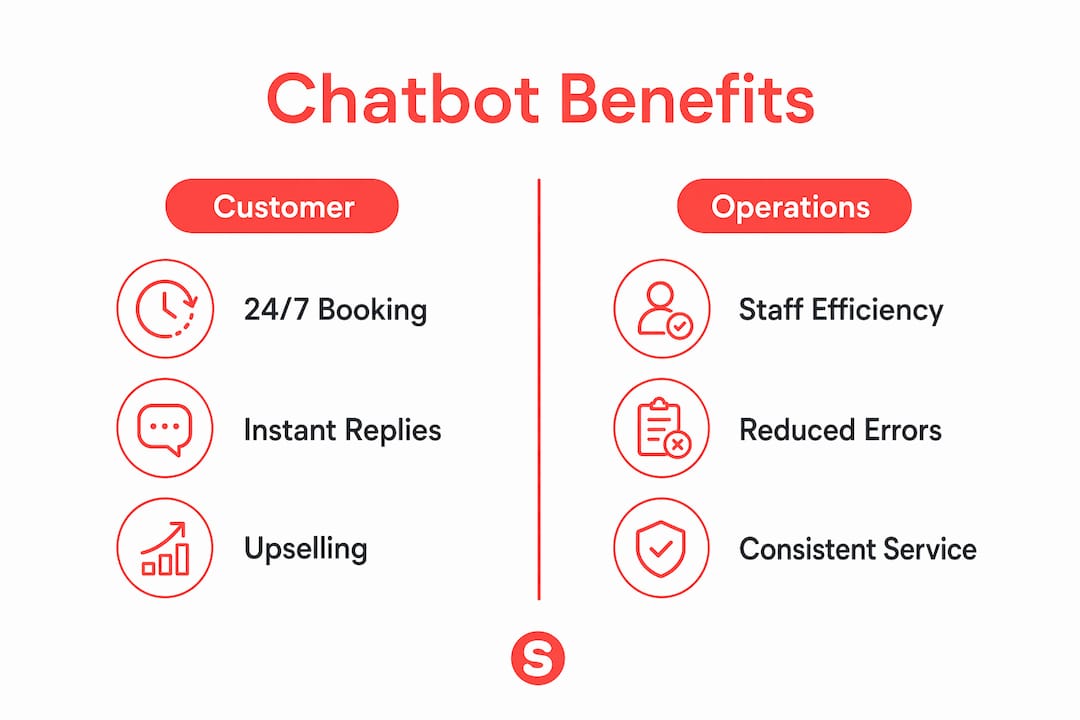
The most immediate chatbot benefit for restaurants is speed. A guest asking about gluten-free options at 11 p.m. gets an answer in seconds, not a voicemail. Chatbots manage up to 80% of frequently asked questions about hours, parking, and menus without any staff involvement. That frees your team to focus on the guests already sitting in your dining room.
Here is what well-deployed chatbots handle across customer touchpoints:
- Reservation requests and confirmations across website, social media, and messaging apps
- Waitlist signups with automated status updates via SMS or WhatsApp
- FAQ responses covering the top 15 repetitive questions your staff answers daily
- Natural language upselling, suggesting wine pairings or dessert add-ons during chat-based ordering
- Event inquiry intake, collecting structured data before routing to a human coordinator
- Smart handoffs to live staff when a complaint or complex request requires a human touch
The upselling function deserves attention. AI-integrated ordering systems increase average check sizes by 10–30% through natural language suggestions. That is not aggressive pop-up advertising. It is a conversational prompt, the digital equivalent of a server saying “the truffle fries are excellent tonight.”
Pro Tip: Set your chatbot to trigger a human handoff any time a guest uses words like “complaint,” “wrong order,” or “disappointed.” Protecting the guest relationship at that moment is worth more than any automation efficiency.
Enhancing customer engagement with chatbots also means meeting guests where they already are. A chatbot integrated across your Google Business profile, Instagram DMs, and website creates a consistent experience regardless of where a guest finds you first.
What operational efficiencies do chatbots bring to restaurant management?
The operational impact of chatbots goes well beyond customer-facing convenience. The internal workflow gains are where many restaurant managers find the biggest return.
-
Staff time on phone inquiries drops sharply. Cutting staff time on phone reservations from 15 hours to 2 hours weekly is a documented outcome in AI chatbot deployments. That is 13 hours per week your team redirects to service, prep, or training.
-
Order accuracy improves measurably. AI-driven chat-based ordering raises order accuracy from 92% to 99.5%. Fewer errors mean fewer comped meals, less food waste, and higher guest satisfaction scores.
-
Event and catering leads arrive pre-qualified. Instead of a vague “do you do private events?” message, your chatbot collects party size, preferred date, budget range, and dietary restrictions before a human ever gets involved. Structured chatbot intake transforms vague inquiries into warm leads ready for follow-up.
-
Brand voice stays consistent. When your chatbot is built on governed content, every guest interaction reflects your restaurant’s tone, not whatever a tired staff member says at the end of a double shift.
-
Internal operations benefit too. Chatbots extend to employee scheduling, inventory tracking, and staff training support. Mobile-optimized bots give your team access to shift info and menu updates on the go.
Pro Tip: During the first two weeks after launch, have a manager review chatbot transcripts daily. You will catch gaps in your content quickly and train the system before guests notice the holes.
Successful chatbot deployment depends on treating the AI as structured infrastructure, not a plug-and-play feature. Restaurants that invest in governance and staff training see compounding returns. Those that skip that step see frustrated guests and abandoned conversations.
Chatbot applications in restaurants: what can they actually do?
The table below maps the most common chatbot applications in hospitality against their primary benefit and realistic limitations.
| Application | Primary benefit | Limitation |
|---|---|---|
| Reservation automation | Captures bookings 24/7 via OpenTable, Resy, or direct links | Cannot override fully booked nights or negotiate table preferences |
| FAQ handling | Answers hours, parking, menu, and allergy questions instantly | Struggles with highly nuanced or multi-part questions |
| Chat-based ordering | Raises accuracy to 99.5%, increases check size by 10–30% | Does not replace POS systems; works alongside them |
| Event lead capture | Collects structured data before human follow-up | Complex negotiations still require a human coordinator |
| Upselling prompts | Increases average check through natural language suggestions | Requires well-written content to avoid feeling scripted |
| Employee support | Delivers scheduling, training, and inventory info on mobile | Requires integration with existing HR and ops platforms |
AI chatbots integrate with booking platforms like OpenTable and Resy, providing booking links and qualifying leads for human follow-up. They do not replace your point-of-sale system. They sit in front of it, handling the conversation layer so your POS handles the transaction layer.
The distinction between customer-facing and internal chatbot uses matters for budgeting. Customer-facing bots drive immediate revenue through reservation capture and upselling. Internal bots build long-term operational efficiency. Most restaurant owners start with customer-facing deployment and expand from there.
What are best practices for implementing chatbots in restaurants?
Deploying a chatbot without a plan produces a bot that frustrates guests and embarrasses your brand. The restaurants that get real returns follow a disciplined implementation process.
- Define your use cases before you build. Decide whether you are solving for reservations, FAQ volume, order accuracy, or event leads. A focused chatbot outperforms a sprawling one every time.
- Build on governed content. Your chatbot’s answers should come from approved sources: your menu, your policies, your actual hours. Never let the AI improvise on allergy information or pricing.
- Train staff during the first two weeks. Implementation timelines under 30 days are achievable, but the two-week staff training window is where the AI-human workflow gets established. Skip it and you get a bot your team works around instead of with.
- Build clear handoff protocols. Every chatbot needs a defined trigger for escalating to a human. Complaints, refund requests, and accessibility needs should never stay in the bot.
- Review and update monthly. Menus change, hours change, and specials rotate. A chatbot running on outdated content does more damage than no chatbot at all.
- Avoid the replacement mindset. AI protects hospitality staff by automating routine tasks. It does not replace the server who remembers a regular’s birthday or the host who defuses a difficult situation. Position it that way with your team and adoption improves significantly.
Common chatbot deployment mistakes include launching without testing edge cases, failing to set guest expectations about bot vs. human response times, and building a bot that cannot gracefully say “I don’t know, let me connect you with someone.” That last one matters more than most operators realize.
For restaurant owners also thinking about how chatbots connect to broader revenue strategy, digital upselling tactics explain how natural language prompts translate into measurable check size increases.
Key takeaways
Chatbots deliver the highest restaurant ROI when deployed as structured infrastructure with clear use cases, governed content, and trained staff managing the AI-human workflow.
| Point | Details |
|---|---|
| After-hours revenue capture | Chatbots recover up to 15% of total bookings from traffic that would otherwise leave without reserving. |
| Order accuracy gains | AI-driven chat ordering raises accuracy from 92% to 99.5%, reducing comps and food waste. |
| Staff time reclaimed | Phone reservation handling drops from 15 hours to 2 hours weekly with chatbot automation. |
| Upselling through conversation | Natural language prompts increase average check sizes by 10–30% without aggressive sales tactics. |
| Implementation discipline | Chatbots succeed with governed content, two-week staff training, and clear human handoff protocols. |
Why I think most restaurants are still underestimating chatbots
I have watched restaurant owners add chatbots the same way they once added a Facebook page: set it up, forget it, wonder why it does not perform. The technology is not the problem. The mindset is.
The real value of conversational AI in restaurants is not the customer experience score improvement, though that matters. It is the revenue that was already walking out the door. Missed calls at 10 p.m. Unanswered DMs on a busy Saturday. Event inquiries that sat in an inbox for three days. Chatbots do not create new demand. They capture demand that already existed and was being lost.
What surprises me most in real deployments is how quickly staff attitudes shift. The front-of-house team that was skeptical in week one is relieved by week three. They are no longer answering the same parking question forty times a week. They are doing the work that actually requires a human.
The future I see is voice AI layered on top of these text-based systems, so a guest can call your restaurant after hours and have a natural conversation with an AI that books their table, confirms dietary needs, and sends a confirmation text. That is not science fiction. It is already in early deployment at select groups. The restaurants building chatbot infrastructure now will adopt voice AI faster and with less friction when it becomes standard.
The operators who treat chatbots as a marketing add-on will keep getting marginal results. The ones who treat it as operational infrastructure will build a compounding advantage. That gap is only going to widen.
— Barthelemy
How Sorbey helps restaurants put chatbots to work
Sorbey builds all-in-one marketing systems for restaurants that include chatbot integration alongside reservation tools, CRM, and local marketing. If you are ready to stop losing after-hours bookings and start capturing structured leads from every channel, Sorbey’s restaurant marketing services connect chatbot technology directly to your existing workflows. The setup is fast, the training is included, and the results show up in your reservation count within the first month. Explore how Sorbey helps local restaurants maximize AI-driven engagement and turn every guest touchpoint into a revenue opportunity.
FAQ
What is the main role of chatbots in restaurants?
Chatbots in restaurants automate routine guest interactions including reservations, FAQ responses, and order guidance, operating 24/7 so staff can focus on in-person service. Their primary business value is capturing revenue from after-hours traffic and reducing missed leads.
How do restaurant reservation chatbots work?
Restaurant reservation chatbots integrate with booking platforms like OpenTable and Resy, collect guest details through conversation, and provide direct booking links or confirmations. They qualify leads with party size, date, and dietary needs before any human follow-up is needed.
Can chatbots replace restaurant staff?
Chatbots handle repetitive, high-volume tasks but cannot replace the judgment, empathy, and relationship-building that define hospitality. The most effective deployments use AI to protect staff time, not eliminate staff roles.
How quickly can a restaurant deploy a chatbot?
Implementation timelines under 30 days are achievable, with the critical period being the first two weeks of staff training to establish the AI-human workflow. Restaurants that invest in that training window see significantly better long-term results.
Do chatbots actually increase restaurant revenue?
Yes. After-hours chatbot deployment captures up to 15% additional reservations, and AI-driven ordering increases average check sizes by 10–30% through natural language upselling. Those are direct, measurable revenue contributions, not abstract engagement metrics.
Recommended
- The Role of Analytics in Restaurants: 2026 Guide | Sorbey Blog | Sorbey
- Online menus: the key to restaurant growth in 2026 | Sorbey Blog | Sorbey
- Top restaurant digital trends: boost success in 2026 | Sorbey Blog | Sorbey
- Tendances numériques restaurants : boostez votre succès en 2026 | Sorbey Blog | Sorbey
Potrebbe interessarti anche

How to Boost Online Reviews for Restaurants
Learn how to boost online reviews for your restaurant with effective strategies. Turn customer feedback into a competitive advantage today!

Why Remarketing Is Important for Restaurants
Discover why remarketing is important for restaurants. Learn how to transform one-time visitors into loyal customers and boost your ROI!

Mobile Marketing Strategies for Food & Beverage in 2026
Discover effective mobile marketing strategies for food & beverage in 2026. Engage customers at the right moment and boost your sales!