
Blog
How to Engage Local Customers: Proven 2026 Strategies
Discover how to engage local customers effectively with proven 2026 strategies. Boost visibility and transform your local marketing efforts today!

How to Engage Local Customers: Proven 2026 Strategies
TL;DR:
- Building consistent local customer engagement involves optimizing your Google Business Profile, collecting reviews systematically, and creating neighborhood-specific content.
- Community participation and local media exposure build trust and generate pre-qualified leads that enhance overall marketing effectiveness.
Local customer engagement is the practice of building consistent, meaningful connections with people who live, work, or shop within your business’s immediate geographic area. The most effective approach combines Google Business Profile optimization, hyperlocal targeting, community participation, and personalized messaging into a single compounding system. Each layer reinforces the next: better visibility generates more reviews, more reviews improve rankings, and stronger rankings make every paid campaign cheaper and more effective. For restaurants, retail shops, and service businesses, mastering these local marketing techniques is the difference between a full house and an empty one.
How to engage local customers through your digital presence
Your Google Business Profile is the single most important free tool for local visibility, and most businesses treat it like a set-and-forget directory listing. That is a costly mistake. A fully optimized profile with current hours, photos updated weekly, and a complete services section directly increases calls, direction requests, and website visits from nearby searchers. According to a 4-part local acquisition model, GBP optimization is the foundation that feeds every other channel, from reviews to referrals to paid ads.
Reviews are the second pillar of your digital presence, and the businesses that win them consistently are the ones that ask for them systematically. Text-based review requests have nearly five times higher open rates than emails. That means a short SMS sent 30 minutes after a meal or service appointment outperforms any email follow-up sequence you could build. Write one script, send it at the same moment after every transaction, and treat it as a non-negotiable part of your operations.
Local landing pages are where many businesses quietly lose ground. A page that simply swaps a city name into a generic template does nothing for rankings and nothing for the reader. Genuinely useful neighborhood-specific content includes local landmarks, customer testimonials from that area, neighborhood-specific FAQs, and linkable resources. A restaurant in Austin’s South Congress neighborhood should have a page that mentions the farmers market two blocks away, not a page that says “best tacos in Austin” five times.
Here is what a strong local digital presence requires:
- A complete and regularly updated Google Business Profile with photos, posts, and Q&A responses
- A scripted, timed review request sent via SMS after every customer interaction
- Dedicated local landing pages with neighborhood-specific content, testimonials, and FAQs
- Consistent NAP (name, address, phone) data across Google, Yelp, Apple Maps, and local directories
Pro Tip: Set a recurring calendar reminder every Monday to upload two new photos to your Google Business Profile. Profiles with fresh photo activity consistently outperform static ones in local search results.
What is hyperlocal marketing and how does it work?
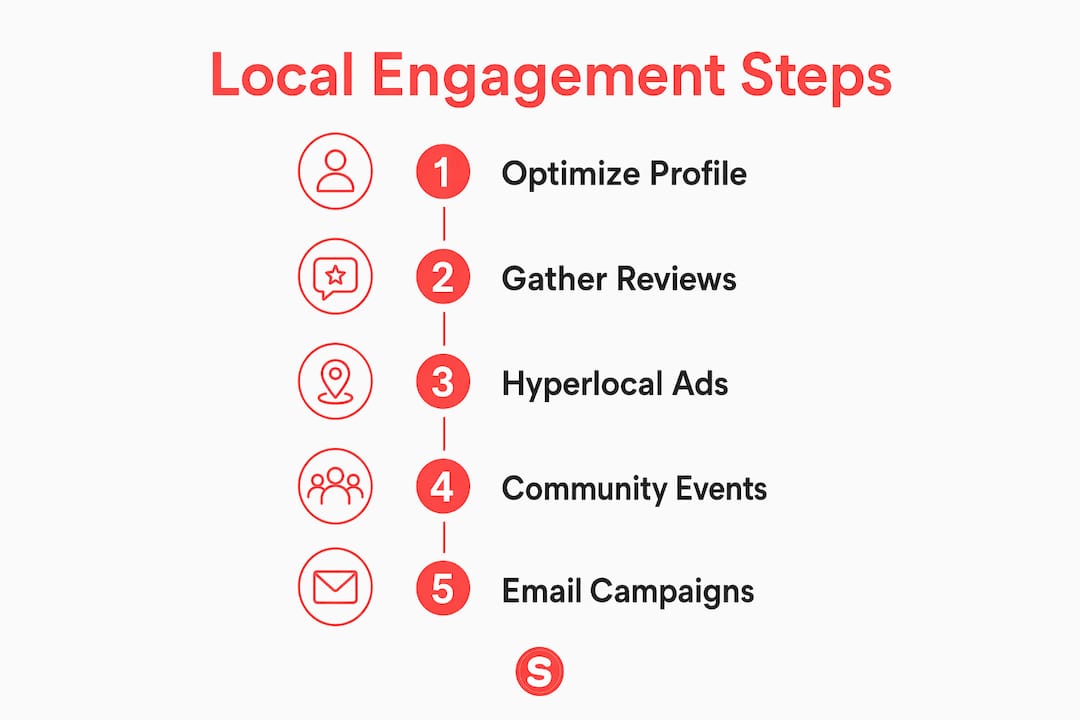
Hyperlocal marketing targets potential customers within a very tight geographic radius, typically one to three miles around your physical location, using messaging that references their specific neighborhood, landmarks, or daily routines. Shopify recommends tighter radii and hyper-relevant copy to increase engagement, because a generic ad for “great pizza nearby” loses to one that says “hot slices two blocks from Millennium Park, ready in 10 minutes.”
Implementing hyperlocal campaigns effectively comes down to four steps:
- Set your radius. Use Facebook Ads, Google Ads, or a platform like Sorbey to target a one to three mile radius around your location. Resist the urge to expand. Tighter targeting means higher relevance and lower cost per click.
- Personalize your creative. Reference local landmarks, neighborhood names, or upcoming community events in your ad copy and visuals. A photo of your storefront with a recognizable street corner converts better than a stock image.
- Use geofencing for time-sensitive offers. Geofencing with time-of-day targeting during lunchtime or post-work hours, paired with offers like “10% off today only,” converts nearby foot traffic into paying customers. Run these campaigns Tuesday through Thursday when competition for ad space is lower and intent is high.
- Connect online ads to in-store actions. Offer buy-online-pick-up-in-store (BOPIS) options or in-store-only redemption codes in your digital ads. Bridging in-person foot traffic triggers with online incentives creates a measurable loop between your digital spend and actual store visits.
Pro Tip: Run your geofenced ads starting 90 minutes before your peak hours, not at peak time. By the time a customer sees your ad, decides to come in, and travels to you, you want them arriving when you are ready for them.
How to engage through community participation and local media
Community involvement is one of the most underused local customer engagement strategies available to small businesses. Sponsoring a Little League team, donating to a school auction, or co-hosting a neighborhood cleanup puts your brand in front of people who have not searched for you yet. HubSpot recommends sponsoring events, using signage, and leveraging local media as proven methods for building local brand awareness that digital ads alone cannot replicate.
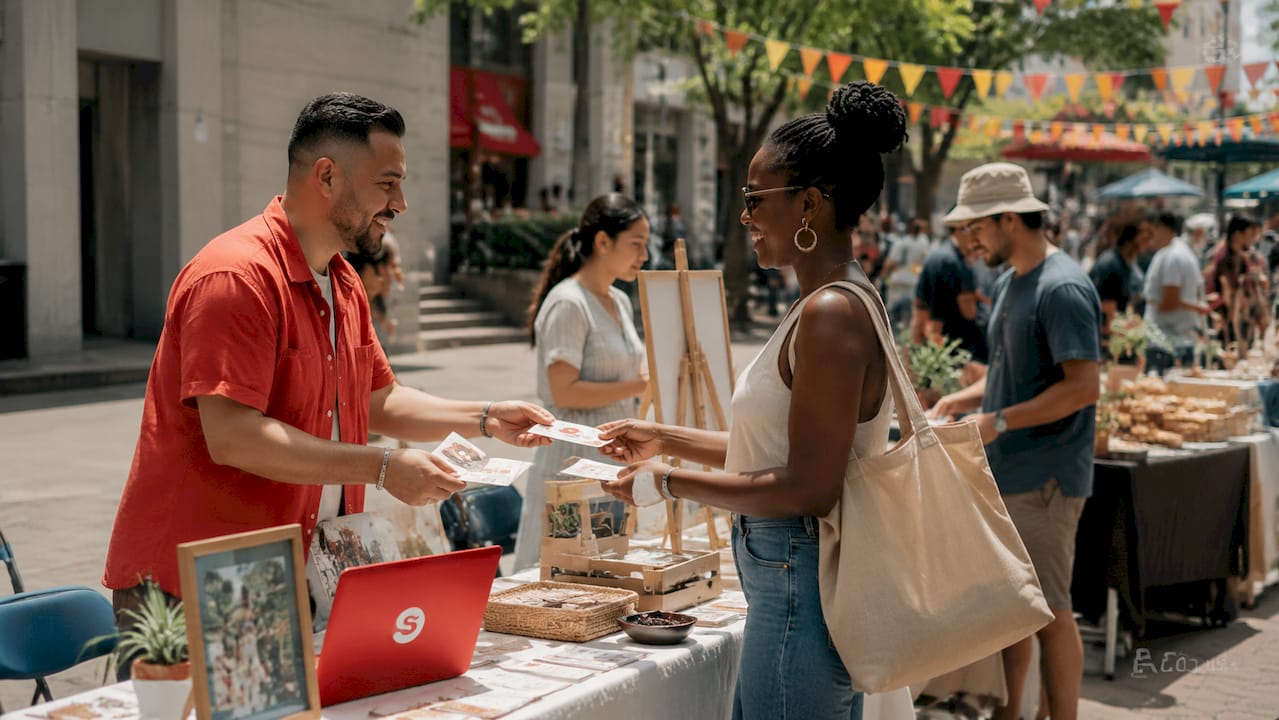
Local media still carries significant trust weight in most markets. A feature in a neighborhood newspaper, a 60-second spot on a community radio station, or a mention on a local TV morning show reaches an audience that is already predisposed to support local businesses. The key is to pitch a story, not an ad. Offer to be a resource: a restaurant owner who comments on local food trends, a retailer who explains supply chain changes affecting local shoppers. Editors want expertise, not press releases.
Offline visibility tactics that consistently drive foot traffic include:
- Sidewalk signs and A-frame boards with a daily special or a reason to walk in right now
- Window graphics that communicate your hours, your story, or a current promotion
- Partnerships with neighboring businesses for cross-referral cards or bundled offers
- Sponsorships of local nonprofits, sports teams, and school events with visible signage
Referral partnerships with other local businesses generate pre-qualified leads that convert at higher rates than cold traffic. A hair salon that refers clients to a nearby coffee shop, and vice versa, creates a trust transfer that no ad budget can buy. These partnerships also reduce your cost per acquisition over time, which makes your eventual paid campaigns more profitable.
How to use local email campaigns to deepen customer relationships
Email remains one of the highest-return channels for local businesses, but only when it is built around geography and behavior rather than blasted to an undifferentiated list. Segmenting email lists by geography and customer behavior with clear calls-to-action increases local store visits and repeat purchases. A customer who visited your restaurant on a Friday night should receive different messaging than one who only orders delivery on weekday lunches.
The subject line is where local email either wins or loses. Subject lines that call out a neighborhood name, a nearby event, or a time-sensitive local offer consistently outperform generic promotional lines. “Your neighbor’s favorite dish is back this weekend” outperforms “New menu items available now” every time. The specificity signals relevance before the email is even opened.
Strong local email campaigns share four characteristics:
- Geographic segmentation: Separate your list by zip code or neighborhood so your messaging matches the reader’s physical context
- Behavioral layering: Tag customers by purchase frequency, order type, or last visit date, then write to those specific situations
- One clear call-to-action: A singular call-to-action per email maximizes click-through. Send people to reserve a table, redeem an offer, or attend an event. Never all three at once.
- Consistent local branding: Use neighborhood photography, local event references, and a tone that sounds like a neighbor, not a corporation
Pro Tip: Build a “lapsed local” segment for customers who have not visited in 60 days. Send them a single email with a specific, time-limited reason to return. A personalized “We miss you” with a real offer converts at two to three times the rate of a standard promotional email.
Common mistakes that kill local engagement efforts
The most common reason local engagement strategies fail is inconsistency, not strategy. Businesses run a review request campaign for two weeks, get ten reviews, then stop. Rankings improve briefly, then plateau. Systematizing review requests with a consistent script sent at the same point after every transaction is what separates businesses with 200 reviews from those stuck at 12.
Other frequent mistakes include:
- Thin local landing pages: Swapping city names into a generic template triggers no local SEO value and serves no reader. Build each page from scratch with real local context.
- Running channels in isolation: A Google ad campaign without a review strategy, a community event without an email follow-up, or a social post without a local landing page all underperform. Local acquisition compounds when channels work together.
- No segmentation in email: Sending the same message to every subscriber regardless of location or behavior wastes your list and trains readers to ignore you.
- Ignoring offline touchpoints: Digital-only strategies miss the customers who discover you through a window sign, a referral card, or a community event.
The businesses that consistently win local market share are not the ones with the biggest budgets. They are the ones that execute the basics without stopping.
Key takeaways
Engaging local customers requires combining digital visibility, hyperlocal targeting, community presence, and segmented messaging into one coordinated system where each channel strengthens the others.
| Point | Details |
|---|---|
| Google Business Profile is the foundation | Optimize it weekly with photos, posts, and Q&A to drive calls and visits. |
| Systematize your review requests | Send a scripted SMS after every transaction to build reviews predictably. |
| Hyperlocal ads need tight radii | Target one to three miles with neighborhood-specific copy and time-sensitive offers. |
| Community involvement builds trust | Sponsor local events and build referral partnerships to generate pre-qualified leads. |
| Email works best when segmented | Separate by geography and behavior, then use one clear call-to-action per send. |
Why I think most local businesses are one system away from real growth
I have watched hundreds of local businesses run every tactic in this article in isolation and wonder why nothing sticks. A great Google Business Profile with zero reviews. A strong email list with no segmentation. A community sponsorship with no follow-up campaign. The tactics are not the problem. The missing piece is almost always the connection between them.
What I have found actually works is treating local engagement as a cycle, not a checklist. You optimize your Google Business Profile, which gets you more visibility. You ask for reviews at the right moment, which improves your ranking. Better rankings bring in more foot traffic, which gives you more customers to build referral partnerships with. Those partnerships make your paid ads cheaper because your brand already has trust in the neighborhood. Each step feeds the next.
The businesses I have seen grow fastest are the ones that commit to attracting local diners and building loyalty through this compounding approach rather than chasing the next platform or trend. Authenticity in your community messaging matters more than production quality in your ads. A photo of your actual team at a neighborhood event outperforms a polished stock-photo campaign every time. Build the system first. Then scale what works.
— Barthelemy
How Sorbey helps local businesses execute these strategies
Sorbey is built specifically for local businesses like restaurants that need all of these strategies working together without managing five separate tools.
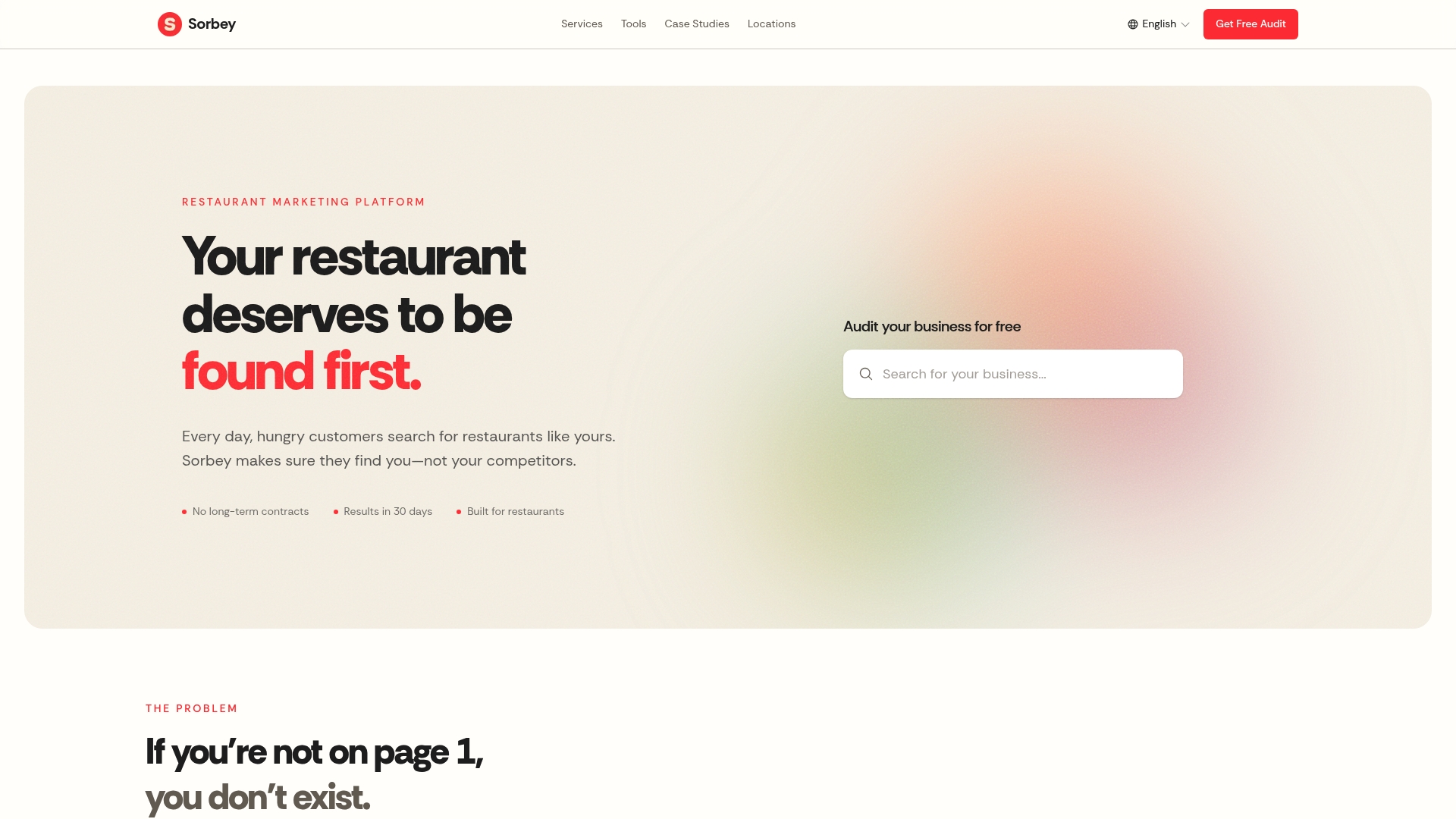
With Sorbey, you get Google Business Profile optimization, local SEO support, hyperlocal ad management, and email campaign tools designed for neighborhood-level targeting. The platform connects your digital presence to your in-store results so you can see what is actually driving foot traffic. If you are ready to stop running tactics in isolation and start building a system that compounds, explore Sorbey’s local marketing services to find the right fit for your business size and goals.
FAQ
How do I start engaging local customers on a small budget?
Start with your Google Business Profile and a scripted SMS review request. Both are free or near-free and directly improve local search visibility before you spend a dollar on ads.
What is the best radius for hyperlocal ad targeting?
One to three miles around your physical location is the recommended range for most local businesses. Tighter targeting produces more relevant impressions and lower cost per click than broader geographic campaigns.
How often should I send local marketing emails?
Once or twice per week is the standard for high-engagement local email programs. Segment by behavior and geography so each send feels relevant rather than repetitive.
Why are my local landing pages not ranking?
Generic pages that only swap city names into a template provide no SEO value. Each local page needs original content including neighborhood landmarks, local testimonials, and specific FAQs to rank and convert.
How do referral partnerships improve local customer engagement?
Referral partnerships with neighboring businesses generate pre-qualified leads that already carry a trust signal. These leads convert at higher rates than cold traffic and reduce your overall cost per acquisition over time.
Recommended
- Local marketing strategies for restaurant growth in 2026 | Sorbey Blog | Sorbey
- Lead Generation Strategies for Urban Restaurants in 2026 | Sorbey Blog | Sorbey
- Boost local restaurant success with strategic local advertising | Sorbey Blog | Sorbey
- Examples of Local Advertising That Actually Work | Sorbey Blog | Sorbey
Vous pourriez aussi aimer

What Is Remarketing? A Guide for Marketers in 2026
Discover what is remarketing and how it can boost your conversions. Learn key strategies for effective digital advertising in 2026!

How to Improve Digital Presence for Your Restaurant
Discover how to improve digital presence for your restaurant, boost visibility, and fill seats with practical strategies that drive revenue.

Why Digital Marketing Matters for Your Business Growth
Discover why digital marketing matters for your business growth. Unlock precise customer engagement and measurable results today!