
Blog
Unlock the role of branded search for restaurant visibility
Discover how branded search drives 30% conversion rates for restaurants. Learn optimization strategies to capture high-intent customers and boost visibility.

Unlock the role of branded search for restaurant visibility
Up to 95% of some websites’ organic traffic comes from branded searches, not discovery queries. This surprising reality challenges the common belief that only non-branded keywords drive growth. For restaurant owners and marketing managers, understanding branded search is essential because these queries signal strong customer intent and convert at dramatically higher rates than generic searches. Mastering your restaurant’s branded search presence can transform your online visibility, reduce marketing costs, and capture customers actively seeking your establishment. This guide explains what branded search means for restaurants and how to leverage it effectively.
Table of Contents
- Key takeaways
- What is branded search and why does it matter for restaurants?
- The impact of branded search on restaurant marketing performance
- Balancing branded and non-branded search strategies for optimal growth
- Practical methods to optimize your restaurant’s branded search presence
- Enhance your branded search strategy with expert support
- What are some common questions about branded search for restaurants?
Key Takeaways
| Point | Details |
|---|---|
| Branded search converts better | People who search for your restaurant by name show strong intent and convert at higher rates than generic discovery queries. |
| Local SEO fundamentals | Optimizing your branded presence requires core local SEO practices such as your Google Business Profile and review management. |
| Balance branded and non branded | A mix of branded and non branded SEO maximizes visibility and ROI by capturing both current customers and discovery audiences. |
| Consistent brand signals | New or rebranded restaurants must maintain consistent brand signals across listings and content to establish a recognizable branded presence. |
What is branded search and why does it matter for restaurants?
Branded search occurs when someone types your restaurant’s name directly into a search engine. These queries show strong customer intent because searchers already know your brand and are actively seeking your location, menu, hours, or contact information. Branded search queries indicate strong brand awareness and bottom-funnel intent, exemplified by searches like “Mario’s Pizzeria downtown” or “Blue Moon Bistro reservations.”
Understanding search engine ranking for restaurants requires recognizing the difference between branded and non-branded queries. Non-branded searches like “Italian restaurant near me” or “best sushi in Chicago” represent discovery opportunities where potential customers don’t yet know your establishment. Branded searches represent customers who have already encountered your restaurant through word of mouth, advertising, social media, or previous visits.
Typical branded search patterns for restaurants include:
- Restaurant name plus location modifiers (“near me,” city name, neighborhood)
- Restaurant name plus specific information needs (“menu,” “hours,” “phone number”)
- Restaurant name plus action intent (“reservations,” “order online,” “delivery”)
- Misspellings or variations of your restaurant name
Branded searches carry immense value because they capture customers at the decision stage. Someone searching for your restaurant by name has already moved past consideration and is ready to visit, call, or order. This bottom-funnel intent translates directly into higher conversion rates and better marketing ROI. Protecting and optimizing your branded search presence ensures you capture this valuable traffic before competitors or third-party platforms intercept it.
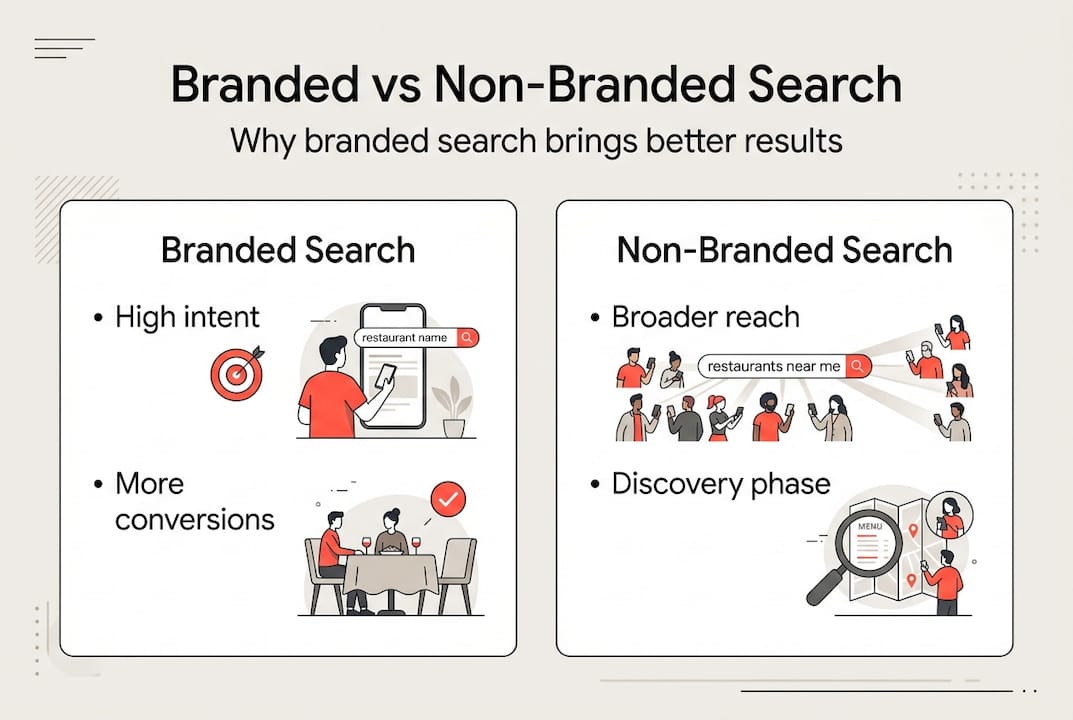
The distinction matters because marketing strategies differ dramatically between branded and non-branded efforts. Branded search requires defensive optimization to maintain your rightful top position, while non-branded search demands content creation, keyword targeting, and authority building to compete for discovery.
The impact of branded search on restaurant marketing performance
The performance gap between branded and non-branded search traffic is staggering. Branded keywords typically yield 30% conversion rates versus 2% for non-branded and have lower cost per click in paid campaigns. For restaurants, this means every customer who discovers your brand and later searches for you by name becomes a high-value conversion opportunity.
Branded vs Non-Branded Performance Metrics
| Metric | Branded Search | Non-Branded Search |
|---|---|---|
| Average Conversion Rate | 30% | 2% |
| Cost Per Click (PPC) | $0.50-$1.50 | $2.00-$8.00 |
| Customer Intent Level | Bottom-funnel (ready to act) | Top/mid-funnel (researching) |
| Competition Level | Low (your brand) | High (category keywords) |
Local SEO efforts that support branded visibility deliver exceptional returns. Local SEO can achieve 500% ROI, with 75% of local searches converting to leads. For restaurants, this means optimizing your Google My Business for restaurants directly impacts how effectively you capture branded search traffic and convert it into reservations, orders, and visits.

The cost efficiency advantage stems from lower competition. When someone searches your restaurant’s name, you should naturally rank first organically. If you run paid ads on branded terms, your cost per click remains minimal because competitors rarely bid aggressively on your brand name. This creates a protective moat around your most valuable traffic source.
Key performance benefits of strong branded search presence include:
- Higher click-through rates from search results (often 40-60% for position one)
- Lower bounce rates because visitors find exactly what they searched for
- Increased direct bookings and orders versus third-party platform fees
- Better customer experience through immediate access to accurate information
Pro Tip: Before investing heavily in non-branded SEO or paid discovery campaigns, ensure your branded search presence is bulletproof. This high-conversion safety net captures demand you’ve already generated through other marketing channels, preventing leakage to competitors or aggregator platforms.
The ROI calculation becomes clear when you consider the customer journey. Every dollar spent on advertising, social media, or PR that introduces customers to your brand creates future branded search volume. If you fail to capture that branded traffic effectively, you waste the initial investment that created awareness.
Balancing branded and non-branded search strategies for optimal growth
Successful restaurant marketing requires strategic balance between protecting branded search rankings and expanding discovery through non-branded keywords. Restaurants should allocate roughly 20-30% SEO effort to branded search protection and 70-80% to non-branded for discovery. This split ensures you defend existing brand equity while building awareness among new potential customers.
Strategic SEO Allocation Framework
| Focus Area | Effort Allocation | Primary Goal | Key Tactics |
|---|---|---|---|
| Branded Search Protection | 20-30% | Capture existing demand | GBP optimization, review management, NAP consistency |
| Non-Branded Discovery | 70-80% | Build new awareness | Content marketing, category keywords, local guides |
Branded search acts as your safety net, capturing customers who already know your restaurant and are ready to convert. This traffic requires less effort to convert but demands consistent maintenance to prevent competitors or directory sites from outranking you for your own name. Non-branded search represents growth potential, helping new customers discover your restaurant when searching for cuisine types, dining occasions, or location-based queries.
The risk profile differs significantly between new and established restaurants. Established restaurants with strong brand recognition enjoy natural branded search volume and must focus primarily on maintaining rankings while expanding non-branded reach. New or recently rebranded restaurants face entity confusion challenges where search engines struggle to associate your brand name with your business, requiring focused effort on building consistent signals.
Common pitfalls to avoid include:
- Neglecting branded search optimization while chasing competitive non-branded keywords
- Allowing third-party platforms to outrank your website for your restaurant’s name
- Inconsistent business information across online directories creating entity confusion
- Ignoring review management which directly impacts branded search visibility
- Over-investing in paid ads for branded terms when organic rankings are strong
Pro Tip: Monitor your branded search share of voice monthly. If competitors or aggregator platforms start appearing in top positions for your restaurant’s name, immediately audit your Google Business Profile completeness, citation consistency, and review velocity to identify weaknesses.
Understanding local SEO for restaurants helps you develop both branded authority and non-branded visibility simultaneously. The tactics often overlap, with strong local SEO fundamentals supporting both objectives. However, the strategic emphasis shifts based on your restaurant’s maturity, competitive landscape, and growth goals.
The parallel development approach works best for most restaurants. While building content and authority for non-branded discovery keywords, simultaneously strengthen branded signals through consistent NAP data, active review generation, and authoritative backlinks. This balanced strategy compounds over time, with non-branded content creating awareness that generates future branded searches you’re prepared to capture.
Practical methods to optimize your restaurant’s branded search presence
Optimizing branded search requires systematic attention to local SEO fundamentals that signal your restaurant’s legitimacy and relevance to search engines. Optimizing branded search involves claiming GBP, ensuring NAP consistency, earning reviews mentioning the brand, and building backlinks to protect rankings. These tactics work together to establish your restaurant as the authoritative source for queries containing your brand name.
Follow these steps to strengthen your branded search presence:
- Claim and fully complete your Google Business Profile with accurate business name, address, phone, hours, categories, and attributes
- Add high-quality photos showcasing your restaurant’s ambiance, dishes, and unique features weekly
- Respond to every review within 24-48 hours, incorporating your restaurant name naturally in responses
- Verify your business information matches exactly across your website, social profiles, and major directories
- Create location-specific pages on your website if you operate multiple locations
- Build authoritative backlinks from local news sites, food bloggers, and community organizations
- Monitor search results for your restaurant name monthly to identify ranking threats
Name, address, and phone consistency (NAP) forms the foundation of branded search optimization. Search engines use these data points to verify your business identity and connect online mentions to your establishment. Even minor inconsistencies like “St” versus “Street” or different phone number formats can create entity confusion that weakens your branded search authority.
Key NAP consistency practices include:
- Using identical business name formatting everywhere (including or excluding legal designations like LLC consistently)
- Standardizing address format across all platforms
- Maintaining the same primary phone number on all listings
- Updating information simultaneously across all platforms when changes occur
Customer reviews mentioning your restaurant’s name provide powerful branded search signals. These reviews create fresh content containing your brand name on authoritative platforms like Google, reinforcing your relevance for branded queries. Encourage satisfied customers to mention your restaurant by name in their reviews rather than generic praise.
To optimize Google Business Profile effectively, focus on completeness and activity. Regularly post updates, special offers, and events to demonstrate your profile is actively managed. Answer questions in the Q&A section to provide helpful information that may appear in search results for branded queries.
New or rebranding restaurants face unique challenges establishing branded search presence. Search engines need time and consistent signals to associate your new brand name with your business entity. Accelerate this process through PR efforts that generate media coverage with backlinks, social media consistency using your exact business name, and citation building across relevant directories. Understanding restaurant search engine ranking factors helps you prioritize the signals that matter most for establishing new branded authority quickly.
Enhance your branded search strategy with expert support
Mastering branded search optimization requires ongoing attention to local SEO fundamentals, review management, and competitive monitoring. While the tactics are straightforward, consistent execution across multiple platforms demands time and expertise many restaurant operators lack. Professional marketing support ensures your branded search presence remains strong while you focus on delivering exceptional dining experiences.
Explore comprehensive restaurant marketing solutions designed specifically for local establishments seeking to maximize online visibility and conversions. Expert guidance on Google Business Profile optimization tips and local SEO guidance for restaurants helps you capture branded search traffic effectively while building non-branded discovery simultaneously. Professional support accelerates results, prevents costly mistakes, and frees your team to focus on restaurant operations rather than technical marketing tasks.
What are some common questions about branded search for restaurants?
What does branded search mean for a local restaurant?
Branded search occurs when customers type your restaurant’s name into search engines, indicating they already know your brand and are seeking specific information like location, menu, hours, or reservations. These high-intent queries convert at significantly higher rates than generic category searches.
How long does it take to see results from branded search optimization?
Established restaurants typically see branded search improvements within 2-4 weeks of optimizing their Google Business Profile and ensuring NAP consistency. New restaurants may require 2-3 months to build sufficient signals for search engines to strongly associate their brand name with their business entity.
Can new restaurants compete in branded search effectively?
Yes, but new restaurants must focus on building consistent signals across all online platforms, generating early customer reviews, and creating authoritative backlinks through PR and community engagement. The lack of existing branded search volume means you’re building from zero rather than competing, requiring patience and systematic execution.
How do reviews impact branded search rankings?
Reviews mentioning your restaurant’s name create fresh content on authoritative platforms like Google, reinforcing your relevance for branded queries. Review quantity, recency, and ratings all factor into local search algorithms, with active review generation significantly strengthening your branded search visibility and click-through rates.
What mistakes should be avoided when managing branded search presence?
Avoid inconsistent NAP data across platforms, neglecting Google Business Profile optimization, ignoring negative reviews, allowing third-party sites to outrank your website for your restaurant name, and failing to monitor branded search results regularly. These mistakes allow competitors and aggregators to intercept your most valuable traffic.
Recommended
Potrebbe interessarti anche

Best Restaurant Loyalty Programs 2026: ROI Guide
Discover the best restaurant loyalty programs 2026 that boost repeat visits. Learn how Sorbey’s platform can transform your guest data strategy!

Why Mobile Marketing Matters for Business Growth
Discover why mobile marketing matters for business growth. Learn how optimizing for mobile drives traffic, conversions, and customer retention.

SF Dim Sum Restaurant Marketing Checklist for 2026
Transform your SF dim sum with our 2026 marketing checklist. Optimize your profile, showcase dishes, and attract customers fast!