
Blog
Top restaurant digital trends: boost success in 2026
Discover the top restaurant digital trends for 2026. Learn how AI, personalization, and smart ROI frameworks help urban restaurant owners grow faster and smarter.
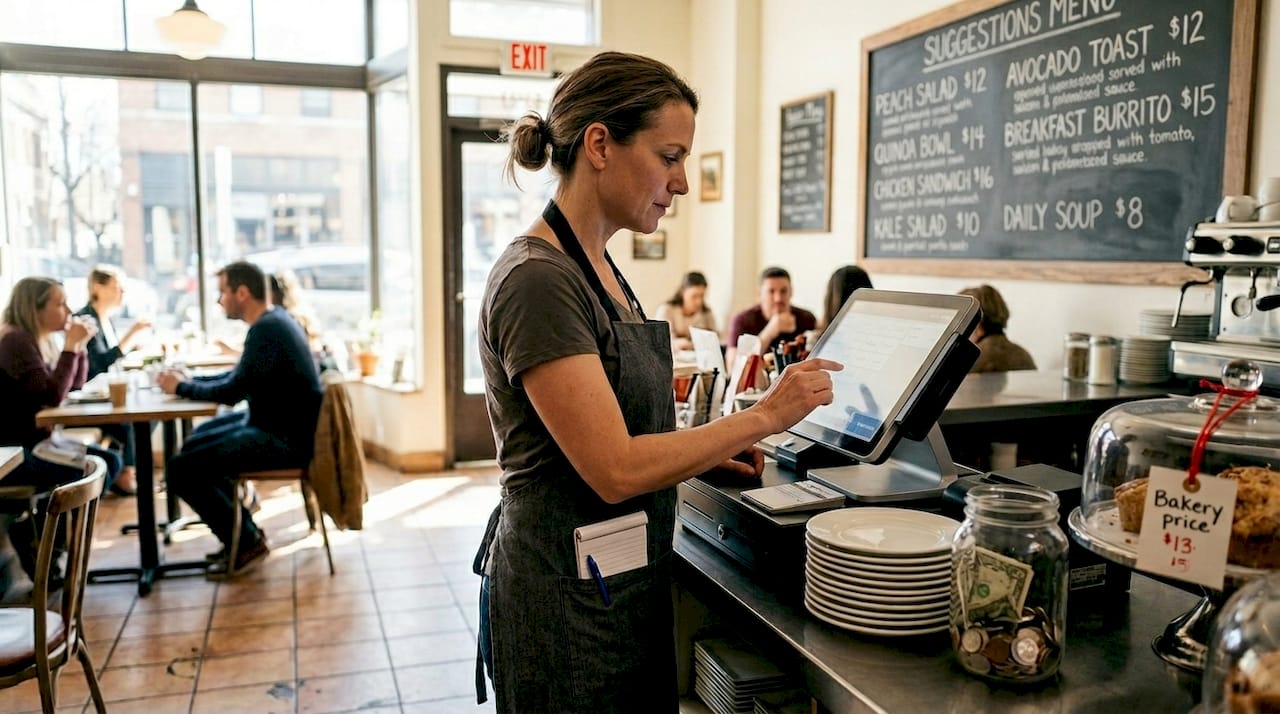
Top restaurant digital trends: boost success in 2026
Seventy-three percent of executives plan to increase AI investment in 2026, yet only 20% have data governance solid enough to make that investment pay off. That gap is not just a statistic. For restaurant owners and marketing managers in competitive urban markets, it represents real money left on the table and real customers lost to better-prepared competitors. The good news is that closing this gap does not require a massive budget or a tech team. It requires clarity on which digital trends actually matter, and a practical plan for acting on them. This guide gives you exactly that.
Table of Contents
- Why digital transformation matters in 2026
- Key digital trends shaping restaurant operations
- Personalization: Elevating the guest experience
- Evaluating ROI: Investment vs. outcomes for digital transformation
- Mistakes to avoid with restaurant digital adoption
- Next steps: Power your restaurant’s digital transformation
- Frequently asked questions
Key Takeaways
| Point | Details |
|---|---|
| Focus on integration | Choose digital solutions that work together and solve real problems for restaurants. |
| Personalization boosts loyalty | AI-powered personalization drives repeat visits and higher guest satisfaction. |
| Measure before scaling | Pilot new digital tools and measure ROI before rollout to avoid wasted investments. |
| Avoid common pitfalls | Don’t chase tech trends without clear business objectives or data practices. |
| Use proven frameworks | Apply established ROI metrics to confidently assess digital investments in restaurants. |
Why digital transformation matters in 2026
Digital transformation, in plain terms, means replacing slow, manual, or disconnected processes with technology that makes your restaurant faster, smarter, and more responsive to what guests actually want. For urban restaurants in 2026, this is not optional. Your competitors are already moving.
Customer expectations have shifted sharply. Guests now expect personalized offers, frictionless ordering, and instant responses across every channel, whether that is your website, a third-party delivery app, or a text message. Speed and convenience are no longer differentiators. They are the baseline.
The pressure is compounded by the fact that AI investments are increasing sharply across the industry, but most operators still lack the foundational readiness to use AI effectively. That creates a window of opportunity for restaurants that get organized now. Staying current on restaurant SEO trends is one piece of that puzzle, but the bigger picture involves your entire digital stack.
Here are the top drivers pushing restaurants toward digital adoption right now:
- Rising labor costs pushing operators toward automation
- Guest demand for personalized, loyalty-driven experiences
- Third-party delivery platforms raising the bar on menu accuracy and speed
- Increased competition from ghost kitchens and digitally native food brands
- Data privacy regulations requiring smarter, more intentional data practices
Key digital trends shaping restaurant operations
Not every shiny new tool deserves your attention. The trends worth your time are the ones with measurable impact on your bottom line. Here is what is actually moving the needle in 2026.
AI-enhanced forecasting and inventory management is at the top of the list. AI for forecasting and inventory delivers real, documented ROI by reducing food waste, preventing stockouts, and helping you schedule labor more accurately. These are not theoretical benefits. Restaurants using AI-driven inventory tools report meaningful reductions in over-ordering and spoilage within the first few months.
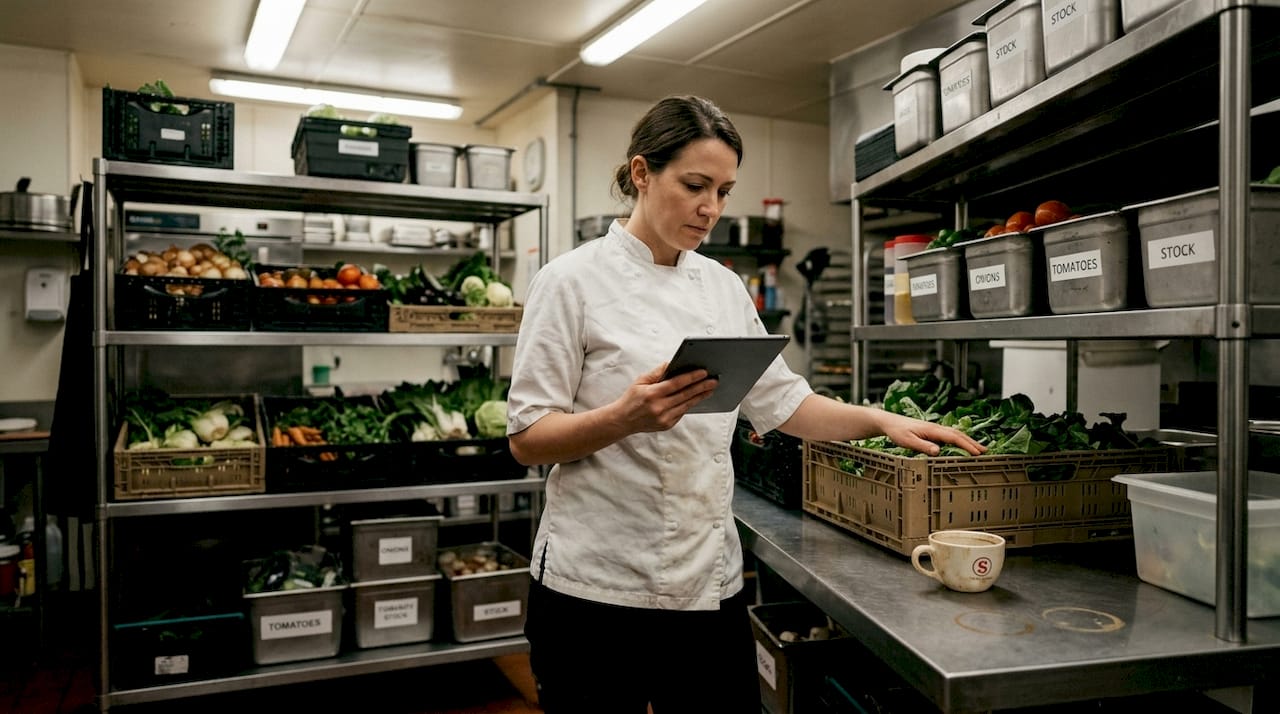
Centralized menu management is critical for any operator running more than one location. When your menu lives in one place and pushes updates to every channel simultaneously, you eliminate the costly errors that come from outdated pricing or unavailable items showing up on delivery apps.
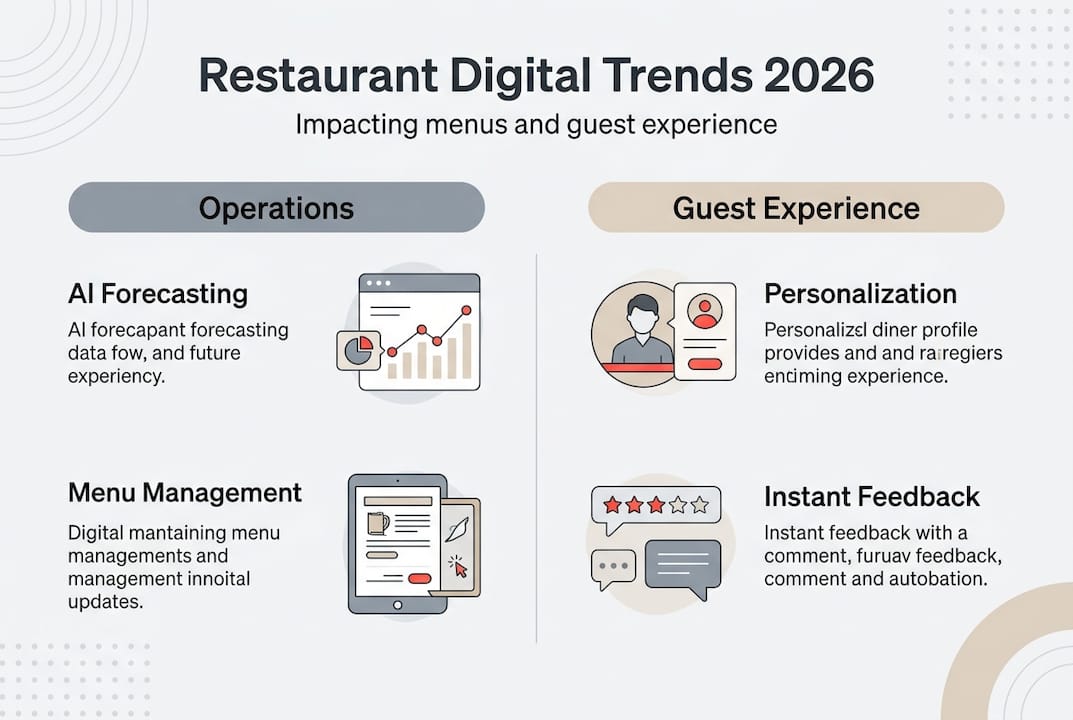
Real-time inventory synchronization solves one of the most frustrating guest experiences: ordering something that turns out to be unavailable. Syncing your inventory with your ordering channels in real time keeps your menu accurate and your guests happy.
The smartest operators in 2026 are not buying standalone tools. They are building integrated systems where their POS, inventory, marketing, and loyalty platforms all talk to each other. Reviewing website best practices is a good starting point for understanding how your digital front door fits into that integrated picture.
“The restaurants winning in 2026 are not the ones with the most technology. They are the ones with the right technology, connected and working together.”
Pro Tip: Before evaluating any new tool, ask one question: what specific operational problem does this solve, and how will I measure whether it worked? If you cannot answer that, wait.
Here is a quick comparison of high-impact versus low-impact digital investments:
| Digital investment | Impact level | Measurable ROI |
|---|---|---|
| AI inventory forecasting | High | Yes, within 90 days |
| Centralized menu management | High | Yes, immediate |
| Social media vanity tools | Low | Rarely |
| Loyalty program integration | High | Yes, long-term |
| Standalone chatbots (no CRM link) | Low | Rarely |
Personalization: Elevating the guest experience
Beyond operational efficiency, digital trends are now redefining how restaurants connect with guests. Personalization is where the biggest loyalty gains are hiding.
Personalization starts with data, and data starts with consent. In 2026, guests are more aware of how their information is used. Restaurants that are transparent about data collection and give guests control over their preferences build more trust and, ultimately, more loyalty. This is not just good ethics. It is good business.
Once you have clean, consented guest data, you can do powerful things. Dynamic menus that highlight dishes based on a guest’s past orders, targeted offers sent via SMS or email at the right moment, and predictive ordering suggestions that feel genuinely helpful rather than intrusive. These are the experiences that turn one-time visitors into regulars.
The challenge is that only 20% of restaurants have the data governance in place to actually use AI for personalization effectively. Without clean data and clear policies, your personalization efforts will be inconsistent at best and a privacy liability at worst.
Here is what a solid personalization data setup looks like:
| Data type | Collection method | Use case |
|---|---|---|
| Order history | POS integration | Predictive menu suggestions |
| Visit frequency | Loyalty app | Targeted re-engagement offers |
| Dietary preferences | Guest profile opt-in | Personalized menu display |
| Birthday and milestones | Sign-up form | Automated celebration offers |
Your digital marketing checklist should include a data governance review as a non-negotiable step before launching any personalization campaign.
Pro Tip: Start your personalization program with one data point, like visit frequency, and one action, like a re-engagement SMS after 30 days of inactivity. Prove the concept before building complexity.
Evaluating ROI: Investment vs. outcomes for digital transformation
Knowing what is possible is only half the job. The other half is knowing what is worth your money. Every digital investment needs a clear ROI framework before you commit.
Here are the key metrics to track for any new digital tool:
- Sales lift: Did average check size or order frequency increase after implementation?
- Labor savings: Did the tool reduce hours spent on manual tasks like scheduling, inventory counts, or order entry?
- Guest retention: Did repeat visit rates improve among guests who interacted with the new tool?
- Error reduction: Did menu accuracy, order accuracy, or inventory accuracy improve?
- Time to value: How quickly did you see measurable results after going live?
The most common mistake restaurants make is overestimating benefits before launch and underestimating the complexity of integration after launch. A tool that works beautifully in a demo can create chaos if it does not connect cleanly with your existing POS or loyalty system.
The smartest approach, backed by AI ROI frameworks from industry analysts, is to focus investments on tools that solve real, documented business problems rather than chasing hype. Pilot first. Measure impact. Then scale.
You can use ROI calculators to model the potential return of specific digital investments before you spend a dollar. This kind of pre-investment modeling saves operators from expensive mistakes.
Pro Tip: Set a 90-day review checkpoint for every new digital tool. If you cannot show measurable improvement in at least one key metric by then, reassess before renewing or expanding.
Mistakes to avoid with restaurant digital adoption
Even with the right knowledge, many urban restaurant teams stumble during execution. These are the traps that cost the most time and money.
Jumping on trends without a clear objective is the most common and most expensive mistake. Buying a tool because a competitor has it, or because a vendor pitched it well, is not a strategy. Every technology decision should start with a specific problem you are trying to solve.
Underestimating staff training is a close second. A new system is only as good as the team using it. If your front-of-house staff does not understand how a new loyalty integration works, or your kitchen team is not trained on a new inventory tool, the technology will fail regardless of how good it is.
Neglecting data governance is the mistake that creates the biggest long-term risk. Without clear policies on how guest data is collected, stored, and used, you are exposed to privacy violations and you are also limiting your ability to use AI effectively.
Here is a quick checklist of what to verify before adopting any new digital tool:
- Does it integrate with your existing POS and loyalty system?
- Do you have a staff training plan ready before launch?
- Have you reviewed data privacy implications with your team?
- Can you measure its impact within 90 days?
- Is there a clear rollback plan if it does not work?
As restaurant tech adoption tips consistently emphasize, the restaurants that succeed with digital transformation are the ones that start with a problem, not a solution. Reviewing restaurant digital best practices before any major tech decision is a habit worth building.
“Avoid implementing AI for AI’s sake. The question is never ‘what can this technology do?’ It is ‘what problem does my restaurant need to solve?’”
Next steps: Power your restaurant’s digital transformation
You now have a clear picture of which digital trends matter in 2026, how to evaluate them, and how to avoid the most common mistakes. The next step is putting that knowledge to work with the right support behind you.
Sorbey’s restaurant marketing solutions are built specifically for local restaurants that want to grow smarter, not just bigger. From AI-powered marketing automation to tools that help you measure the real impact of every campaign, Sorbey gives you an all-in-one platform designed for the way urban restaurants actually operate. Use the SMS ROI calculator to model the return on your next text marketing campaign before you launch it, or explore the full suite of free digital tools to find the right starting point for your restaurant’s next phase of growth. The gap between ambition and execution closes faster when you have the right tools in your corner.
Frequently asked questions
What is the most important digital trend for restaurants in 2026?
AI-enhanced operations and personalization are the biggest drivers of competitive success in 2026. AI in forecasting and inventory is delivering measurable ROI for operators who implement it with clear goals.
How can restaurants measure the ROI of digital tools?
Track sales lift, labor savings, and guest retention as your primary metrics. Key ROI metrics like these give you a clear, objective picture of whether a tool is earning its place in your operation.
What mistakes should restaurants avoid with new digital technologies?
Avoid adopting technology without a specific goal, and never skip staff training or data governance planning. Avoiding AI for AI’s sake and ensuring your data practices are solid are the two most important guardrails.
How does data governance affect restaurant technology success?
Good data governance is the foundation that makes AI and personalization actually work. Only 20% of operators currently have effective data governance in place, which limits how much value they can extract from their technology investments.
Recommended
Potrebbe interessarti anche

Best Restaurant Loyalty Programs 2026: ROI Guide
Discover the best restaurant loyalty programs 2026 that boost repeat visits. Learn how Sorbey’s platform can transform your guest data strategy!

Why Mobile Marketing Matters for Business Growth
Discover why mobile marketing matters for business growth. Learn how optimizing for mobile drives traffic, conversions, and customer retention.

SF Dim Sum Restaurant Marketing Checklist for 2026
Transform your SF dim sum with our 2026 marketing checklist. Optimize your profile, showcase dishes, and attract customers fast!