
Blog
Voice Search Optimization: 50% More Local Reach in 2026
Learn what voice search optimization is and how restaurants can capture 50% more local customers in 2026 through conversational queries and mobile optimization.

Voice Search Optimization: 50% More Local Reach in 2026
Voice search has transformed how customers discover restaurants. Over 50% of all smartphone users conduct voice searches daily, and this trend is rapidly growing, especially for local queries. For restaurant owners, voice search optimization unlocks a massive opportunity to connect with nearby diners actively seeking places to eat. This guide explains what voice search optimization is, why it matters, and how to implement strategies that drive measurable increases in calls and reservations.
Table of Contents
- Introduction To Voice Search And Its Importance For Restaurants
- How Voice Search Works And What Makes It Different From Traditional Search
- Key Elements Of Voice Search Optimization For Restaurants
- Common Misconceptions About Voice Search Optimization
- Framework And Practical Steps For Implementing Voice Search Optimization
- Case Studies And Real-World Impact
- Conclusion: Maximizing Local Restaurant Success Through Voice Search Optimization
- Boost Your Restaurant’s Voice Search Success With Sorbey
Key Takeaways
| Point | Details |
|---|---|
| Voice queries are conversational | Users speak naturally in full questions rather than typing short keywords. |
| Schema markup boosts visibility | Implementing structured data can improve voice search answer extraction by 20-25%. |
| Mobile speed is critical | Page speed under 3 seconds markedly improves voice search ranking due to mobile dominance. |
| Local intent drives results | Voice searches have stronger immediate intent, making optimization vital for nearby customer capture. |
| Combined tactics yield growth | Restaurants see 40% more calls and 25% more reservations through comprehensive voice optimization. |
Introduction to Voice Search and Its Importance for Restaurants
Voice search lets users speak queries into smartphones or smart speakers instead of typing. In 2026, this technology has exploded in popularity, especially for local restaurant discovery. When someone asks “What’s the best Italian restaurant near me?” they expect instant, accurate answers.
The primary platforms driving this shift are Google Assistant and Siri, which dominate voice search usage among U.S. consumers. These assistants prioritize quick, relevant responses tailored to the user’s location and immediate needs. For restaurants, this creates a golden opportunity to appear exactly when potential customers are hungry and ready to dine.
Why does voice search matter so much for your restaurant?
- Voice queries carry higher local intent than text searches, meaning users are closer to making dining decisions
- Speaking feels more natural than typing, especially when multitasking or driving
- Voice results typically feature fewer options, so ranking well means capturing significant traffic
- The technology favors businesses optimized for conversational queries and mobile experiences
Restaurant owners who ignore voice search risk losing customers to competitors who appear in these prime voice results. With local restaurant marketing tips becoming increasingly voice focused, now is the time to adapt your digital strategy.
How Voice Search Works and What Makes It Different From Traditional Search
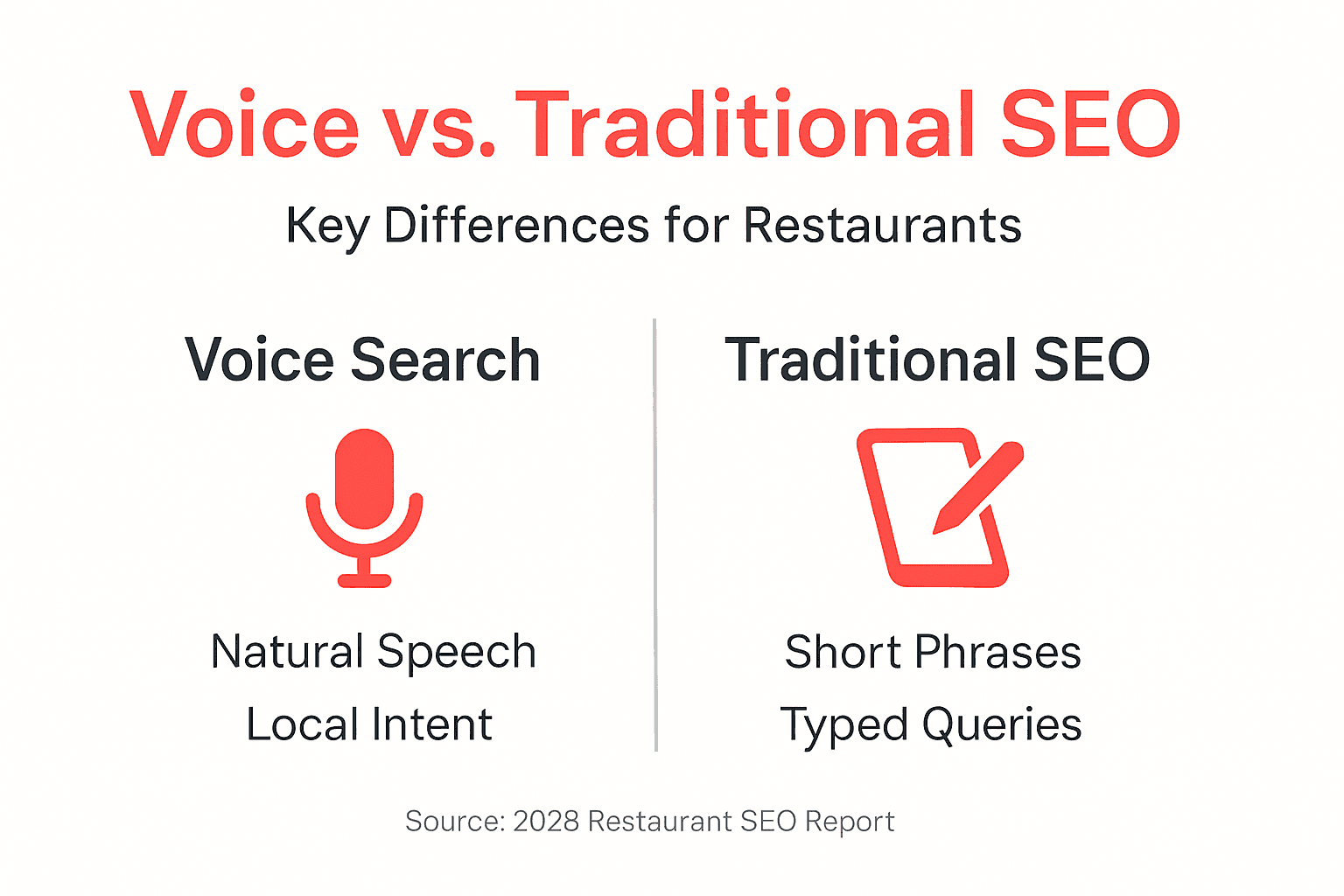
Voice search operates fundamentally differently from traditional typed queries. When users speak to their devices, they use complete sentences and natural phrasing. Instead of typing “Italian restaurant Boston,” they ask “Where can I find authentic Italian food near me right now?”
This conversational style demands different optimization approaches. Voice assistants like Google Assistant analyze spoken queries, interpret intent, and deliver direct answers rather than lists of blue links. Speed matters enormously because users expect immediate responses while on the go.
The local and immediate intent in voice queries creates urgency. Someone asking about restaurants typically wants to eat soon, not research options for next week. Voice assistants prioritize businesses with accurate location data, strong reviews, and mobile friendly websites that load instantly.
Key distinctions between voice search vs traditional SEO:
| Factor | Traditional SEO | Voice Search Optimization |
|---|---|---|
| Query Length | 2-4 words | 7-10 words or more |
| Keyword Style | Short tail | Question based, conversational |
| User Intent | Research focused | Immediate action oriented |
| Device Focus | Desktop and mobile | Primarily mobile |
| Result Format | Multiple listings | Single answer or top 3 results |
Understanding these differences shapes your entire optimization strategy. You must create content that answers specific questions, loads quickly on mobile devices, and signals strong local relevance to voice assistants.
Key Elements of Voice Search Optimization for Restaurants
Successful voice search optimization requires attention to several technical and content elements working together. Each component strengthens your restaurant’s chances of appearing in voice results when potential customers search.
Schema markup stands as perhaps the most powerful technical tool. This structured data helps voice assistants extract your restaurant information efficiently. Implementing schema markup can improve voice search answer extraction by 20-25% by clearly labeling your business name, address, hours, menu items, and price range.
Natural language keywords form the content foundation. Instead of optimizing for “pizza delivery,” target phrases like “Where can I order pizza for delivery tonight?” or “Which pizza places deliver near me?” These question based phrases match how people actually speak to voice assistants.

Local listing accuracy remains essential but cannot work alone. While Google My Business provides foundational information, combining it with local SEO tactics like consistent NAP data across directories, customer reviews, and locally focused content delivers superior results.
Mobile optimization determines whether voice users actually visit your site. Page speed under 3 seconds markedly improves voice search ranking because most voice queries happen on mobile devices. Slow loading sites get skipped entirely.
Pro Tip: Prioritize implementing LocalBusiness, Restaurant, and Menu schema types through schema markup guidance to maximize voice assistant data extraction. These specific schemas directly answer common restaurant queries about cuisine, location, and offerings. Test your implementation with mobile site speed optimization tools to ensure fast loading times.
Common Misconceptions About Voice Search Optimization
Many restaurant owners hold incorrect assumptions about voice search that limit their optimization success. Clearing these misconceptions helps you focus efforts on tactics that actually drive results.
Voice search is not simply people reading typed queries aloud. The queries differ fundamentally in structure, length, and intent. Optimizing for traditional keywords without adapting to conversational patterns leaves you invisible in voice results.
A Google My Business listing alone doesn’t guarantee top voice rankings. While important, GMB accounts for less than 30% of voice ranking factors. You must also optimize website content, implement schema markup, build quality reviews, and ensure mobile performance to compete effectively.
Content strategy must shift from traditional short tail keywords to question based, conversational phrases. Users ask complete questions when speaking, so your content needs to provide direct answers in natural language that matches how people talk.
Common pitfalls to avoid:
- Ignoring mobile site performance and assuming desktop speed suffices
- Failing to monitor voice specific analytics and relying only on traditional SEO metrics
- Creating content for search engines rather than answering real user questions
- Neglecting ongoing content updates as voice query patterns evolve
Pro Tip: Regularly update your FAQs and content sections to reflect emerging voice queries rather than assuming your initial optimization remains effective indefinitely. Voice search patterns shift as technology improves and user behavior changes, so quarterly content reviews keep you competitive.
Framework and Practical Steps for Implementing Voice Search Optimization
Implementing voice search optimization requires a structured approach across multiple areas. This framework breaks down the process into manageable steps you can execute systematically.
The layered optimization framework includes:
- User intent analysis: Research how your target customers ask voice queries about restaurants
- Technical SEO foundation: Implement schema markup and ensure mobile performance
- Content strategy: Create conversational, question answering content
- Local management: Maintain accurate listings and build quality reviews
- Analytics and iteration: Monitor performance and refine tactics based on data
Follow these practical implementation steps:
- Audit and update your Google My Business information for accuracy, ensuring hours, address, phone number, and menu links are current
- Implement targeted schema markup using LocalBusiness, Restaurant, and Menu types relevant to your establishment
- Create and optimize FAQ sections answering common voice queries like “What time does [restaurant] open?” or “Does [restaurant] have vegetarian options?”
- Improve mobile website speed and usability by compressing images, minimizing code, and ensuring tap targets are appropriately sized
- Use voice search analytics tools regularly to monitor which queries drive traffic and which need better optimization
Ongoing maintenance checklist:
- Update menu items and pricing monthly in schema markup
- Respond to all reviews within 48 hours to maintain engagement signals
- Add new FAQ content quarterly based on emerging voice query patterns
- Test mobile site speed monthly and address any performance degradation
- Monitor call tracking data to identify voice driven customer contacts
Local review acquisition deserves special attention. Encourage satisfied customers to leave Google reviews mentioning specific dishes or experiences. These reviews provide rich, natural language content that voice assistants extract when answering queries about your restaurant.
Case Studies and Real-World Impact
Real world results demonstrate the tangible benefits of voice search optimization for restaurants. These examples show measurable improvements in customer acquisition and engagement.
A family owned Italian restaurant in Austin implemented comprehensive voice optimization in early 2026. Within three months, they documented a 40% increase in phone calls, with call tracking revealing many customers mentioned finding them through voice search. The owner noted customers frequently said “I asked my phone for Italian restaurants nearby.”
A casual dining chain with five locations optimized their schema markup and mobile experience, seeing a 25% rise in online reservations attributed directly to enhanced voice search visibility. Their reservation system data showed increased bookings from mobile devices with referral sources indicating voice assistant traffic.
The typical timeframe for observing measurable improvements ranges from six to twelve weeks after implementing optimization changes. Voice assistants need time to recrawl your content, index new schema markup, and adjust rankings based on user engagement signals.
| Metric | Before Optimization | After Optimization | Percentage Change |
|---|---|---|---|
| Weekly Phone Calls | 85 | 119 | +40% |
| Monthly Reservations | 240 | 300 | +25% |
| Mobile Website Traffic | 1,200 visits | 1,680 visits | +40% |
| Voice Query Impressions | 450 | 1,125 | +150% |
Key success factors from these examples:
- Comprehensive approach combining technical, content, and local optimization
- Consistent monitoring and iteration based on performance data
- Focus on mobile user experience as the primary optimization target
- Active review management to provide fresh, relevant content signals
These restaurants didn’t just implement one tactic. They addressed multiple optimization elements simultaneously, creating compounding effects that drove substantial business growth through restaurant SEO trends adoption.
Conclusion: Maximizing Local Restaurant Success Through Voice Search Optimization
Voice search represents a critical channel for local restaurant discovery in 2026. With over half of smartphone users conducting daily voice searches, restaurants that optimize for this technology gain significant competitive advantages in attracting nearby customers.
The most effective approach combines technical optimization through schema markup, content strategy focused on conversational queries, mobile performance excellence, and active local listing management. No single tactic delivers results in isolation. Success comes from implementing multiple elements that work together to signal relevance and authority to voice assistants.
Continuous monitoring and adaptation ensure lasting competitive advantages. Voice search technology evolves rapidly, and user behavior shifts as people become more comfortable with voice interactions. Restaurants that commit to ongoing optimization see sustained growth in calls, reservations, and foot traffic.
Optimizing for voice search translates directly into more customers walking through your doors. The investment in technical improvements, content creation, and local management pays dividends through increased visibility exactly when potential diners are ready to choose where to eat.
Boost Your Restaurant’s Voice Search Success with Sorbey
Ready to capture more local customers through voice search? Sorbey specializes in helping restaurants implement comprehensive voice optimization strategies that drive real business results.
Our Sorbey restaurant marketing services include schema markup implementation, mobile performance optimization, and ongoing analytics to track your voice search success. We understand the unique challenges restaurants face in local digital marketing and provide tailored solutions that fit your specific needs.
Explore our local SEO strategies for restaurants guide for detailed implementation steps, and access our free voice search analytics tools to monitor your current performance. Let Sorbey accelerate your restaurant’s growth through expert voice search optimization.
FAQ
What is the difference between voice search optimization and traditional SEO?
Voice search optimization targets longer, question based queries with immediate local intent, while traditional SEO often focuses on shorter keywords for research oriented searches. Voice optimization requires conversational content, stronger mobile performance, and schema markup to succeed.
How can I measure the effectiveness of my voice search optimization?
Monitor increases in phone calls, reservations, and mobile website traffic from voice enabled devices. Use specialized voice search analytics tools to track which conversational queries drive traffic and how your rankings improve for question based searches.
What common mistakes should restaurant owners avoid in voice search optimization?
Avoid relying solely on Google My Business without implementing proper schema markup and conversational content. Don’t neglect mobile website speed optimization or fail to regularly update FAQ sections to reflect evolving voice query patterns and customer questions.
How long does it take to see results from voice search optimization?
Most restaurants observe measurable improvements within six to twelve weeks after implementing comprehensive optimization changes. Voice assistants need time to recrawl your content, index schema markup, and adjust rankings based on user engagement signals and mobile performance metrics.
Recommended
Potrebbe interessarti anche

Best Restaurant Loyalty Programs 2026: ROI Guide
Discover the best restaurant loyalty programs 2026 that boost repeat visits. Learn how Sorbey’s platform can transform your guest data strategy!

Why Mobile Marketing Matters for Business Growth
Discover why mobile marketing matters for business growth. Learn how optimizing for mobile drives traffic, conversions, and customer retention.

SF Dim Sum Restaurant Marketing Checklist for 2026
Transform your SF dim sum with our 2026 marketing checklist. Optimize your profile, showcase dishes, and attract customers fast!