
Blog
What Is Email Marketing? A Guide for Small Business
Discover what email marketing is and how it can drive engagement and revenue for your small business. Learn effective strategies today!

What Is Email Marketing? A Guide for Small Business
TL;DR:
- Email marketing generates high returns by owning the audience and using automated, targeted campaigns.
- It outperforms other channels through cost efficiency, personalization, and measurable results, especially with segmentation.
Email marketing is defined as the practice of sending commercial messages to a list of opted-in subscribers to drive engagement, retention, and revenue. For small business owners and marketing professionals, it remains the highest-return channel in digital marketing. ROI benchmarks show $36 earned for every $1 spent, a figure no paid social or search channel consistently matches. This guide breaks down how email marketing works, why it outperforms other channels, and what best practices separate high-performing campaigns from ignored inbox clutter.
What is email marketing and how does it work?
Email marketing operates through a permission-based system. A subscriber opts in through a sign-up form, landing page, or point-of-sale prompt. From that moment, you own that relationship. No algorithm decides whether your message reaches them.

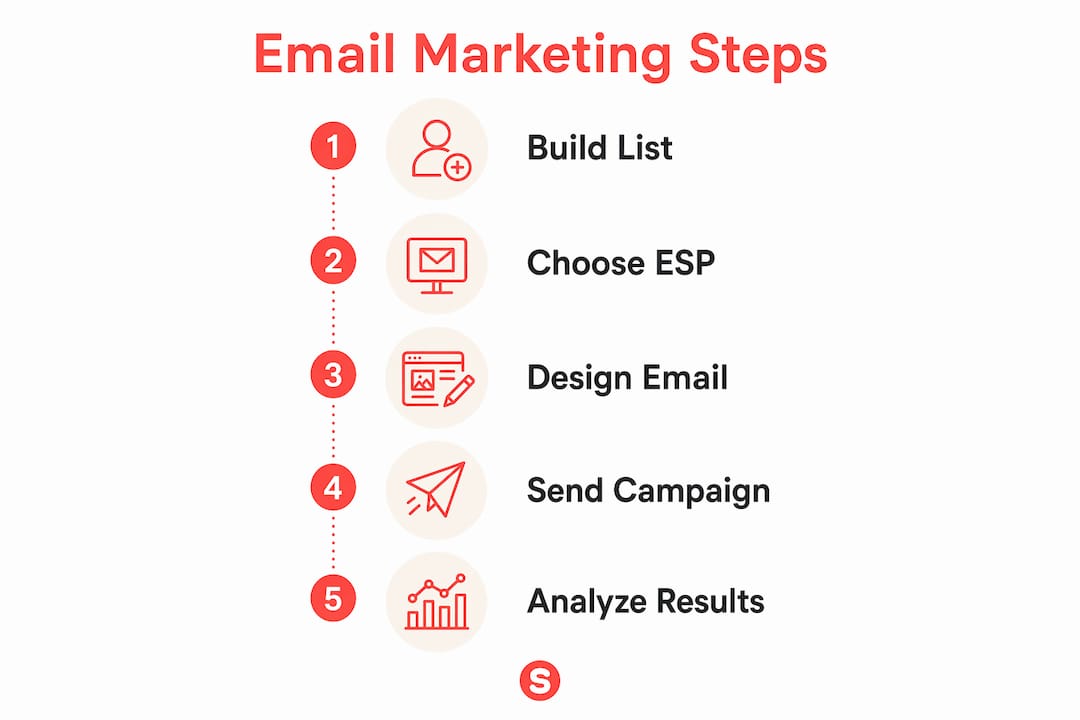
The mechanics involve four core components: a subscriber list, an email service provider (ESP) like Mailchimp or Klaviyo, the message itself, and a measurable goal. Every campaign flows through this chain. The ESP handles delivery, tracking, and automation triggers. Your job is to build the list, write the message, and set the goal.
Email types vary by purpose and timing. Newsletters build ongoing relationships. Promotional emails drive immediate sales. Transactional emails confirm orders and reset passwords. Lifecycle automation, such as welcome series and abandoned cart flows, runs in the background and converts without manual effort.
| Email type | Primary purpose | Engagement impact |
|---|---|---|
| Newsletter | Relationship building | High long-term retention |
| Promotional | Drive immediate sales | High short-term conversion |
| Transactional | Confirm actions | Very high open rates |
| Welcome series | Onboard new subscribers | Strong first impression |
| Abandoned cart | Recover lost revenue | Direct revenue recovery |
Segmentation and personalization sit at the core of effective execution. Sending the same message to every subscriber is the fastest way to lose them. Behavioral data, purchase history, and location all feed smarter targeting.
Pro Tip: Before sending at scale, set up SPF, DKIM, and DMARC authentication on your sending domain and warm it up over 45–60 days. Skipping this step puts your deliverability at risk from day one.
What are the benefits of email marketing vs. other channels?
The core advantage of email marketing is audience ownership. Social media followers are rented. A platform algorithm change or account suspension can erase your reach overnight. Your email list belongs to you.
The financial case is equally strong. Automated lifecycle flows generate 41% of total email revenue while representing only 5.3% of total sends. That ratio is extraordinary. A small set of well-built automations, running without daily attention, produces nearly half of all email-driven revenue.
Email also wins on intent. A subscriber who opted in to hear from your restaurant or shop has already signaled interest. Paid ads interrupt. Email arrives by invitation.
Here is how email compares directly to competing channels:
| Channel | Audience ownership | Avg. ROI | Personalization depth | Cost per send |
|---|---|---|---|---|
| Email marketing | Full ownership | $36 per $1 | High | Very low |
| Social media | Platform-controlled | Variable | Medium | Low to high |
| SMS | Full ownership | High | Medium | Medium |
| Paid search | None | Variable | Low | High |
The specific benefits that make email the right foundation for any marketing strategy include:
- Cost efficiency: Sending to 10,000 subscribers costs a fraction of equivalent paid reach.
- Scalability: The same workflow that serves 500 subscribers scales to 50,000 with no structural change.
- Personalization: Dynamic content blocks let you show different offers to different segments in one send.
- Measurable impact: Every click, conversion, and revenue dollar ties back to a specific campaign.
93% of B2B marketers use email to distribute content. That adoption rate reflects a simple truth: email works across every industry and business size.
What are email marketing best practices to boost engagement?
Segmentation is the single highest-leverage practice in email marketing. Segmented campaigns produce 30% more opens and 50% more clicks compared to unsegmented sends. The reason is straightforward: relevant messages get read, generic ones get deleted.
Start with behavioral segmentation. Group subscribers by purchase history, browsing behavior, or engagement level. A customer who bought from you last week needs a different message than someone who has not opened an email in three months. Treating them the same wastes both their attention and your sending reputation.
Timing matters more than most marketers admit. Audience-specific send times consistently outperform general benchmarks like “Tuesday at 10 a.m.” Test your own list. A restaurant audience behaves differently from a B2B software audience. Your data will tell you when your subscribers are ready to engage.
Goal clarity drives better copy. Every message needs a clear business goal stated in six words or less before you write a single line. “Drive lunch reservations this Friday.” “Re-engage lapsed customers with a discount.” Vague goals produce vague emails that produce no results.
Deliverability is the invisible factor most small businesses ignore until it is too late. Google and Yahoo require spam complaint rates below 0.3% to avoid throttling or blocking. That threshold is lower than it sounds. One angry batch of unengaged subscribers can push you past it.
Key practices to protect your sender reputation and keep engagement high:
- Remove subscribers who have not opened in 90 days before they become a liability.
- Use double opt-in for new sign-ups to confirm genuine interest.
- Write subject lines that match the email content exactly, since misleading subjects spike spam reports.
- Monitor your unsubscribe rate after every send. A spike signals a relevance problem, not just a list problem.
- Keep promotional frequency consistent. Disappearing for months and then sending five emails in a week destroys trust.
Pro Tip: Start with 4–5 core segments mapped to your business goals before adding complexity. Over-segmenting without the content capacity to serve each group leads to inconsistent sends and lower quality across the board.
How do you measure and optimize email marketing performance?
Open rates are no longer a reliable primary metric. Apple Mail Privacy Protection, which launched in 2021 and now covers a large share of email opens, pre-loads tracking pixels regardless of whether the subscriber actually opened the email. Post Apple MPP, click-through rates and revenue influence are the metrics that tell the truth about campaign performance.
The KPIs worth tracking consistently are:
- Click-through rate (CTR): The percentage of recipients who clicked any link. This measures content relevance and offer strength.
- Click-to-open rate (CTOR): Clicks divided by opens. This isolates how well your email body converts readers who did open.
- Conversion rate: The percentage who completed the goal action, whether that is a purchase, reservation, or form fill.
- Revenue per email: Total revenue attributed to a send divided by the number of emails delivered. This is the clearest business-level metric.
- List growth rate: New subscribers minus unsubscribes, divided by total list size. A shrinking list is a warning sign.
A/B testing is the most direct path to improvement. Test one variable at a time: subject line, send time, call-to-action placement, or offer type. Run each test on a statistically meaningful segment before drawing conclusions. Small businesses often skip this step because it feels slow. It is actually the fastest way to stop guessing.
CRM integration amplifies measurement accuracy. When your ESP connects to a platform like Salesforce or HubSpot, you can trace a subscriber’s journey from first email open to closed sale. That attribution data justifies your email budget and reveals which campaigns actually drive revenue versus which ones just generate clicks.
B2B and B2C measurement differ in one key way. B2B email marketing cycles are longer. A single email rarely closes a deal. Track pipeline influence and meeting bookings rather than immediate conversions. B2C campaigns, especially for restaurants and retail, can measure direct revenue impact within 48 hours of a send.
Key Takeaways
Email marketing delivers the highest ROI of any digital channel because it combines audience ownership, behavioral targeting, and automated revenue generation in a single, measurable system.
| Point | Details |
|---|---|
| ROI leadership | Email returns $36 per $1 spent, outperforming social media and paid search. |
| Automation leverage | Lifecycle flows generate 41% of email revenue from just 5.3% of total sends. |
| Segmentation impact | Segmented campaigns produce 30% more opens and 50% more clicks than unsegmented sends. |
| Deliverability first | SPF, DKIM, and DMARC setup plus a 45–60 day domain warm-up protect sender reputation. |
| Metrics shift | Post Apple MPP, click-through rate and revenue influence replace open rates as primary KPIs. |
Why I think most small businesses are leaving email money on the table
I have watched hundreds of small business owners treat email marketing as a newsletter they send when they remember to. That mindset is the most expensive mistake in local marketing.
The infrastructure piece is where most people fail silently. You can write great subject lines and still land in spam because your domain was never authenticated. Nobody tells you this when you sign up for Mailchimp. You find out six months later when your open rates mysteriously collapse.
The second mistake is confusing activity with strategy. Sending emails is not email marketing. Sending emails tied to a specific business goal, to a specific segment, at a tested frequency, is email marketing. The difference in results is not marginal. It is the difference between a channel that pays for itself and one that feels like a chore.
Human review of AI-drafted content matters more than most people acknowledge. AI tools can draft a promotional email in 30 seconds. They cannot replicate your restaurant’s voice, your neighborhood’s inside jokes, or the specific reason a loyal customer keeps coming back. Use the tools. Own the voice.
My honest advice: build your email list from day one, set up authentication before your first send, and write every campaign against a goal you can measure within a week. Everything else is refinement.
— Barthelemy
How Sorbey helps small businesses run smarter email campaigns
Sorbey is built for local businesses, including restaurants, that need a complete marketing system without a full-time marketing team.
Sorbey’s restaurant marketing solutions include done-for-you email workflows, list-building tools, and campaign strategy grounded in the same ROI benchmarks covered in this guide. If you want to move from occasional sends to a system that drives reservations, repeat visits, and measurable revenue, Sorbey handles the infrastructure and strategy so you can focus on running your business. You can also explore the Sorbey blog for a deeper look at building email workflows that convert.
FAQ
What is email marketing in simple terms?
Email marketing is the practice of sending targeted commercial messages to a list of subscribers who have opted in to receive them. The goal is to drive engagement, repeat purchases, and customer retention.
What is an email campaign?
An email campaign is a single coordinated send or series of sends designed around one specific business goal, such as promoting a sale, welcoming new subscribers, or recovering abandoned carts.
How much does email marketing cost?
Email marketing costs vary by platform and list size, but most ESPs like Mailchimp and Klaviyo offer plans starting under $20 per month for small lists. The channel’s $36 return per $1 spent makes it one of the most cost-efficient options available.
Why are open rates no longer reliable?
Apple Mail Privacy Protection pre-loads email tracking pixels on Apple devices, recording an “open” even when the subscriber never reads the message. Click-through rate and revenue influence are now the more accurate performance indicators.
How often should I send marketing emails?
Send frequency depends on your audience and content quality. Most small businesses perform well with one to two sends per week. Consistency matters more than volume, and audience behavior data should guide your final timing decisions.
Recommended
Potrebbe interessarti anche

Role of Chatbots in Restaurants: 2026 Guide
Discover the role of chatbots in restaurants and how they boost reservations and improve guest interactions. Learn more in our 2026 guide!

How to Boost Online Reviews for Restaurants
Learn how to boost online reviews for your restaurant with effective strategies. Turn customer feedback into a competitive advantage today!

Why Remarketing Is Important for Restaurants
Discover why remarketing is important for restaurants. Learn how to transform one-time visitors into loyal customers and boost your ROI!